

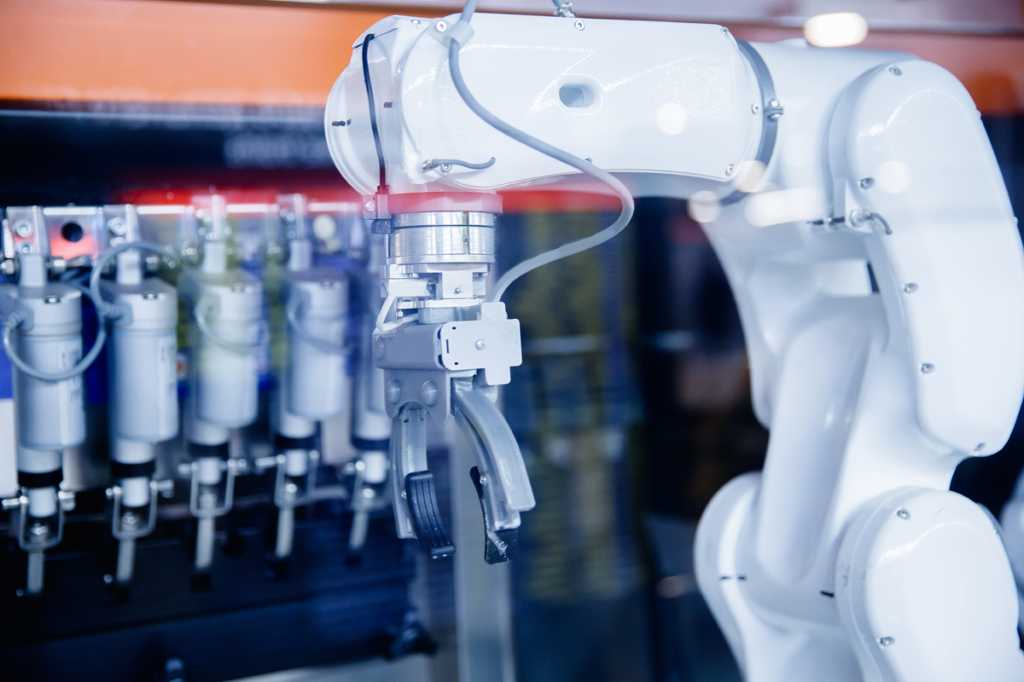

It’s no big deal, you’d think, that researchers have found a way to reduce the computing requirements for one of the many steps involved in training an AI model to help robots manipulate simple geometric objects.
Yet such is the concern about the rising cost of powering data centers for AI applications that this one small and largely unremarkable finding prompted breathless headlines such as “100x Less Power: The Breakthrough That Could Solve AI’s Massive Energy Crisis.”
Don’t believe the hype
No-one’s disputing the researchers’ findings, but reports about them may be somewhat exaggerated: “The leap from the research conducted in the arXiv study to the conclusion in the associated news articles is the stuff of myth. It’s the kind of hype that Gartner warns clients to avoid,” said Gartner VP analyst Nader Henein.
The researchers, from Human-Robot Interaction Lab at Tufts University in the US and the Center for Vision, Automation, and Control in Vienna, Austria, compared the training cost and performance of vision-language-action (VLA) models with that of a neuro-symbolic architecture using PDDL-based symbolic planning, reporting the results in a paper, The Price Is Not Right: Neuro-Symbolic Methods Outperform VLAs on Structured Long-Horizon Manipulation Tasks with Significantly Lower Energy Consumption. The paper has been accepted for presentation at the IEEE International Conference on Robotics and Automation.
Yuri Goryunov, who is the CIO for consulting firm Acceligence, also questioned whether the study’s energy-saving findings are applicable to broader problems in the enterprise.
“The ‘100x less power’ headline is misleading. What the researchers actually showed is that a rule-based system uses less energy than a neural model on a single puzzle. And it was in simulation, with the rules hand-coded by experts in advance,” Goryunov said. “That’s not a breakthrough. That’s a calculator beating a supercomputer at arithmetic.”
Goryunov argued that “the savings disappear the moment you hit real-world complexity. Disparate data sources and messy inputs, ambiguous situations without clear rule sets, or actually any domain where the rules aren’t already obvious. And someone still has to write all those rules.”
The researchers did not respond to a request for comment — but they likely wouldn’t disagree with Goryunov. In their conclusion, they state, “These results highlight important trade-offs between end-to-end foundation-model approaches and structured reasoning architectures. For manipulation tasks governed by explicit procedural constraints, incorporating symbolic structure can yield substantial advantages in reliability, data efficiency, and energy consumption.”
Some of these discussed hypothetical new approaches to AI do have potential, Goryunov said, specifically citing research work done by Google. “Google’s approach is to make the AI we’re already running dramatically cheaper and faster. Tufts’ approach is to replace it with something architecturally different for a narrow class of tasks. From an enterprise standpoint, there’s no contest. You can deploy Google’s findings tomorrow through your existing model providers. Tufts requires you to rewrite your architecture, hand-code your domain rules, and hope your problem looks like a puzzle.”
The benefits of short-termism
Nathan Marlor, the head of data and AI at Irish consulting firm Version 1, said that even though the Tufts research may not have immediate applicability to enterprise IT deployments, it could impact pricing negotiations with hyperscalers.
“For enterprise IT there’s nothing to do here. Nobody’s building PDDL planners in-house. But the cost angle matters if you’re watching AI compute bills climb and vendors keep telling you the answer is more GPUs. This is one more reason to push back on that,” Marlor said. “If hybrid architectures prove out more broadly, it shows up downstream as cheaper inference and lower cloud bills. But that’s on the platform and hyperscalers to figure out and not enterprise IT teams.”
Another consultant, Brian Levine, executive director of FormerGov, agrees that the Tufts report could color how IT views future AI pricing.
Enterprise IT executives “should absolutely track this space, not because they’ll deploy these models next quarter, but because the economics of AI are getting even more volatile. Enterprises need to stay flexible with their AI vendors,” Levine said. “This market can pivot on a dime. Locking yourself into a single hyperscaler’s stack or a single model architecture is a recipe for regret when breakthroughs like this start to commercialize.” Levine advocated staying flexible and avoiding long-term obligations. “This is a reason to avoid overcommitting to any one vendor’s roadmap. The ground under AI is shifting faster than most procurement cycles. The winners will be the CIOs and orgs that build for portability, negotiate for flexibility, and assume that today’s state of the art may look outdated sooner than anyone expects.”
