

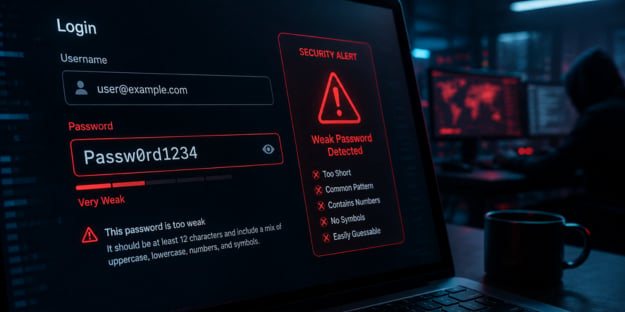
Every year, World Password Day reminds individuals and organizations to create stronger passwords, avoid password reuse, and enable multi-factor authentication (MFA).
While these practices remain important, new research from Proton suggests that traditional password security advice is no longer enough to protect modern businesses from cyber threats.
Key Takeaways
- Despite 92% of small businesses investing in cybersecurity, one in four still experienced a breach or cyberattack in the past year.
- Password managers alone are not solving credential security problems because employees continue using insecure workarounds.
- Human behavior and workflow friction remain major cybersecurity challenges for organizations of all sizes.
- Passkeys and passwordless authentication are emerging as more secure and user-friendly alternatives to traditional passwords.
- World Password Day 2026 highlights the need to reduce reliance on passwords rather than simply creating stronger ones.
| Proton SMB Cybersecurity Report 2026 Key Findings | Password Security Insight |
| 92% of small businesses invest in cybersecurity | Awareness and spending are increasing across organizations. |
| 1 in 4 businesses experienced a breach | Existing protections are still falling short. |
| Over half use password managers | Credential management tools are becoming standard. |
| Employees still share passwords insecurely | Human behavior continues to create security risks. |
| Passkeys and biometrics are gaining adoption | Organizations are moving toward passwordless security. |
Businesses Are Investing in Cybersecurity in 2026 but Still Getting Breached
According to Proton’s 2026 SMB Cybersecurity Report, small businesses are investing heavily in security measures, yet many continue to experience breaches and attacks.
Proton surveyed 3,000 small business leaders across six global markets and found that 92% are actively investing in cybersecurity tools and protections.
Despite those efforts, one in four businesses reported experiencing a cyberattack or data breach within the past year.
The report findings reveal a critical issue in cybersecurity today: awareness is not the problem.
“The most effective password may be no password at all,” said Stuart Sharp, Vice President of Product at OneLogin, in an email to eSecurityPlanet.
“This points to a deeper issue. It is not a lack of awareness or even a lack of preparation. It is the challenge of consistently enforcing secure tools and effectively detecting and stopping threats,” said Son Nguyen Kim, Head of Proton Pass, in a message to eSecurityPlanet.
As Kim highlights, many organizations understand password risks and have implemented tools designed to improve security.
The challenge lies in consistently enforcing secure practices across real-world business environments.
Password Managers Alone Are Not Solving the Problem
More than half of the surveyed organizations reported deploying password managers to help employees manage credentials securely.
However, many employees still share passwords through insecure methods such as email, messaging applications, and shared spreadsheets.
These workarounds undermine the effectiveness of security tools and expose organizations to unnecessary risk.
Why Human Behavior Continues to Create Security Risks
The research also challenges the outdated assumption that small businesses neglect cybersecurity.
In reality, many small and midsize organizations are investing in security technologies, employee training, and access management solutions.
The difficulty comes from ensuring that security measures function effectively within everyday workflows.
Employees often prioritize convenience and speed, especially when security processes become overly complicated or disruptive.
This highlights an important cybersecurity principle: effective security cannot depend entirely on perfect human behavior.
Organizations must build systems and policies that remain resilient even when mistakes occur.
Secure collaboration tools, simplified authentication methods, and automated protections are becoming increasingly necessary because human error remains one of the leading causes of security incidents.
Uzair Gadit, CEO and Founder of Dubai-based Secure, argues that password security failures are increasingly tied to system governance and insecure architecture rather than just user behavior alone.
Gadit noted that credentials are often exposed through public JavaScript bundles, unauthenticated endpoints, and improperly configured files, while some browser-based password management systems have also faced scrutiny over how credentials are stored and handled in memory.
The Growing Shift Toward Passwordless Authentication
World Password Day 2026 also reflects a broader industry conversation about the future of passwords themselves.
Increasingly, cybersecurity professionals argue that passwords may no longer be the best solution for digital authentication.
As Proton noted in its research, password security has become increasingly burdensome for end users.
Employees are expected to create long, unique passwords, rotate them regularly, and combine them with additional authentication layers.
Yet users frequently forget passwords, reuse them across accounts, or store them insecurely because managing credentials has become difficult and time-consuming.
Why Passkeys May Replace Traditional Passwords
In response, organizations are increasingly using passwordless authentication technologies, including biometrics and passkeys.
Passkeys allow users to authenticate through device-based credentials, fingerprints, or facial recognition rather than memorizing traditional passwords.
This approach can help improve both security and usability by reducing opportunities for successful phishing attacks, credential theft, and password reuse.
Passkeys also represent a shift in how authentication fits into the user experience.
Instead of interrupting workflows with repeated password prompts, authentication becomes a more seamless background process tied directly to trusted devices and biometric verification.
However, the transition away from passwords will not happen immediately.
Many organizations still rely on legacy systems and unmanaged devices that require traditional password-based authentication.
As a result, businesses are likely to operate in hybrid authentication environments for years to come, balancing passwords, MFA, biometrics, and passkeys simultaneously.
Even so, the cybersecurity industry increasingly views passwords as an outdated technology struggling to meet modern security demands.
In many ways, passwords resemble physical keys for a locked door: users need different credentials for every system, creating complexity that often leads to insecure shortcuts.
The Future of World Password Day
World Password Day remains valuable because it raises awareness about cybersecurity best practices. However, the conversation is evolving.
Rather than simply encouraging users to create stronger passwords, organizations should focus on reducing reliance on passwords altogether while implementing systems that support secure behavior naturally.
Ultimately, the message of World Password Day 2026 is not that password hygiene no longer matters.
Instead, it is that businesses must move beyond basic password advice and adopt authentication strategies designed for the realities of modern work environments.
Security solutions must be practical, user-friendly, and resilient enough to function effectively even when human mistakes occur.
As organizations shift their approach to authentication and move beyond just passwords, many are turning to zero trust solutions that continuously verify every user and device.
