

Artificial intelligence (AI) is reshaping cybersecurity at a pace that is forcing educators, businesses, and governments to rethink workforce development and national defense strategies.
During a recent discussion with cybersecurity entrepreneur and ConnectSecure Chairman, Arnie Bellini, key themes emerged around the evolution of cyber threats, the importance of protecting America’s “digital border,” and the urgent need to modernize cybersecurity education.
Bellini argued that AI is simultaneously lowering the barrier to entry for attackers while creating unprecedented opportunities to accelerate cybersecurity training and workforce readiness.
Our conversation explored how AI-driven education, hands-on learning, and national investment in cyber talent are becoming essential components of U.S. national security.
The Expanding Cyber Threat Landscape
Bellini described cybercrime as one of the world’s largest economies, estimating that it now generates trillions of dollars annually.
As AI tools become more accessible, attackers no longer require advanced technical skills to launch sophisticated operations.
According to Bellini, “anybody can be a hacker” when equipped with modern AI-driven tools.
This evolution has significant implications for national defense. Bellini introduced the concept of America’s “digital border,” explaining that every connected device — including laptops, phones, routers, vehicles, and sensors — represents part of the nation’s attack surface.
Unlike physical borders, digital borders are continuously targeted by cybercriminals and nation-state adversaries.
He emphasized that modern warfare begins in cyberspace, where attacks against infrastructure, communications, and intelligence systems can directly influence geopolitical outcomes.
The Cybersecurity Workforce Gap
One of the most pressing concerns discussed during the interview was the growing cybersecurity workforce shortage.
Bellini noted that hundreds of thousands of cybersecurity positions remain unfilled across the United States, creating vulnerabilities for both private organizations and government agencies.
A major challenge, according to Bellini, is that many educational programs remain outdated and overly focused on theory instead of practical application.
Traditional lecture-based instruction often fails to prepare students for real-world cyber operations.
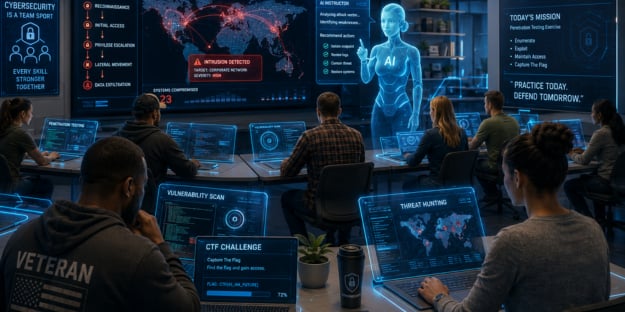
Effective cybersecurity training, he argued, must combine foundational knowledge with immersive hands-on exercises in areas such as penetration testing, threat hunting, and capture-the-flag simulations.
This practical approach is essential because defenders must understand how attackers think and operate.
Cybersecurity professionals who understand attack chains and adversary tactics are better equipped to build defensive controls, detect malicious behavior, and respond effectively to incidents.
AI as a Force Multiplier for Education
Bellini believes AI can fundamentally transform cybersecurity education by acting as a personalized instructor for every student.
Rather than relying on the traditional model of one professor teaching a limited number of students, AI-driven systems can scale instruction to thousands of learners simultaneously while adapting to each student’s pace and skill level.
AI-powered learning platforms can identify where students struggle, reinforce difficult concepts, and provide guided hands-on exercises in real time.
This adaptive learning model enables individuals from nontraditional backgrounds — including military veterans, stay-at-home parents, and career changers — to transition into cybersecurity careers more efficiently.
Bellini emphasized that cybersecurity education should become more accessible, affordable, and engaging through gamification and continuous skills assessment.
Our discussion also highlighted the role of AI agents in simulating expert guidance.
AI-driven assistants modeled after experienced security leaders can walk students through incident response scenarios, penetration testing exercises, and other defensive operations, effectively providing over-the-shoulder mentorship at scale.
Balancing Innovation and Security
Despite AI’s potential benefits, Bellini cautioned that AI systems are not inherently safe.
He argued that governments and organizations still do not fully understand how advanced AI models operate internally, making comprehensive regulation difficult.
At the same time, global competition — particularly from China — requires the United States to continue innovating aggressively in AI and cybersecurity.
Rather than attempting to halt innovation, Bellini advocated for practical safeguards and stronger cybersecurity fundamentals.
He identified several fundamental defensive measures for organizations, including multi-factor authentication, endpoint protection, user awareness training, continuous risk assessments, and secure data backups.
These foundational practices remain important even as AI changes the cyber threat landscape.
Bottom Line
Our conversation underscored that AI and cybersecurity are now inseparable components of national security.
While AI empowers attackers with new capabilities, it also provides powerful tools for accelerating cybersecurity education and strengthening the workforce needed to defend America’s digital border.
Bellini’s vision emphasizes scalable, hands-on, AI-driven education that prepares individuals from diverse backgrounds to enter the cybersecurity field quickly and effectively.
As cyber threats continue to evolve, investment in workforce development, modernized education, and AI-enabled defense strategies will play a critical role in maintaining U.S. security and technological leadership.
