


A new open-source project called “RuView” is drawing widespread attention online for demonstrating how ordinary Wi-Fi signals can be used to detect human movement, breathing patterns, and even body posture through walls without cameras or wearable devices.
The project surged on GitHub this week after social media posts showcasing its capabilities accumulated hundreds of thousands of views.
The project presents itself as a “WiFi DensePose” platform that transforms wireless radio signals into what the developers describe as “spatial intelligence.” According to the repository, the system uses Channel State Information (CSI) extracted from Wi-Fi traffic and combines it with machine learning models to infer human presence, movement, and physiological signals.
RuView builds upon years of academic research into Wi-Fi sensing and radio-frequency-based human detection, including work pioneered at Carnegie Mellon University on “DensePose from WiFi.” Instead of relying on cameras, the technology measures how radio waves scatter and change as they interact with human bodies and objects inside a room.
According to the documentation on the project’s GitHub repository, Wi-Fi routers continuously emit radio waves that bounce off walls, furniture, and people. By collecting CSI data from multiple low-cost ESP32-S3 microcontrollers positioned around an environment, the software analyzes minute changes in signal amplitude and phase. Those variations are then processed using signal processing pipelines and neural networks to estimate movement, occupancy, respiration, and body posture.
The project claims support for several sensing functions, including:
- Presence and occupancy detection
- Through-wall human tracking
- Contactless breathing and heart-rate monitoring
- Sleep monitoring and apnea screening
- Gesture and activity recognition
- Fall detection
- Human pose estimation with 17 COCO keypoints
The repository states that advanced features require CSI-capable hardware such as ESP32-S3 boards or specialized wireless network cards. However, the developers also provide Docker-based demos using simulated data, allowing users to test portions of the system without dedicated hardware.
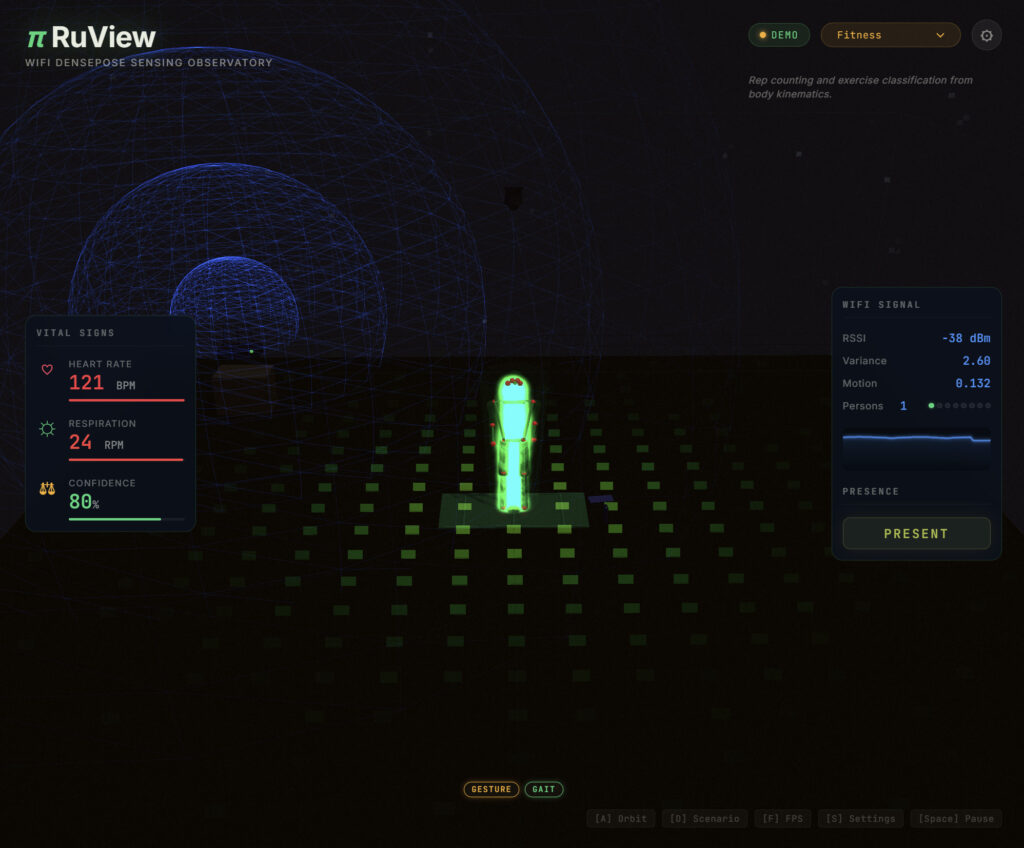
RuView can operate entirely locally without cloud connectivity, describing the system as “privacy-preserving” because it does not rely on video capture. The project specifically markets the absence of cameras to avoid traditional video surveillance concerns and regulatory complications associated with image collection.
Still, the technology raises significant privacy and ethical questions because it can monitor people through walls using existing wireless infrastructure. While Wi-Fi sensing has long been studied in research environments, projects like RuView are pushing the technology closer to accessible consumer-grade implementations using inexpensive hardware.
The developers state the software is still “beta” quality, with APIs and firmware actively changing. Accuracy also remains constrained in some areas, particularly in camera-free pose estimation, which the maintainers say currently achieves lower precision than camera-supervised training systems. Security researchers have also historically warned that Wi-Fi sensing systems can be sensitive to environmental noise, room layouts, and signal interference, thereby affecting reliability.
If you liked this article, be sure to follow us on X/Twitter and also LinkedIn for more exclusive content.
