


This guide is for security leaders, IT administrators, and growing businesses evaluating extended detection and response (XDR) platforms, and it covers the top solutions available today along with key features and buying considerations.
XDR tools provide centralized visibility and threat detection across endpoints, networks, cloud workloads, and email systems, helping organizations respond to increasingly complex cyber threats. By unifying data from multiple security layers, these platforms enable faster detection, streamlined investigations, and more effective incident response. In this guide, we break down the leading XDR solutions, their core capabilities, and what to consider when choosing the right platform for your environment.
Here are the best six XDR platforms:
Top XDR Solutions Compared
The following table compares my top vendors based on their important detection and response features and the availability of a free trial.
✔️= Yes ❌= No ➕ = Add-on
Based on this comparison, each of the six XDR platforms highlighted offers strong detection and response capabilities, with varying strengths in areas like integration, automation, and scalability. The right choice ultimately depends on your organization’s existing tech stack, security maturity, and operational needs.
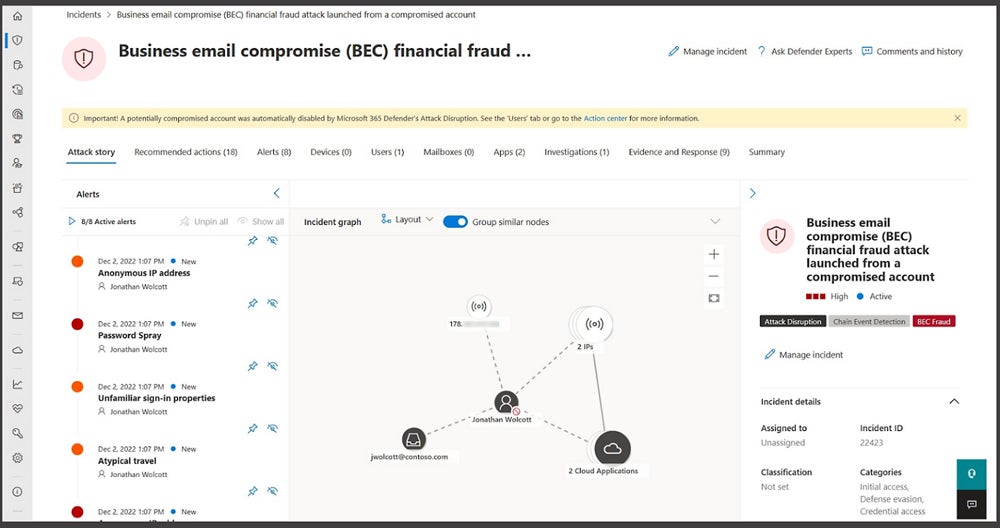
Microsoft Defender XDR is a cloud-native extended detection and response platform built to help organizations unify security across endpoints, identities, email, cloud apps, and hybrid environments. It delivers correlated alerts, automated response actions, and AI-driven threat detection to help security teams identify and contain threats faster. The platform integrates tightly with Microsoft’s broader security ecosystem, including SIEM and identity solutions, enabling centralized visibility and streamlined operations. With scalable deployment options and deep automation capabilities, Microsoft Defender XDR is well-suited for organizations ranging from mid-sized teams to large enterprises.
Pros
Cons
- Query-based threat hunting: Security teams can create custom queries and use them to explore 30 days’ worth of raw log data for specific threat searches.
- Automated self-healing: Defender XDR automates simple healing tasks, like device cleaning, and allows teams to develop customized auto-responses to common alerts.
- Entra ID integration: Defender XDR helps you protect apps and identities by integrating with Entra ID, Microsoft’s IAM solution.
- Copilot: Microsoft’s tool for security assistance answers natural-language questions and gives you options for resolving threats, allowing you to view policies and get device info.
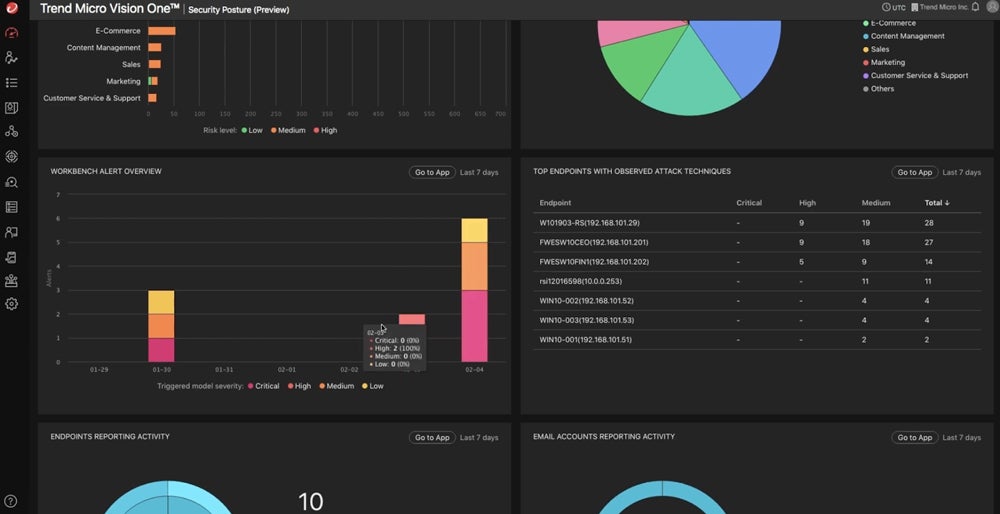
Trend Micro Vision One is an extended detection and response (XDR) platform that combines threat intelligence, attack surface management, and cross-layer detection in a single solution. It provides visibility across endpoints, servers, email, cloud workloads, and user identities, helping security teams identify and respond to threats more efficiently. A centralized data lake aggregates telemetry, logs, and metadata from across the environment, reducing data silos and improving investigation workflows. Vision One also integrates with leading SIEM and SOAR platforms, allowing organizations to extend and automate their security operations.
Pros
Cons
- Vulnerability management: Vision One helps you track vulnerabilities’ CVEs and the meantime to patch them.
- Sandbox analysis: Analysts can send suspicious files to Vision One’s sandbox and isolate possible threats during an examination.
- Role-based dashboards: Specific organizational roles — like CIOs or IT operations personnel — receive custom dashboards based on their responsibilities.
- Custom reports: Vision One customers can create out-of-the-box or custom risk reports tailored to the specific reports you need to give.
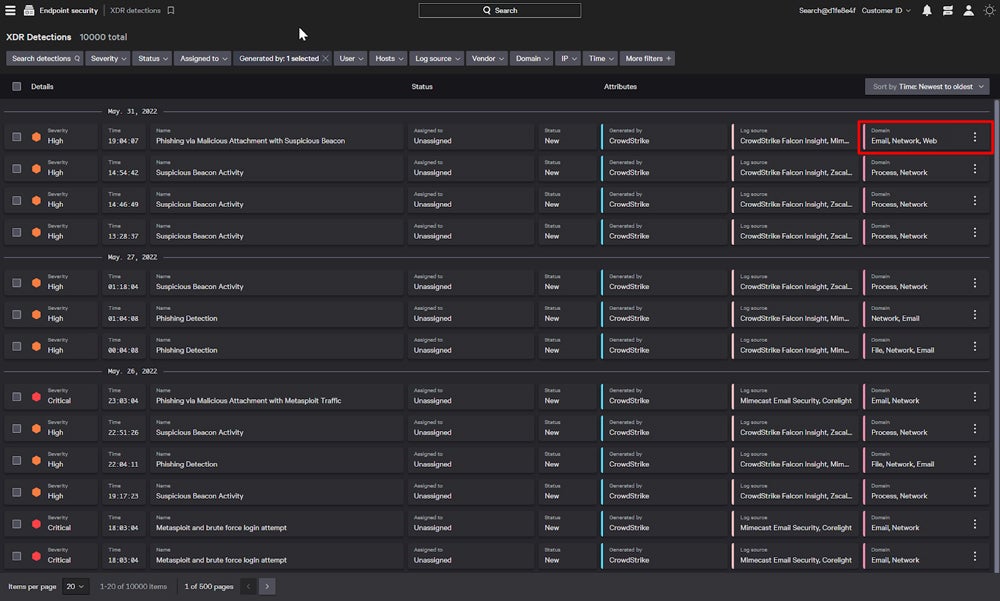
CrowdStrike Falcon is a cloud-native platform that delivers extended detection and response (XDR) capabilities through its Falcon Insight module and broader Falcon ecosystem. It provides unified visibility across endpoints, identities, cloud workloads, and more, combining advanced antivirus, behavioral analytics, threat intelligence, and proactive threat hunting. The platform is designed for scalability, with modular licensing that allows organizations to tailor capabilities to their needs, along with robust incident response and automation features. CrowdStrike also offers flexible support options, including dedicated enterprise support, making it a strong fit for organizations seeking a highly customizable and scalable security platform.
Pros
Cons
- Zero trust assessments: Falcon Insight’s ZTAs assess business-wide endpoint health and let you know what OS settings and policies make you vulnerable.
- Incident workbench: Security teams can view an attack from beginning to end to better understand its process.
- CrowdScore: Your organization receives an overall threat score and an incident dashboard that triages alerts for you.
- Data ingestion: Falcon Insight XDR users receive 10GB of free third-party ingested data daily through CrowdStrike Falcon Next-Gen SIEM.
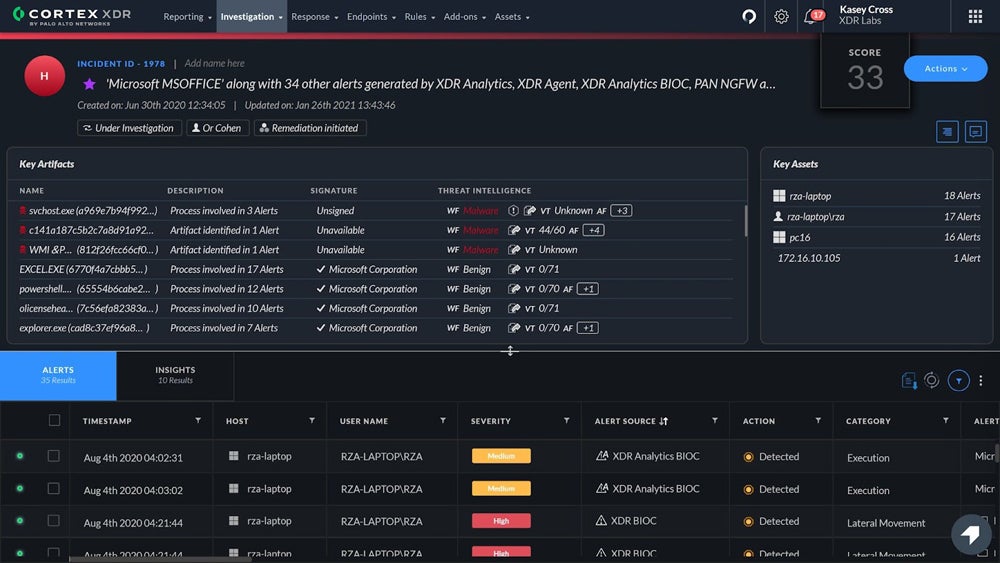
Palo Alto Networks’ Cortex XDR is an advanced extended detection and response platform that unifies data from endpoints, networks, and cloud environments to improve threat detection and reduce manual workloads. It leverages machine learning–driven behavioral analytics, customizable detection rules, and integrated threat intelligence from Palo Alto’s Unit 42 team to identify and respond to sophisticated attacks. Cortex XDR also emphasizes automation and cross-environment correlation, helping security teams investigate incidents more efficiently. While the platform has a steeper learning curve, it is well-suited for organizations with mature security operations that need deep visibility and advanced threat analysis capabilities.
Pros
Cons
- Custom rules: Cortex XDR offers rules based on indicators of compromise (IOCs), like IP addresses, file names, and event correlation rules.
- Cloud lateral movement analytics: Palo Alto finds strange patterns in cloud services based on usage, identifying behavior that’s typically used to move laterally.
- Response actions: Teams can isolate endpoints, remediate malicious changes, and search for and destroy malicious files on a device.
- XSOAR integration: Cortex XDR and Cortex XSOAR integrate closely, allowing you to ingest incidents from Cortex XDR into XSOAR playbooks automatically.
SentinelOne Singularity is an extended detection and response (XDR) platform that combines autonomous protection, advanced automation, and integrated SOAR capabilities to streamline security operations. It delivers real-time threat detection and machine-speed response across endpoints, cloud workloads, and identities, helping teams contain threats quickly with minimal manual intervention. The platform also includes RemoteOps Forensics, enabling deeper investigation and incident analysis from a centralized console. With its intuitive interface and strong customer support reputation, SentinelOne Singularity is a solid option for organizations seeking powerful protection that remains accessible to less experienced security teams.
Pros
Cons
- RemoteOps Forensics: Singularity Enterprise customers can set automatic evidence collection to be triggered by threats and customize specific forensics profiles.
- Role-based access control: SentinelOne offers six predefined roles and also allows admins to create custom roles and permission settings.
- Network discovery: SentinelOne Network Discovery fingerprints IP-enabled devices on customers’ networks and identifies vulnerable endpoints.
- Firewall control: Singularity lets you perform native firewall control for Windows, Linux, and macOS operating systems.

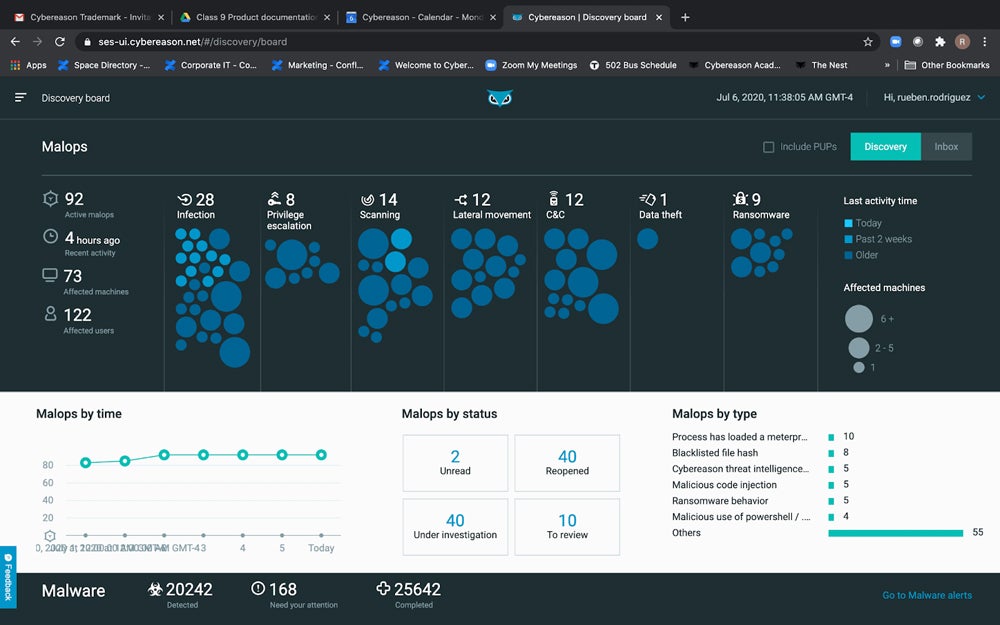
Cybereason Defense Platform is an extended detection and response (XDR) solution known for its focus on analyzing malicious operations, or “MalOps,” to provide a clear view of how attacks unfold. It visualizes the full attack lifecycle — from initial compromise to lateral movement and impact — helping security teams understand and respond to threats more effectively. The platform also includes capabilities like automated incident triage, behavioral detection, and customizable rules for tailored threat monitoring. With its strong emphasis on visibility and context, Cybereason is well-suited for organizations that prioritize deep investigation and comprehensive threat analysis.
Pros
Cons
- MalOps: Cybereason tracks the history and behavior of a specific threat from its first entry into the network until its attempted attack.
- Incident triage: Cybereason’s incident response prioritizes your business’s most critical assets, so you’re responding to the most important issues first.
- Threat hunting: Teams can search for threat evidence, conduct investigations, and use custom detection rules based on their business.
- Device controls: Cybereason Endpoint Controls help you manage endpoints from one screen.
5 Key Features Of XDR Solutions in 2026
Identifying the right XDR platform starts with understanding the core capabilities that define modern detection and response. While every organization’s needs differ, today’s leading XDR solutions are built around a common set of features, including unified visibility, intelligent incident response, automation, high-quality threat intelligence, and strong integrations. Use these as a baseline when evaluating vendors.
Unified Visibility Across Environments
A primary advantage of XDR in 2026 is its ability to provide centralized visibility across endpoints, networks, cloud workloads, identities, and email systems. This unified view helps eliminate security silos and enables teams to correlate activity across different environments, making it easier to detect sophisticated, multi-stage attacks. When evaluating solutions, look for proven cross-layer correlation — not just broad coverage claims.
Advanced Incident Detection and Response
Modern XDR platforms go beyond alerting by offering full incident context, including attack timelines, affected assets, and recommended actions. Key response capabilities include isolating endpoints, stopping malicious processes, and automating containment. Many platforms now incorporate AI-assisted investigation and response to reduce dwell time and improve accuracy.
Automation and Orchestration (SOAR Capabilities)
Automation is no longer optional — it’s essential. XDR solutions now include built-in orchestration features that allow teams to create automated workflows for detection, triage, and response. These workflows help standardize processes, reduce manual effort, and ensure faster reaction times, especially in high-volume alert environments.
Integrated Threat Intelligence
Effective XDR platforms aggregate and analyze threat intelligence from multiple sources, including global threat feeds, vendor research teams, and real-time telemetry. In 2026, leading tools also use AI to prioritize and contextualize threats, helping teams focus on what matters most. High-quality, continuously updated intelligence is critical for staying ahead of emerging threats.
Open Integrations and Ecosystem Compatibility
Today’s XDR solutions are expected to integrate seamlessly with existing security stacks, including SIEM, identity providers, cloud platforms, and third-party tools. Open APIs and strong partner ecosystems are key to avoiding vendor lock-in and ensuring that security data flows freely across systems. The more interoperable the platform, the more effective your overall security posture will be.
How I Evaluated the Best XDR Solutions
I created a product scoring rubric to compare XDR platforms and evaluated industry-leading solutions using six major criteria and individual subcriteria. The six categories I selected, like features and support, are significant for buyers to consider when purchasing an XDR platform. I weighted each criterion based on importance, and weighted all the subcriteria, too. How each solution met the criteria I set, as well as criteria weighting, determined the platform’s total score.
Evaluation Criteria
First I considered product features, including device controls and automated response, which are the backbone of XDR. I also looked at usability and product coverage, like documentation and device support, and administration, including APIs and deployment options. Next I evaluated customer support options, like phone and 24/7 channels, and MITRE ratings, which test vendors’ real-world capabilities. Finally, I considered free trials and pricing transparency.
- Features (25%): This category covered important XDR capabilities like threat hunting, detection rules, and email and cloud protection.
- Usability and coverage (20%): I considered features that contribute to ease of use, like managed services, and product coverage, including network and IoT protection.
- Administration (15%): This category included APIs, security policy management, and dashboards, as well as other subcriteria that ease administrative work.
- Customer support (15%): I evaluated support channels like email, phone, and chat, as well as the availability of demos, community forums, and technical account managers.
- Criterion winner: Multiple winners
- MITRE ratings (15%): Vendors’ independent security testing scores help show their product’s true abilities.
- Criterion winner: Multiple winners
- Pricing (10%): I looked at XDR platforms’ pricing information and the availability of free product trials.
Frequently Asked Questions (FAQs)
What are the advantages of XDR?
XDR provides a more unified and comprehensive approach to threat detection by correlating data across endpoints, networks, cloud environments, identities, and email systems. This broader visibility helps security teams detect sophisticated, multi-stage attacks that might be missed by standalone tools. In 2026, many XDR platforms also incorporate AI-driven analytics and automation to reduce alert fatigue and accelerate response times. However, to get the most value, organizations still need proper configuration, tuning, and ongoing management.
What’s the difference between XDR and EDR?
Endpoint detection and response (EDR) focuses specifically on endpoint devices like laptops and servers, providing visibility and response capabilities at the device level. XDR expands on this by aggregating and correlating data from multiple security layers, including networks, cloud workloads, identities, and email. While many EDR solutions have evolved to include XDR features, true XDR platforms are designed to deliver cross-environment visibility and response — not just endpoint protection.
What’s the difference between XDR and MDR?
Managed detection and response (MDR) is a service, not a product. It provides organizations with an external team that monitors, investigates, and responds to threats on their behalf. MDR services can be built on top of EDR or XDR platforms, depending on the provider. In 2026, many vendors offer managed XDR services, combining advanced technology with human expertise — making MDR a strong option for organizations with limited in-house security resources.
Bottom Line: The Best XDR Solutions In 2026
Extended detection and response has become a foundational component of modern cybersecurity, helping organizations gain visibility across their entire digital environment — not just endpoints. By connecting signals across systems, XDR enables faster detection, deeper investigation, and more coordinated response to threats.
That said, XDR is not always a plug-and-play solution. It requires thoughtful deployment, ongoing tuning, and integration with your existing security stack to be truly effective. Organizations that invest the time to optimize their XDR platform — and align it with their broader security strategy — will be positioned to detect and respond to emerging threats.
If your business is debating which type of security platform to choose, read about the differences between XDR, SIEM, and SOAR next.
