


PowerPoint has more powerful features than Google Slides, including ways to customize animations between slides.
Preston Gralla / Foundry
However, Google Slides rules when it comes to collaboration, which far outstrips the capabilities built into PowerPoint. And because Slides offers fewer capabilities than PowerPoint, it’s slightly easier to create slides in it, because it doesn’t pack as many features into the interface.
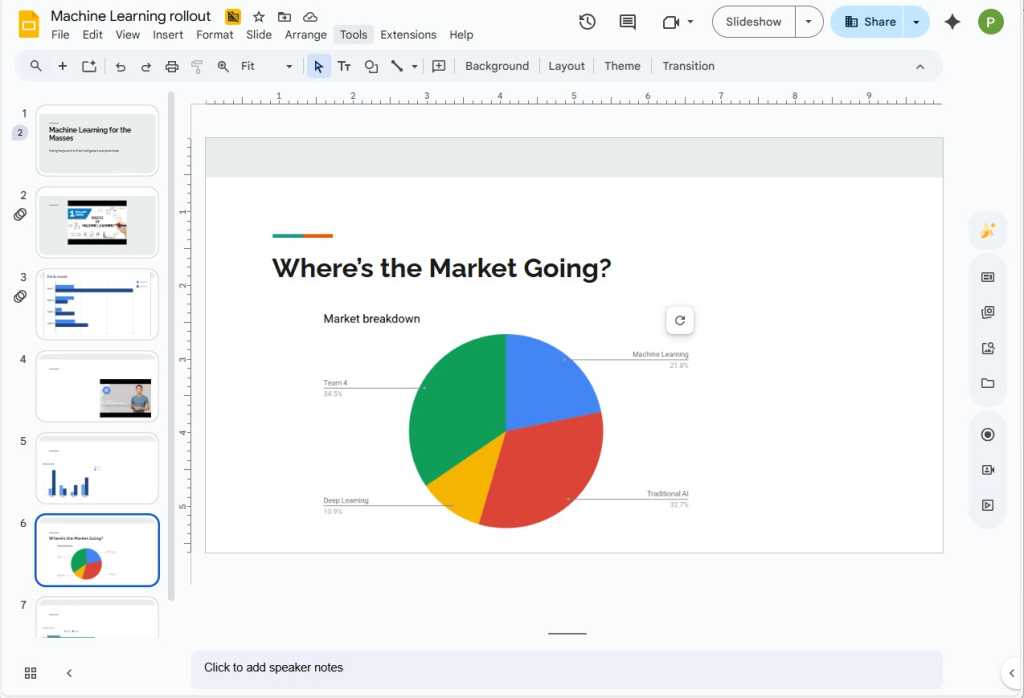
Slides isn’t as powerful as PowerPoint, but its interface is less cluttered and confusing.
Preston Gralla / Foundry
Note that in the latest version of PowerPoint, Microsoft killed one of its most useful features: QuickStarter, which made it exceptionally easy to get a leg up on building a presentation, including creating an outline, starter slides, templates, and themes. Microsoft now recommends using its Copilot AI to do that, but Copilot isn’t as simple to use as QuickStarter was. And Google’s Gemini AI can help you build presentations in a similar way to Copilot. (For more on that, see “Google Workspace vs. Microsoft 365: AI tools” later in the article.)
Email: Gmail vs. Microsoft Outlook
If you prize simplicity, you’ll favor Gmail over Outlook. Gmail has a cleaner and less cluttered interface than Outlook’s, offering the best balance between ease of use and powerful features. However, Outlook has made some headway towards being more straightforward to use with a simplified Ribbon that puts your most used features within easy reach.
Whether it’s creating, responding to, or managing email, Gmail offers an intuitive interface with easy-to-use tools for getting your work done fast. My favorites include an AI-driven option that suggests words and phrases as you type, a “nudge” feature for surfacing forgotten messages, and a handy snooze button for delaying incoming messages. Its ability to automatically handle messages by filtering to specific folders is a snap to use as well.
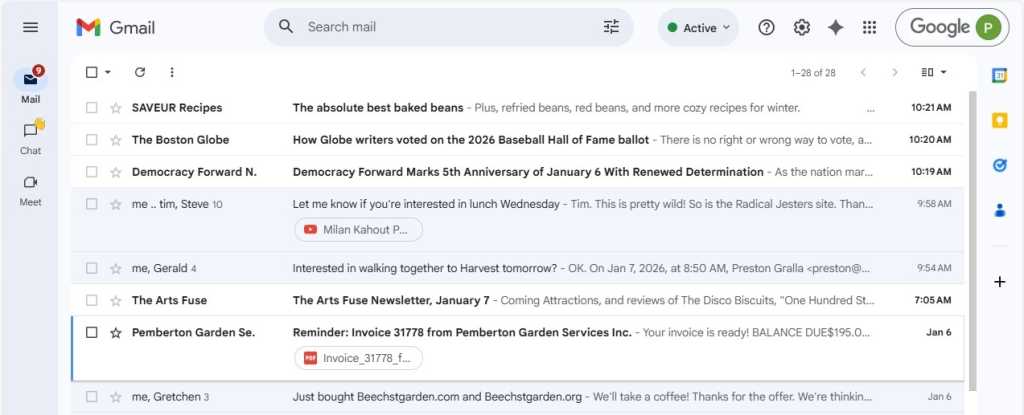
Gmail offers a streamlined interface and intuitive ways to accomplish your most important email tasks.
Preston Gralla / Foundry
When it comes to power features, however, Outlook rules. For example, Outlook offers a number of tools including Quick Steps and customizations that automate mail handing in sophisticated ways that aren’t possible in Gmail. And because the contacts and calendar functions are part of Outlook itself, they’re well integrated with email. Gmail relies on the separate Google Contacts and Calendar apps, which can be a bit more cumbersome to navigate.
In addition, Outlook has a left-hand pane that links directly to all the Microsoft 365 apps, and it lets you link to a Gmail account so you can read and manage all your mail accounts directly inside Outlook. Gmail has links to the rest of its Workspace suite, but they’re not within as easy reach — you’ll have to click the Google apps button to the right of your account icon at the top right of the screen, and then hunt for the app you want. And you can’t see all your other email accounts on a single screen. You’ll have to open them on separate tabs.
Outlook is well known for its confusing interface that bristles with too many features and options. However, the latest version has been simplified, and although Gmail is still far easier and more straightforward to use, you won’t find yourself as easily lost in Outlook as you were in the past. Outlook’s web interface now mimics its desktop app, so there’s no more confusion when you switch between one and the other.
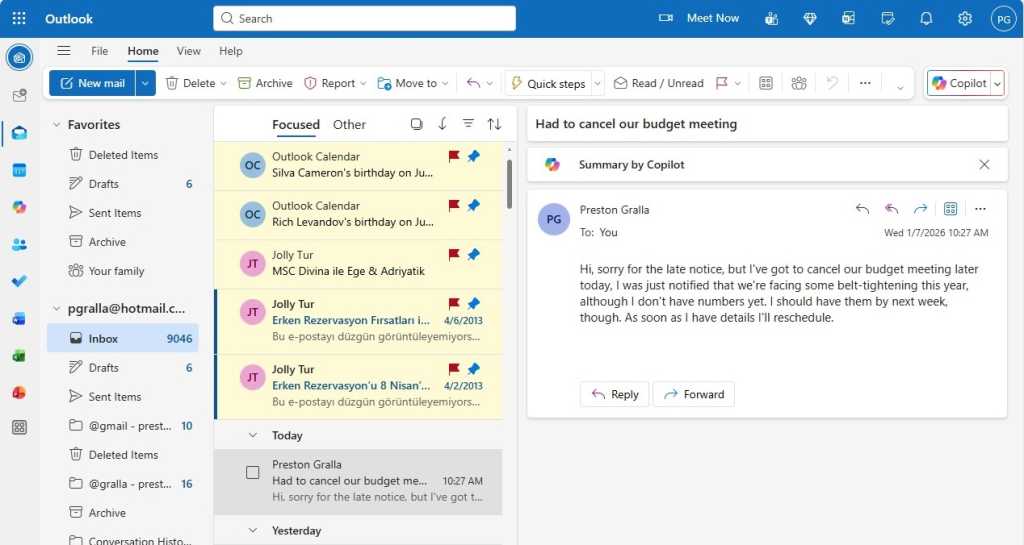
Outlook isn’t as simple to use as Gmail, but its newest look is cleaner than in the past. Pictured here is the web interface, which mimics the desktop app.
Preston Gralla / Foundry
If your users want every bell and whistle possible, Outlook provides them all. For getting things done quickly, Gmail is a better choice.
Collaboration: Google Meet, Chat, and Spaces vs. Microsoft Teams
As I’ve noted multiple times in this article, when it comes to collaborating on documents, Google Workspace is far superior to Microsoft 365 — it’s baked right into the interface, rather than feeling like an afterthought as it does in the Office apps. Everything is in front of you to invite people to collaborate, set their collaboration rights, and chat with them while you do the work together. There’s a deeper learning curve for using collaboration in Office, and even when you learn how to do it, it’s not nearly as seamless as in the Google apps.
Working together on individual documents is only one part of the equation, though. When it comes to more complex, enterprise-wide collaboration features, Microsoft 365 includes tools that beat anything Google Workspace offers. Microsoft Teams, for example, combines group chat, online meetings, videoconferencing, customized workspaces, calendars, and shared team file repositories in a way that’s more sophisticated and useful than anything Google has. And Teams has deep ties to the rest of the Office platform, offering effortless integration with Outlook, SharePoint, OneDrive for Business, and more.
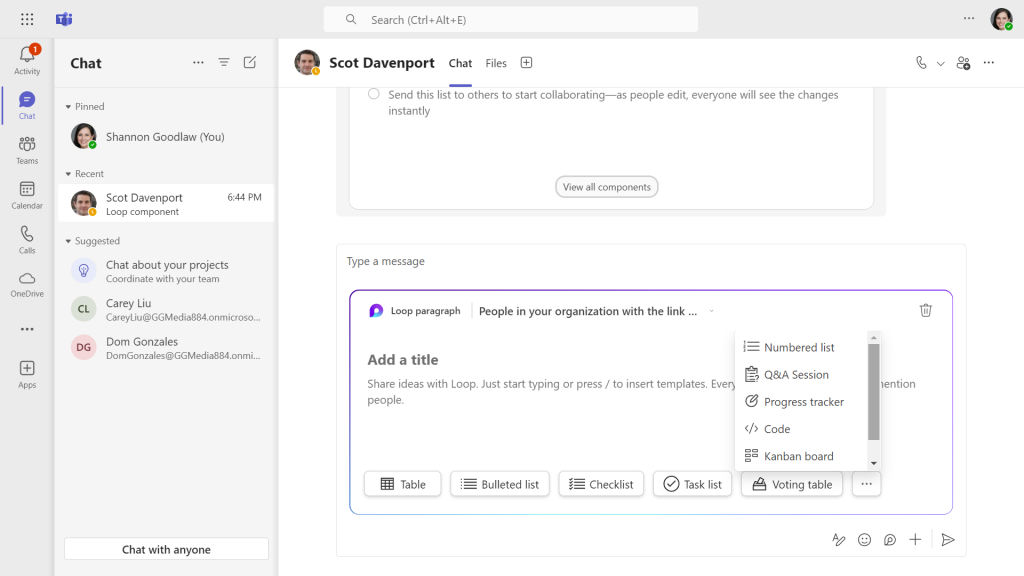
The Teams group-chat platform integrates closely with the rest of Microsoft 365.
Howard Wen
Teams used to be included with all M365 business and enterprise plans, but after facing antitrust scrutiny in the European Union, Microsoft partially unbundled Teams from its M365 enterprise plans, first in the EU and then globally. Enterprise and small business customers can now buy M365 versions either with or without Teams.
For its part, Workspace offers Google Meet for videoconferencing and Google Chat for messaging. There’s also Spaces, a workflow integration and collaboration tool that’s available as part of Google Chat and integrated with Google Calendar, Drive, Docs, Sheets, Slides, Meet, and Tasks. Spaces lets you create shared workspaces where you can chat, share files, and assign tasks.
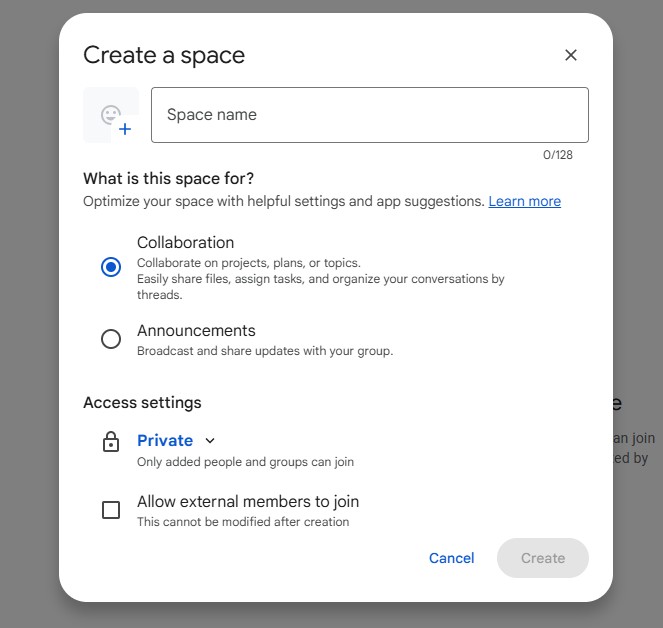
Creating a new shared workspace in Google Spaces.
Preston Gralla / Foundry
These tools are useful and straightforward, although switching among them is not as seamless as having all these functions in the Teams app.
Storage and file sharing: Google Drive vs. Microsoft OneDrive for Business and SharePoint
Both suites come with substantial amounts of storage, aside from the cheapest Google Workspace version, Starter, which offers only 30GB per person. The Standard plan includes 2TB per person, the Plus plan has 5TB per person, and the Enterprise and Enterprise+ versions essentially offer unlimited storage per person.
Microsoft 365’s small business and lower-tier enterprise plans include 1TB of storage per user, while its E3 and E5 plans include 5TB of storage per user. Customers with E3 and E5 plans can request additional storage from Microsoft. (Subscriptions with fewer than five users get only 1TB of storage, which can’t be expanded.)
There’s little to differentiate Google Workspace’s and Microsoft 365’s storage-and-shared-documents features from one another. Both Google Drive and Microsoft OneDrive for Business integrate directly with their own office suites, and both allow you to access the files on any device. In Workspace, the files live in the cloud by default rather than on the devices themselves, although you can also store them locally. In Microsoft 365 they typically live on each device and also in the cloud, and it all syncs together, although you have the option of keeping specific files and folders cloud-only.
If you’re worried about offline access for the cloud-first Google Workspace, it offers management tools that allow administrators to set whether users can access their documents and use Docs, Sheets, and Slides when their computers aren’t connected to the internet. The tools allow admins to install a policy on each computer allowing that access, or else let each user decide whether to allow offline access.
OneDrive has a nice feature called OneDrive Files on Demand that lets users decide, on a file-by-file and folder-by-folder basis, which files to store on individual devices and which to leave in the cloud, although the files and folders in the cloud are still available for download when you want them on a device.
Almost all Microsoft 365 business and enterprise plans also include a free version of Microsoft’s SharePoint service, called SharePoint Online. SharePoint Online adds substantial features to storage and sharing. It manages and organizes documents, workflows, and other shared information, typically via a series of mini-sites.
SharePoint Online is delivered as a service and is hosted by Microsoft, so businesses do not need to purchase and manage their own servers and infrastructure for it. However, they may need admins to handle a number of SharePoint Online tasks, such as content management and portal design.
There’s also a for-pay version of SharePoint, called SharePoint Server, that is available under a separate license and isn’t included as part of Microsoft 365. With SharePoint Server, your business hosts and manages the physical and software infrastructure required for SharePoint. That means performing tasks such as racking servers; applying security patches and feature updates; and monitoring uptime, reliability, and security. With SharePoint Online, those tasks are handled by Microsoft.
Google doesn’t offer a true equivalent to SharePoint Online in Google Workspace. All versions of Workspace except Business Starter can use a feature called Shared Drives, which are Google Drive folders that can be accessed and managed by more than one person. They can be used as handy repositories for members of a team to store and share documents, images, and other files, but Shared Drives are not integrated intranet sites like those offered by SharePoint.
One final note: Google’s search tools for finding documents in Google Drive are far better than Microsoft’s search tools in OneDrive, and its Cloud Search function extends Google’s search power across all of a company’s content. That being said, it’s generally easier to browse OneDrive using File Explorer than it is to browse Google Drive on the web.
Suites like Google Workspace and Microsoft 365 are tremendous productivity boosters; it’s almost unimaginable for any business not to use them or something like them. Many people believe the same thing will eventually be said of AI — both traditional AI and newer generative AI tools like Microsoft 365 Copilot and Gemini.
Both suites have included built-in AI features for years. Microsoft 365’s Power Automate (previously called Microsoft Flow) uses AI to help people build workflows using natural language prompts. Microsoft Power BI is a data visualization app connects to Excel and other data sources. And Microsoft Editor works in Word and Outlook for text prediction and spelling and grammar checking.
Built-in AI tools in Google Workspace include Smart Compose for creating documents and Smart Reply for responding to comments. Workspace also has Smart Cleanup, which identifies errors in Sheets and corrects them, and Smart Fill, which automates adding data to Sheets.
But most of the buzz is around more recently released genAI tools, Microsoft 365 Copilot and Gemini. GenAI can be particularly effective when combined with the productivity suites, and adding new genAI features is clearly a top priority for both companies. There are those who believe that genAI tools have already become a must-have addition to office suites.
Google Workspace includes Gemini in its apps for free. As for Copilot, it’s complicated. Copilot Chat, a basic version of Microsoft’s chatbot, is now available in Office apps for free under any M365 subscription for business. Access to more advanced features requires a Microsoft 365 Copilot add-on subscription, which costs $30 per user per month for large businesses or $21 per user per month for small businesses. That said, additional functionality is planned for Copilot Chat this year, along with price increases for most M365 plans in July 2026.
Microsoft 365 Copilot has been available longer than Gemini in Google Workspace. It integrates with Word, Excel, PowerPoint, Outlook, and Teams.
In Word, it can create documents based on your prompts, or by being given an existing document and asked to create a new one from that — for example, creating a new sales pitch based on an existing marketing document. In PowerPoint, it works similarly and can create presentations based on prompts or existing documents. In Excel, it can analyze data, generate formulas, automate repetitive tasks, and use Python for advanced analysis.
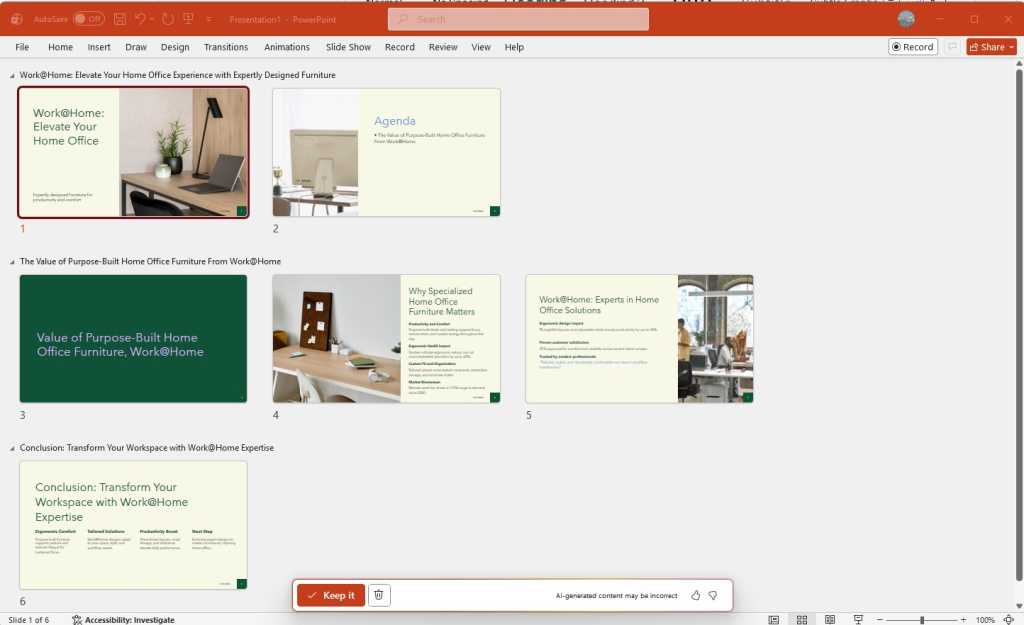
Copilot created this first draft of a presentation in PowerPoint based on a one-paragraph description.
Preston Gralla / Foundry
In Outlook, it can write emails based on prompts or documents, answer emails and summarize email threads, and prioritize your inbox so you can quickly see which emails are most important. In Teams, it can summarize primary discussion points of meetings and suggest action items, among other capabilities.
It also can provide a big-picture view of projects and then let you drill down to get more granular information — for example, finding a specific spreadsheet with revenue projections for the next five years for new lines of business.
Beyond that, there are capabilities outside the core Microsoft 365 apps, such as Copilot Pages, designed for AI-driven collaboration. Unlike the typical ephemeral genAI output, this shared canvas provides a persistent environment where users can interact with the AI and each other, with everything saved to be built on in the future.
Other features include Researcher and Analyst agents, which show in real time how they reach their conclusions when you interact with Copilot, and Copilot Notebooks, which can search and summarize data across Microsoft 365 and third-party apps.
Also new is Agent Mode, which can build and edit documents, spreadsheets, and presentations from chats, and can also run multi-step tasks such analyzing an Excel spreadsheet and drafting a summary of its findings.
In Google Workspace, Gemini offers features similar to M365 Copilot’s, with some of its own unique twists. Gemini can write new documents and emails based on prompts. In Docs, Sheets, and Slides it can summarize, analyze, and generate new content from scratch or based on your existing files and emails. Gemini can also scan people’s calendars and propose meeting times where everyone is free, and take meeting notes in Google Meet.
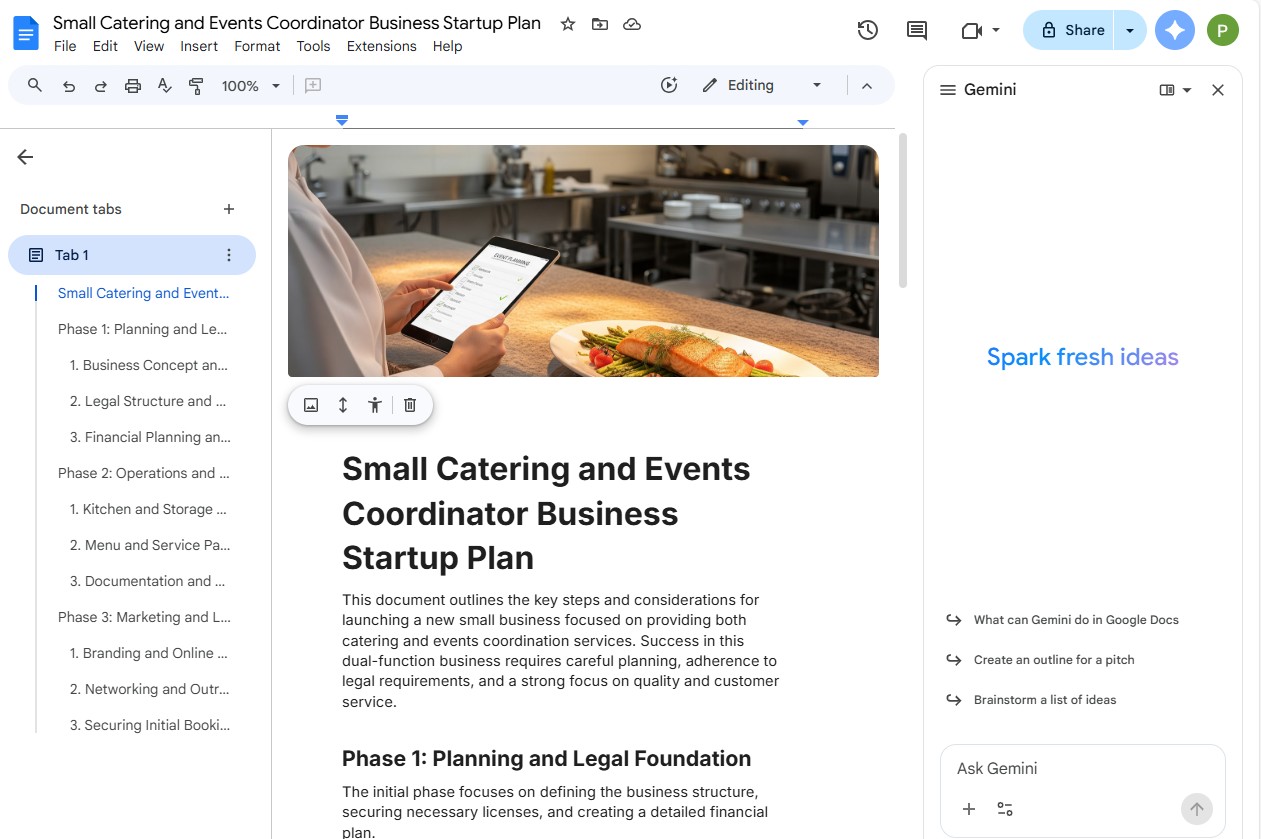
A launch plan for starting a small business created by Gemini in Google Docs.
Preston Gralla / Foundry
Gemini also has Workspace Flows, which can automate work across Workspace apps, such as a stream of jobs required for document reviews, customer support requests, or product analysis. Gemini’s Gems custom AI agent builder serves as a kind of front end to Flows so that people with no coding experience can use it.
Gemini’s NotebookLM lets you perform research based on your own documents, notes, audio, websites and other resources. It can then answer questions, generate summaries, and help you brainstorm. NotebookLM is available to anyone with a Google account, but more advanced features are included with a Workspace subscription.
In Gmail, Gemini can summarize email threads, find info from previous emails, and suggest reply options. In January 2026 it was publicly testing new Gemini Gmail features, including letting it create to-do lists based on recent emails. In Slides it can create images, remove backgrounds from images, and generate new slides. In Sheets it can create tables and formulas, as well as create templates for project schedules, budgets, charts, and other purposes.
In Docs, Gemini can be used to collaboratively create documents with co-workers — multiple people, for example, can work on the same document, and each person can use prompts to generate ideas that everyone can work on together. And in Meet, it can take meeting notes and share them with your team, create translated captions in multiple languages, and create custom background images. It can also suggest questions to ask during a meeting and provide key takeaways from meetings.
It’s worth noting that with generative AI a top priority for both companies, both Copilot and Gemini will rapidly gain more features and more integrations with their respective app suites and with third-party software. As this article was being prepared, both companies introduced several new features in their genAI tools, and we’ve no doubt that they’ll continue to do so for the foreseeable future.
Google Workspace vs. Microsoft 365: Other apps and extras
Microsoft 365 goes well beyond suite basics, with plenty of extra applications and smaller apps. Among them is Access, which can be used to build business applications, either based on templates or completely from scratch. It’s designed for non-developers, although it does require some coding smarts. Access is available for Windows only, and it’s only included with certain subscriptions: Business Standard and Premium, M365 Apps for Business, Office 365 E3 and E5, and M365 E3 and E5.
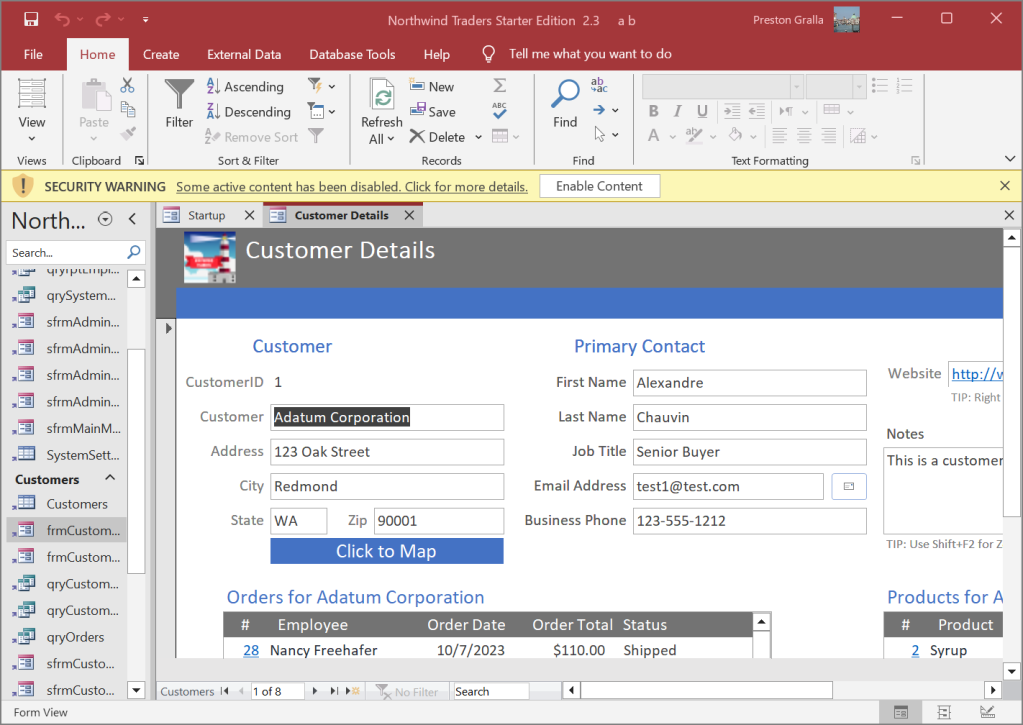
Access for Windows is among the tools included with some M365 subscriptions.
Preston Gralla / IDG
The OneNote note-taking app, available with most M365 subscriptions, is a very useful yet underutilized part of the Office suite. Enterprise-level plans also come with Microsoft Forms, an app that lets you create surveys, quizzes and polls, and Microsoft Planner, which, as its name implies, helps teams create plans, and assign tasks, share files, chat about what you’re working on, and keep track of updates. It can work by itself or integrate with Microsoft Teams.
Another application included with some Microsoft 365 enterprise plans is Power Automate (previously called Microsoft Flow), which allows businesses to automate repetitive tasks and integrate them into workflows — for example, automatically sending an alert when a new item is added to SharePoint. Microsoft Clipchamp offers video editing and design tools, and Microsoft Loop is a collaborative tool that lets you build workspaces that integrate all the parts of a project.
Other apps and services included with some plans include PowerApps, a low-code app development tool; Viva Insights, a productivity analysis tool; Sway, a tool for creating web-based presentations; To Do, a to-do list app that integrates with other M365 apps; Visio, a diagramming app; and Bookings, an appointment scheduling app.
Google Workspace has extras as well. Google Forms, which works hand-in-hand with Sheets, is particularly useful. As the name implies, it lets you create forms for a wide variety of purposes, such as an order form, a work request, a time-off request, or getting feedback about an event.
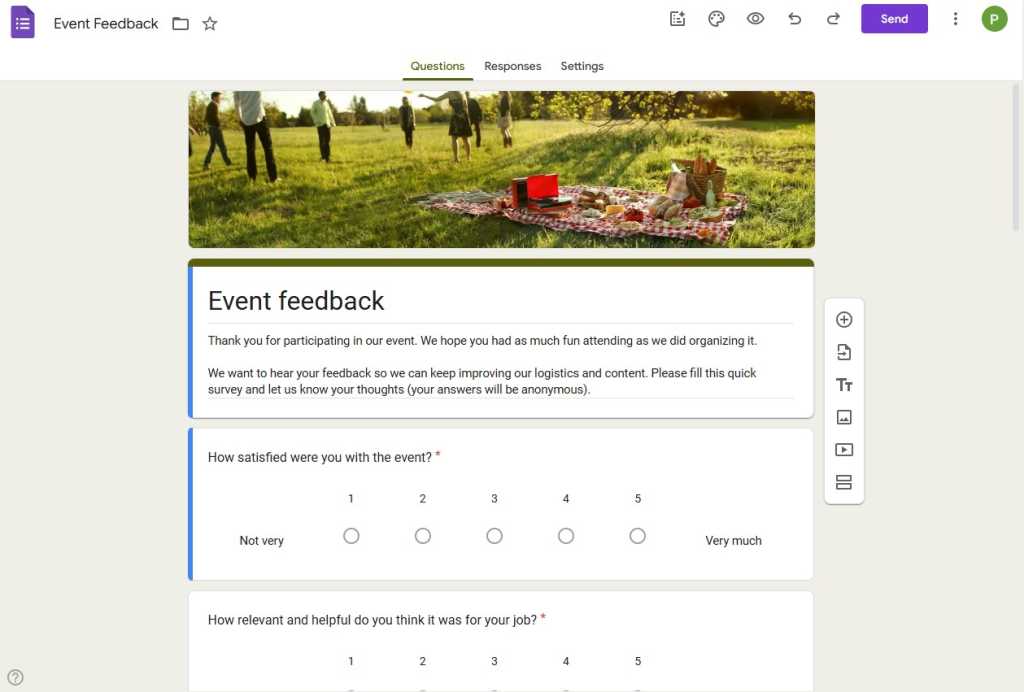
Google Forms lets you quickly and easily create customized forms to get feedback.
Preston Gralla / Foundry
Google Sites is another useful one. It lets you create team and company websites for individual projects, events, and other similar purposes. There’s also the Google Keep note-taking app, which is straightforward, bare-bones, and not nearly as sophisticated as Microsoft’s OneNote. AppSheet provides a low-code app development environment.
And if you want to create drawings, particularly diagrams, you’ll appreciate Google Drawings, which is not included with Google Workspace but works in concert with it (and is free). If you create a drawing with Drawings and embed it into a Google Doc, and then make a change in the drawing file itself, the drawing in Google Docs gets updated as well.
None of these extras offers knock-your-socks-off capabilities, aside from Microsoft’s Access and Clipchamp and Google’s AppSheet, which can allow those with limited programming experience to create truly useful applications. So they may not affect your decision on which suite is best for your business. For many companies, they’re nice-to-have tools, not must-have ones.
Choosing the productivity suite with the best features for your business is one thing, but often overlooked is how easy or difficult it is to manage the suite and protect your data. Even the best user-facing features can’t make up for poor or insufficient security and management tools.
Both suites are managed from a web interface, and in both instances, the interface leaves something to be desired, with somewhat confusing options and layouts. However, the simplified view in the Microsoft 365 admin center beats anything in Google Workspace because of how easily it lets you accomplish the most common tasks, including and editing new and existing users, changing licenses, paying bills, and installing Office on devices.
Interfaces aside, Microsoft 365 offers better admin account security, superior mobile administration, and more management controls. Both suites protect your data with enterprise-grade security and offer a central security center for managing user permissions and protections.
For an in-depth comparison, check out “Google Workspace vs. Microsoft 365: Which has better management tools?”
Google Workspace vs. Microsoft 365: Service and support
In an ideal world, nothing goes wrong with an office suite, and no one ever needs technical support. But we don’t live in that ideal world. So you’ll want to know the kind of support and updates that Google Workspace and Microsoft 365 offer.
Google Workspace offers 24/7 tech support via phone, email, and chat, but for Workspace administrators only. There’s also a searchable help center for administrators and a blog covering release information for Google Workspace updates. Also useful is the Google Workspace Community, which includes forums as well as YouTube videos to help administrators accomplish common tasks. Non-administrators will have to visit Google’s general help area, which covers many Google products such as YouTube, Google Maps, and Google Photos in addition to the individual components of Google Workspace. There’s also a Google Workspace Learning Center for user training.
Google releases Google Workspace updates multiple times a month, and publishes a schedule of all current and planned updates.
Microsoft also has 24/7 tech support via phone, an online support site, and chat for Microsoft 365 administrators. The Microsoft 365 admin center help site includes help targeted at small businesses as well as enterprises. There’s a sizable number of forums devoted to Microsoft 365. And the Microsoft Office Help & Training area has a wide variety of help, down to the application level and including troubleshooting for both consumers and admins.
As for updates, Microsoft generally releases Microsoft 365 updates one or more times a month and publishes information online about every update.
Can Microsoft 365 and Google Workspace work together?
As you’ve seen throughout this piece, Microsoft 365 and Google Workspace have their own strengths and weaknesses, so you might be tempted to use both of them — for example, Microsoft 365 for document creation and Google Workspace for collaboration.
Theoretically, it’s possible. In practice, it’s a bad idea. In part that’s because Google Workspace’s documents aren’t saved as local documents with their own file formats. Instead, they live on Google’s servers. You can save them in various file formats, including Microsoft 365’s .docx, .xlsx and .pptx, and you can import files from those and other formats as well. There’s even a way to natively edit Word, Excel, and PowerPoint files in their original formats on Google’s servers. But I’ve found that formatting and layouts are often lost in translation between Microsoft 365 and Google Workspace, embedded videos don’t work, not all comments are shown, resolved comments don’t appear, comments you make in Google aren’t brought back into Office, and so on.
In addition, the workflow is a nightmare if you’re transferring files back and forth between the two suites. The idea behind editing online is to have a single location where everyone can collaborate on the latest version of each file, but if you use both Workspace and Microsoft 365, various versions of the file may be stored in Google Drive, OneDrive for Business, or both.
But what about using one suite for content creation, collaboration, and storage and the other for communications like email, shared calendars, group chat, and videoconferencing? Again, it’s theoretically possible, but I don’t see the point. It makes everything much more difficult because of convoluted workflows, and you’d lose the integrations built into each suite. And there’s also the issue of businesses having to pay for, manage, and maintain two office suites, not one, when there are no obvious benefits to be gained by it.
As for integrating with other enterprise software such as Salesforce, Shopify, HubSpot, and others, there are plenty of tools for doing that with both suites. If any particular piece of enterprise software is particularly important to your business, you’d do well to test out the integrations with both Google Workspace and Microsoft 365 before deciding on a suite.
Who should use Google Workspace
Based on all this, what kind of company should use Google Workspace? It’s pretty straightforward: If collaborating on documents is baked into your company’s DNA — or you want to bake it in — Google Workspace is for you. Its live collaboration features far outstrip anything Microsoft 365 has to offer. They’re such an integral part of the suite’s design and so simple to use, it requires practically no time at all to get up and running with them.
Google Workspace is also a good bet if your company doesn’t need all the sophisticated features of Microsoft 365’s individual apps. Each individual application in Google Workspace is simpler to use than Microsoft 365’s, with Gmail in particular more straightforward than Outlook. And if your users do a lot of searching for documents, Google’s search capabilities for Google Drive easily outstrip what Microsoft 365 has to offer.
All of Gemini’s capabilities are included for free as part of most Google Workspace plans, while Copilot’s most powerful features require an expensive add-on subscription to Microsoft 365. So if you want a fully powered AI assistant as part of your business’s productivity suite, Google Workspace is a compelling option.
Who should use Microsoft 365
If powerful and sophisticated features are more important to you than the best in collaboration, then Microsoft 365 is for you. Every one of its applications beats out its Google Workspace equivalent. And it’s not as if you can’t do live collaboration in Microsoft 365. It’s just a bit more of a chore and not as straightforward as in Google Workspace. And Microsoft 365’s markup features are exemplary, so it’s a good bet when people need to review each other’s work.
Until recently, the biggest argument in favor of Workspace over Microsoft 365 was the former’s inclusion of Gemini tools at no additional cost. With Copilot Chat now embedded in M365 apps for free, much of that argument has been removed — although the most powerful features still require a separate M365 Copilot subscription.
There are other reasons for a business to use Microsoft 365 as well. Although Google Workspace’s shared drives are useful for sharing documents and materials, they are no match for the fully collaborative environments that SharePoint offers. If you want to manage your mail server, rather than use hosted email, you’ll also want Microsoft 365. And Microsoft Teams provides a great way for teams to share work with one another.
Hands-on help:
This story was originally published in February 2020 and most recently updated in March 2026.
