

editorially independent. We may make money when you click on links
to our partners.
Learn More
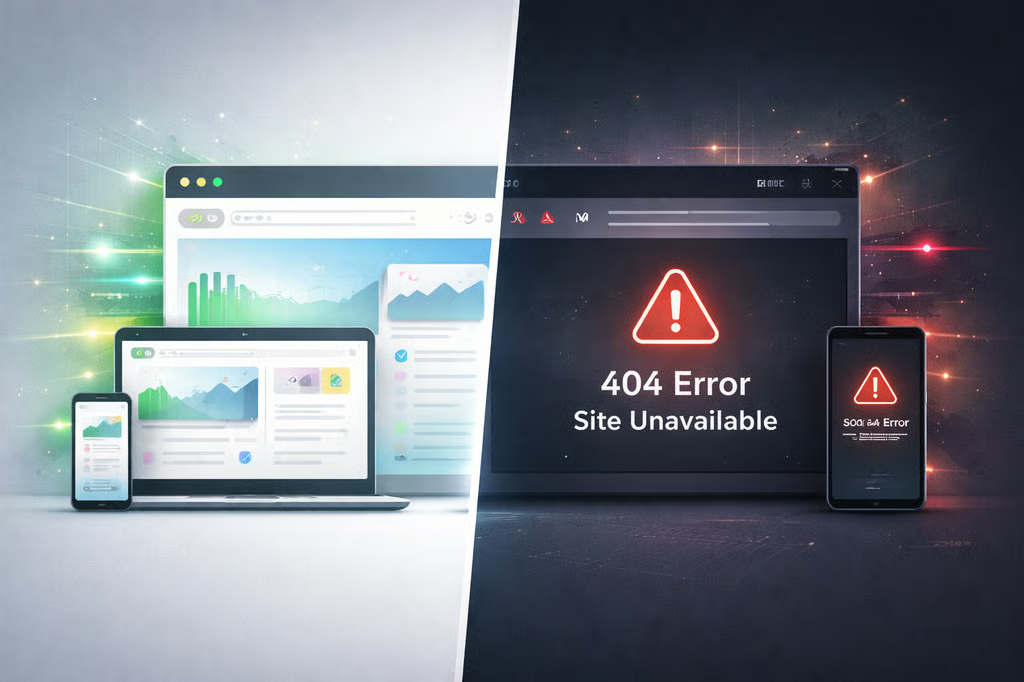
Service outages continue to occur, impacting organizations across a variety of industries and maturity levels. And these types of outages are likely to only increase in frequency and scale.
When major outages take place, the affected service providers, along with their customers and partners, can suffer from hours of downtime and thousands or even millions in financial losses due to the disruption to operations and customer services.
In fact, Global 2000 companies combine to lose $400 billion annually due to IT systems or cloud downtime and service degradation, and 44 percent of incidents are caused by application or infrastructure problems.
On top of taking a financial hit, major service outages can further damage an organization’s reputation, lower customer trust and satisfaction, and create contract or compliance risks.
While the cause behind service disruptions could be traced back to all kinds of infrastructure flaws or even security incidents, the takeaway remains the same.
Organizations need a thorough backup plan in the event their core means for operating either malfunction or become inaccessible.
I’d argue though, that compared to other valid investments in disaster response and team preparedness, many companies are not thoroughly equipped for when their domain name system (DNS) – and the online services it supports – are inevitably impacted by a service outage.
This can lead to unreachable websites, email issues, slow internet or application failures — all contributing to the costly side effects described above.
Applying “Plan B” Thinking to DNS
Companies are always thinking in terms of “Plan B” continuity. They conjure up a list of potential disasters and respond accordingly.
And if you take a look at any IT department, it may resemble Noah’s Ark, with two of everything from backup servers to data centers in the event the main one goes down.
But, if you ask organizational leaders about their Plan B for their DNS, they’ll just shrug and say, “We’ll switch providers.”
However, that could take 24 to 72 hours. This is an unacceptable length of time to shut down the store or halt business-critical emails.
It’s a recipe for catastrophe on multiple levels and likely out of policy for key metrics such as Recovery Time Objective (RTO).
DNS Outages Aren’t Hypothetical Anymore
That’s why planning to have dual infrastructure in place, with multiple providers and DNS redundancy, proves so significant.
The recent swath of web outages demonstrates that even “household name” providers — behind everything from daily shopping to usage of digital office tools — are not immune to operational and security incidents that impact DNS.
Whether an incident relates to human error, bad configuration or malicious actors, organizations should take the initiative to plan ahead for similar incidents impacting their own services.
To kickstart the planning process, companies should call for leadership teams — including the chief risk officer (CRO), the chief information officer (CIO) and the chief information security officer (CISO) — to focus on DNS resiliency.
In Europe, the Network and Information Security Directive (NIS2) addresses the need for practices such as DNS redundancy. As a collective whole, U.S. organizations should follow this example.
At the same time, they need to work with providers who view themselves as similarly minded business partners when it comes to safeguarding operational and security continuity, which includes vigilant security policies and practices.
These practices should involve the use of authoritative DNS, which serves as a dependable “source of truth” on the internet, delivering swift and definitive query answers about specific domain names.
Through enterprise authoritative DNS, companies benefit from increased speed, performance, uptime, and security.
Redundancy Is No Longer Optional
Major service outages are not going away anytime soon, and DNS flaws will continue to add to the fallout. As a result, redundancy has emerged as an indispensable component of an IT resiliency plan.
When we drive in a car from point A to point B, we must consider alternative routes in case heavy traffic or even road closures stop us from using our main route.
This is no different than extending the “Noah’s Ark” mindset that applies to virtually everything else in IT to cloud infrastructure and DNS.
By building in true alternatives to your primary cloud or DNS provider, you’re not just creating a fallback — you’re ensuring your business can keep moving even when the main road suddenly disappears.
