

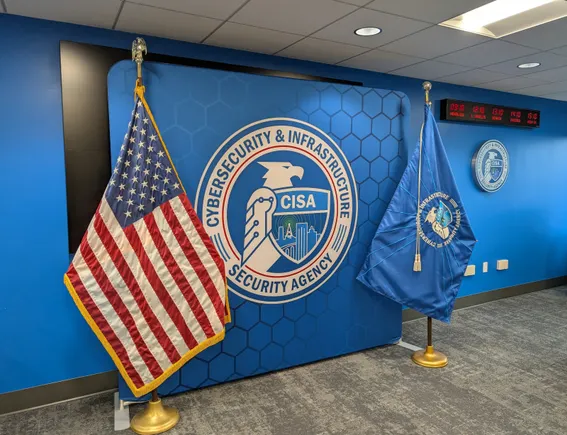
President Donald Trump on Friday proposed significantly slashing the Cybersecurity and Infrastructure Security Agency’s budget.
The White House’s fiscal year 2027 budget would reduce CISA’s funding by $707 million, roughly 30% of its FY2025 budget of $2.4 billion.
The administration said its proposal “refocuses CISA on its core mission” of protecting federal networks and helping critical infrastructure operators defend themselves from cyberattacks and physical threats.
But the White House also repeated its criticism of CISA’s work with tech companies to stop the spread of misinformation in 2020, at the end of the first Trump administration, which it described as weaponizing the powers of government to stifle Americans’ online speech.
“CISA was more focused on censorship than on protecting the Nation’s critical systems, and put them at risk due to poor management and inefficiency, as well as a focus on self-promotion,” the budget document said.
The proposed budget cut, which is likely to face strong opposition from congressional Democrats, represents the latest blow to CISA under the second Trump administration. The agency has already lost one-third of its workforce, including many key employees, as well as the trust of partners in industry and state and local government.
The Department of Homeland Security has not released a detailed budget proposal for CISA and other DHS agencies, so the specifics of the administration’s planned cuts to the cyber agency remain unclear. But the White House’s budget overview offers a few clues.
Slashing partnerships
The White House is proposing to codify its October layoffs of virtually all employees in CISA’s Stakeholder Engagement Division (SED), including personnel focused on liaising with critical infrastructure operators, foreign governments and U.S. universities.
Under the administration’s plan, only one of SED’s four subdivisions — the one that handles CISA’s responsibilities as the Sector Risk Management Agency for eight of the 16 infrastructure sectors — would remain, although it would move to another division so that SED could be eliminated.
CISA has rehired the SED employees it laid off in October after a federal judge ruled in December that those layoffs, which occurred during a government shutdown, were invalid.
In its budget proposal, the White House said that the “external engagement offices” in which those employees worked “were used as a key hub in the Censorship Industrial Complex to violate the First Amendment, target Americans for their protected speech, and target the President.”
Rep. Bennie Thompson, D-Miss., the ranking member on the House Homeland Security Committee, dismissed the Trump administration’s argument that CISA was overly focused on online speech, noting that CISA spent only $2 million on that work in fiscal year 2023.
“There is nothing that justifies a reckless $700 million cut to CISA, particularly at a time of heightened tensions with Iran and an increasingly aggressive China,” Thompson said in a statement.
He added that the budget reflected Trump’s “utter lack of understanding of the urgency of the cyber threats we face and how to mobilize the government to help confront them.”
Pushing off more work to states
The budget also described one other purpose of the CISA cuts: to continue the Trump administration’s transfer of critical infrastructure protection responsibilities to state and local governments.
“The Budget removes offices that are duplicative of existing and effective programs at the State and Federal level, such as certain targeted school safety programs,” the document said.
While it is best known for its cybersecurity work, CISA also runs the federal government’s school-safety program as part of its infrastructure security division.
The Trump administration’s attempt to divest the government of infrastructure security responsibilities has baffled, alarmed and outraged many state and local leaders and cybersecurity experts, who say only the federal government has the resources and expertise to effectively perform that work.
Despite these criticisms, the White House has continued to reduce the amount of cybersecurity support it provides to local leaders. In October, the federal government stopped subsidizing the state and local community’s information sharing and analysis center, which forced many members to exit the group because they couldn’t afford its fees.
