

editorially independent. We may make money when you click on links
to our partners.
Learn More
Trend Micro has released patches for two high-severity vulnerabilities in its Apex One endpoint security platform.
The flaws impact the Apex One management console and could allow remote code execution on unpatched systems.
One of the vulnerabilities, CVE-2025-71210, “… could allow a remote attacker to upload malicious code and execute commands on affected installations,” said Trend Micro in its advisory.
Inside the Apex One CVEs
Apex One is deployed in enterprise environments to detect and respond to malware, malicious tools, and other advanced threats across endpoints.
Because it has broad visibility and control across endpoints, vulnerabilities in the platform can pose elevated risk.
If exploited, the flaws could let attackers bypass protections, move laterally, and deploy additional payloads without immediate detection.
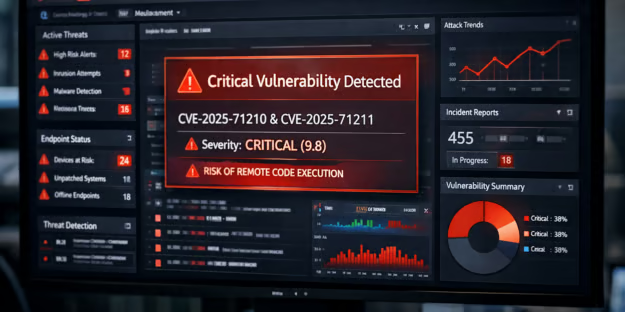
The most serious vulnerabilities, CVE-2025-71210 and CVE-2025-71211, each carry a CVSS v3 score of 9.8, indicating critical severity.
CVE-2025-71210
CVE-2025-71210 is caused by a directory traversal weakness in the Apex One management console.
The flaw stems from improper limitation of a pathname to a restricted directory. An unauthenticated remote attacker could exploit the vulnerability to upload malicious files and execute arbitrary commands on vulnerable installations.
Because the issue does not require prior authentication or user interaction, environments with exposed or insufficiently restricted management consoles may face greater risk.
CVE-2025-71211
CVE-2025-71211 is similar in nature but affects a different executable within the management console.
Like CVE-2025-71210, it involves improper path validation that could allow an attacker to write files outside intended directories and trigger remote code execution.
Although the vulnerabilities are distinct, both create opportunities for attackers to gain control of the management infrastructure if left unpatched.
Additional Vulnerabilities
In addition to the remote code execution flaws, Trend Micro also addressed two local privilege escalation vulnerabilities affecting Apex One agents.
CVE-2025-71212 is a link-following vulnerability in the scan engine.
This type of flaw occurs when software improperly handles symbolic links, potentially allowing an attacker to redirect file operations to unintended locations and escalate privileges.
CVE-2025-71213 stems from an origin validation error in the platform.
Origin validation issues arise when a system fails to properly verify the source of a request, which can allow a local attacker to bypass trust boundaries and perform actions with elevated privileges.
Each carries a CVSS score of 7.8 and requires an attacker to first obtain low-privileged access to the target system.
While these flaws cannot be exploited remotely without initial access, they could be leveraged in multi-stage attacks to escalate privileges and deepen persistence after compromise.
Trend Micro has released patches for all of the vulnerabilities and is not aware of any exploitation in the wild at the time of publication.
Mitigation Steps for Apex One Flaws
Organizations should take a layered approach to addressing these vulnerabilities.
Strengthening access controls, hardening underlying systems, and enhancing monitoring capabilities can help reduce overall risk and improve detection of suspicious activity.
- Apply the latest patches for on-premises systems and confirm SaaS deployments are fully updated.
- Restrict management console access to trusted IP ranges, eliminate public internet exposure where possible, and place the console behind a VPN, ZTNA solution, or web application firewall.
- Enforce MFA, strong password policies, session controls, and least privilege access for all administrative and service accounts.
- Harden the underlying server by disabling unnecessary services, applying operating system patches, restricting file system permissions, and enabling application allowlisting.
- Monitor logs, EDR, and file integrity controls for signs of directory traversal attempts, unauthorized file uploads, unusual process execution, or privilege escalation activity.
- Rotate administrative credentials, service accounts, and API keys if compromise is suspected, and validate that secure, offline backups are current and restorable.
- Test incident response plans and build playbooks around potential management console compromise.
Together, these measures can help limit the blast radius of a potential compromise while strengthening overall resilience.
Management Infrastructure Security Matters
While Trend Micro has not reported active exploitation, the severity of these vulnerabilities reinforces the need for layered controls around management infrastructure.
These vulnerabilities serve as a reminder that endpoint security platforms are high-value assets within the enterprise stack, and weaknesses in these systems should be prioritized within risk management and remediation strategies.
They also highlight why organizations are investing in zero trust solutions to reduce implicit trust across their environments.
