


This guide is for compliance leaders, risk managers, and IT teams seeking the best governance, risk, and compliance (GRC) tools in 2026, covering top platforms, key features, and selection considerations.
These tools simplify the complexity of governance by equipping your team with the resources needed to manage evolving regulations, reduce risk, and control costs more effectively. In this article, we’ll explore the top GRC tools for 2026, highlighting their strengths, potential drawbacks, and pricing insights to help you choose the right solution for your organization.
Top Governance, Risk & Compliance (GRC) Tools Comparison
This table compares leading GRC tools in 2026, including their features, ease of use, and cost. As pricing can vary greatly between solutions, we offer in-depth reviews below this chart to help you choose the tool with the features and compatibility you need.
Choosing the right Governance, Risk, and Compliance (GRC) tool is crucial for ensuring your business remains compliant with regulations while effectively managing risk. With a wide range of GRC software available, selecting one that aligns with your unique business requirements is essential. Here’s a guide to help you make the best choice.
Assess Your Compliance Requirements
Start by identifying the regulations that apply to your business, such as GDPR, PCI-DSS, or SOX. Understanding your compliance obligations will help you choose a GRC tool tailored to these standards.
Evaluate Risk Management Capabilities
Ensure the GRC software has robust risk assessment features. Look for tools that can proactively identify, assess, and mitigate risks across your organization, providing real-time monitoring and alerts.
Scalability & Flexibility
Choose a GRC solution that can grow with your business. Whether you’re expanding into new markets or increasing your regulatory scope, the tool should be flexible and scalable enough to accommodate evolving needs.
Integration with Existing Systems
Select GRC software that integrates seamlessly with your IT infrastructure, including ERP, CRM, and other management systems. Integration ensures smoother operations and enhanced efficiency.
User-Friendly Interface
A user-friendly platform is essential for widespread adoption across your team. Opt for a tool that simplifies governance, risk management, and compliance processes with intuitive dashboards and easy navigation.
Focusing on these key areas can help you find a GRC tool that supports your business needs and enhances your compliance strategy.
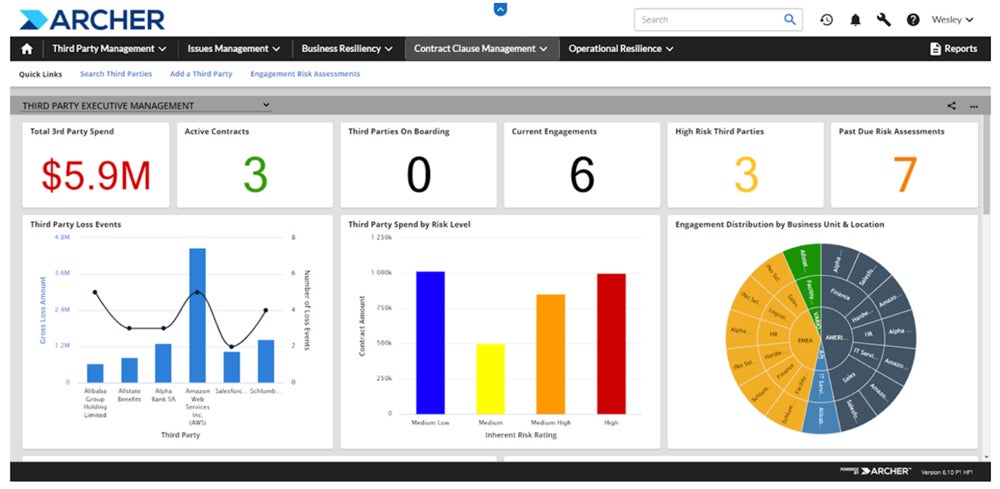
RSA Archer is a leading governance, risk, and compliance (GRC) platform designed to help organizations effectively manage risk, ensure regulatory compliance, and protect their assets. With its modular and customizable structure, RSA Archer is ideal for organizations across various industries looking to integrate risk management processes into their operational workflow.
It is widely used for automating risk assessments, incident tracking, audit management, and policy enforcement, providing users with real-time visibility into their risk profile.
Pros
Cons
Archer does not list pricing on its website, but pricing per risk area typically starts around $30,000 to $50,000.
- IT & security risk management
- Enterprise & operational risk management
- Regulatory & corporate compliance
- Audit management
- Business resiliency
- Public sector solutions
- Third-party governance
- ESG management
- Operational resilience
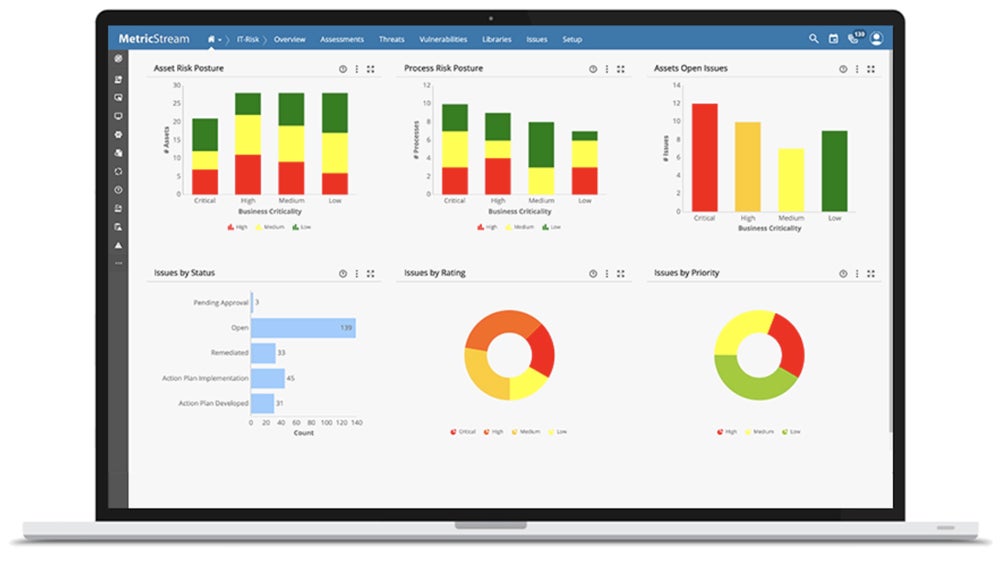
MetricStream’s platform is ideal for organizations with diverse user needs, offering tailored solutions for auditors, IT managers, and business executives alike. It excels in delivering a comprehensive GRC experience that meets the specific demands of different organizational roles.
At the core of MetricStream’s GRC platform are three critical dimensions of risk management: risk categories (financial, cyber, human health, and environmental), stakeholder engagement, and organizational agility. This framework allows organizations to prioritize and address the most pressing risks in real time, ensuring a focused, adaptive approach to managing risk in an ever-evolving landscape.
Pros
Cons
MetricStream does not publish pricing information for its solutions. However, the AWS marketplace quotes MetricStream CyberGRC Prime for IT risk assessments, reporting, scoring, and centralized management at $180,000 for 36 months. Prospective buyers should contact MetricStream directly to request pricing information and schedule a platform demo before making a purchase decision.
- Enterprise & operational risk management
- Business continuity management
- Policy & compliance management
- Regulatory engagement & change management
- Case & survey management
- Internal audit management
- IT threat & vulnerability management
- Third-party management
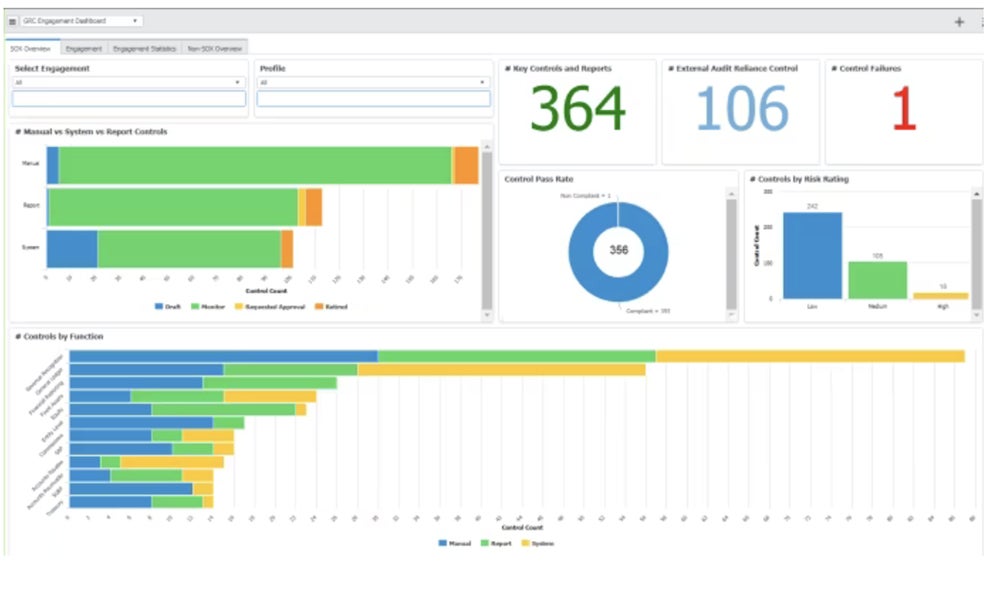
ServiceNow lives up to its name by delivering real-time insights through advanced monitoring, automation, and analytics tools. It proactively identifies risks, enabling organizations to respond swiftly and efficiently to emerging threats.
ServiceNow GRC stands out for its ability to simplify workflow management and facilitate seamless collaboration across internal and external teams. In addition, it often doubles as an effective project management tool, streamlining processes and improving overall efficiency. While its reporting capabilities could benefit from enhanced data visualization features, ServiceNow remains a formidable player in the GRC market, offering a robust and dynamic solution for risk management.
Pros
Cons
Pricing for ServiceNow GRC is available on request. ServiceNow partner pricing can start at about $3,000 monthly, while base licensing can start at around $50,000.
- Policy & compliance management
- Risk management
- Business continuity management
- Vendor risk management
- Operational risk management & resilience
- Continuous authorization & monitoring
- Regulatory change
- Audit management
- Performance analytics
- Predictive intelligence
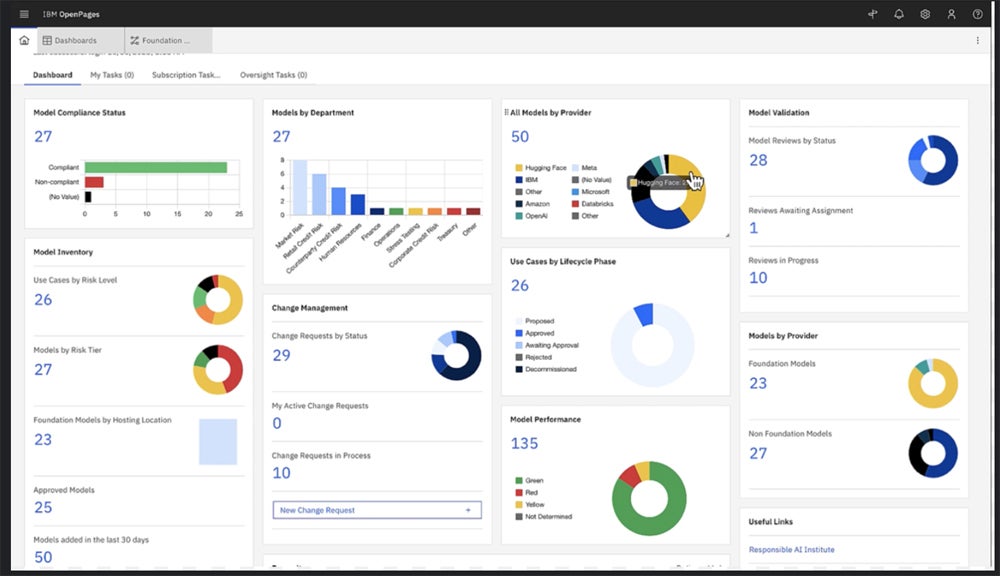
IBM OpenPages is an enterprise-level Governance, Risk, and Compliance (GRC) platform renowned for integrating AI-powered insights. Leveraging IBM’s Watson AI technology, OpenPages provides predictive analytics and automation to help organizations proactively manage risk, ensure regulatory compliance, and streamline governance processes.
It’s best suited for large enterprises across finance, healthcare, and manufacturing industries that must handle vast amounts of data while anticipating and mitigating risks through intelligent insights.
Pros
Cons
IBM OpenPages operates on a custom pricing model, typically ranging from $9,000 to $200,000+ annually based on the size and complexity of the organization, the number of users, and the level of customization required.
- AI-Powered Risk Insights
- Compliance Management
- Risk Management
- Policy Management
- Audit Management
- Vendor Risk Management
- Incident Management
- Dashboard and Reporting
- Regulatory Change Management
- Scalability and Customization
Hyperproof is a cloud-based Governance, Risk, and Compliance (GRC) platform designed to streamline compliance management and automate real-time tracking of regulatory requirements. It helps organizations manage multiple compliance frameworks simultaneously, simplifying the audit process and providing clear visibility into compliance status.
Ideal for industries like tech, finance, and healthcare, Hyperproof offers an intuitive platform to monitor and ensure continuous adherence to complex regulatory standards.
Pros
Cons
Hyperproof’s pricing is based on company size. For a company with 200 employees, the cost ranges from $16,300 to $32,200 annually. For larger organizations with 1,000 employees, the price increases to between $23,600 and $49,300 annually.
- Real-time Compliance Monitoring
- Audit Trail Automation
- Framework Mapping
- Task Management
- Risk Register
- Document Management
- Collaboration Tools
- Compliance Reporting
- Control Automation
- Third-Party Integrations
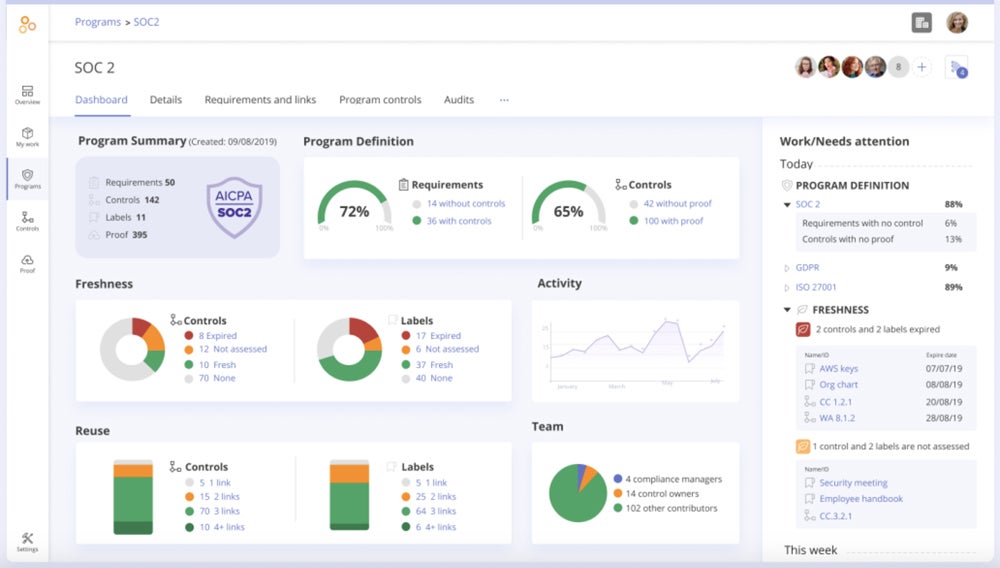
Riskonnect’s GRC platform is tailored for risk management, information security, compliance, and auditing professionals across healthcare, retail, insurance, financial services, and manufacturing industries. It unifies governance, management, and reporting of performance, risk, and compliance processes across the entire organization.
With built-in strategic analytics through Riskonnect Insights, the platform provides actionable intelligence by identifying, alerting, and visualizing key risks for senior leadership. Additionally, Riskonnect offers seamless integration with Salesforce CRM, enhancing workflow efficiency and data connectivity.
Pros
Cons
Riskconnect doesn’t list prices on its website, but the ESG Governance solution is available to Salesforce users for $25 per user per month. The Riskonnect website also includes an ROI study that may benefit potential customers.
- Risk management information system
- Claims administration
- Internal auditing
- Third-party risk management
- Enterprise risk management
- Compliance management
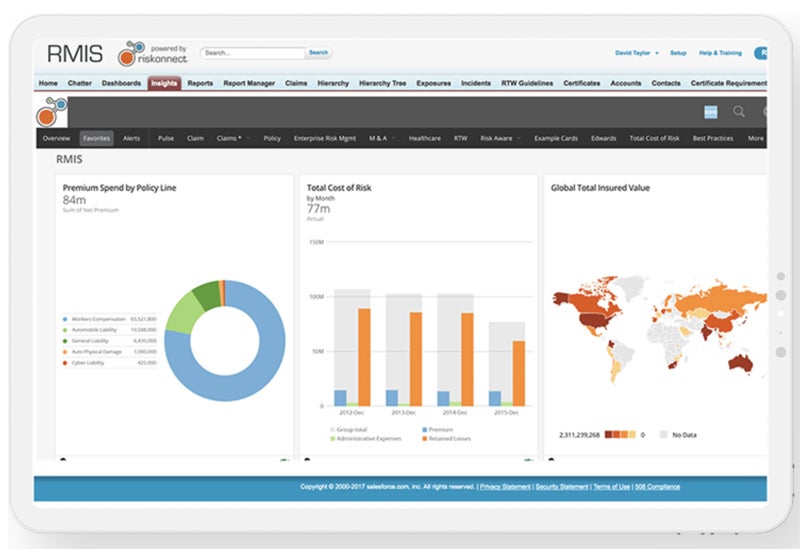
LogicManager’s GRC solution serves various industries, including financial services, education, government, healthcare, retail, and technology. It accelerates key processes such as data aggregation, report generation, and file management, enabling organizations to efficiently analyze and act on critical risk and compliance information, similar to other top-tier GRC platforms.
Pros
Cons
LogicManager’s pricing is based on an organization’s size and complexity, but it can start at as low as $10,000 a year.
- Enterprise risk management
- IT governance and security
- Compliance management
- Third-party risk management
- Audit management
- Incident management
- Policy management
- Business continuity planning
- Financial reporting compliance
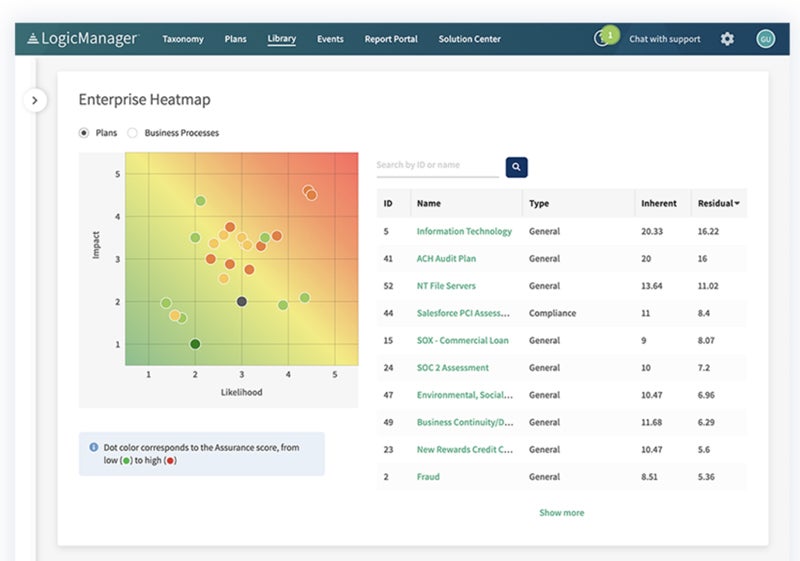
SAI360 from SAI Global provides three distinct editions of its platform, catering to a wide range of needs — from small businesses requiring essential functionalities to large enterprises seeking extensive customization.
The platform effectively catalogs, monitors, updates, and manages an organization’s operational GRC requirements. It prioritizes oversight of third parties with access to your systems, automates workflows to address potential gaps, and fosters a culture of compliance best practices within your internal teams.
Pros
Cons
SAI360 does not provide pricing, and we could find no secondary sources.
- Compliance education & management
- IT risk & cybersecurity management
- Environment, health, and safety (EHS) management
- Enterprise & operational risk management
- Audit management
- Business continuity management
- Regulatory change management
- Internal control
- Vendor risk management
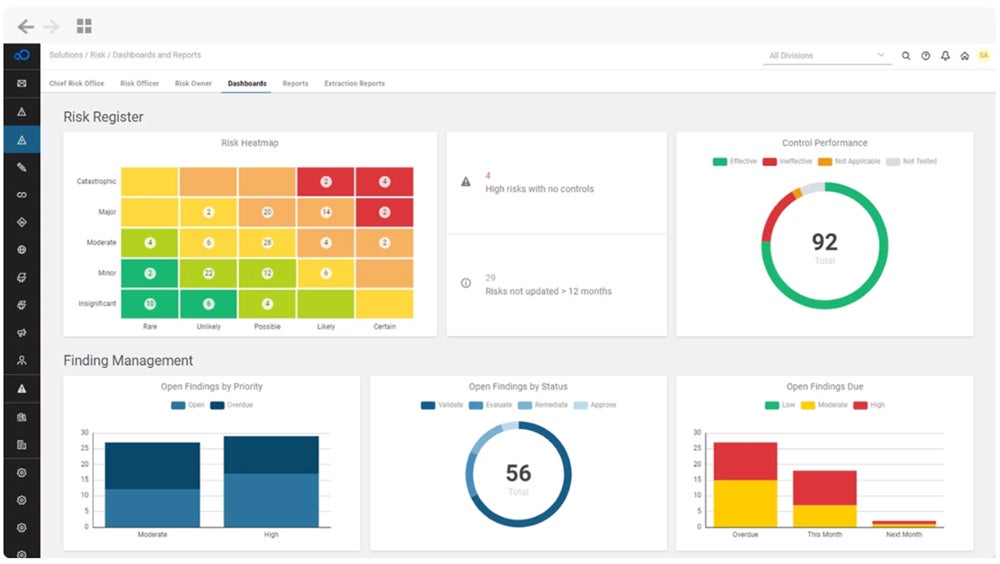
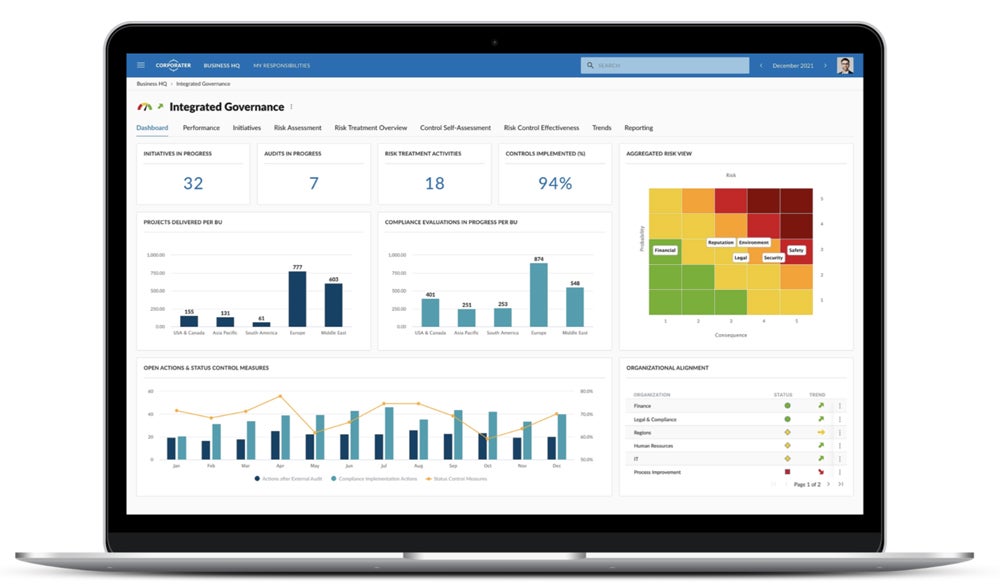
Corporater is a comprehensive business performance management platform that integrates and aligns various performance metrics across an organization. It empowers organizations to visualize, monitor, and analyze their performance data, making it ideal for strategic planning, decision-making, and achieving business objectives.
Corporater is particularly beneficial for organizations seeking to enhance their governance, risk, and compliance (GRC) processes while driving overall business performance.
Pros
Cons
No pricing information is given on the company’s official website.
- Integrated Performance Management
- Customizable Dashboards
- Strategic Alignment
- Advanced Reporting
- Risk Management
- Data Visualization
- Goal Tracking
- Collaboration Tools
- Compliance Management
- Automated Workflows
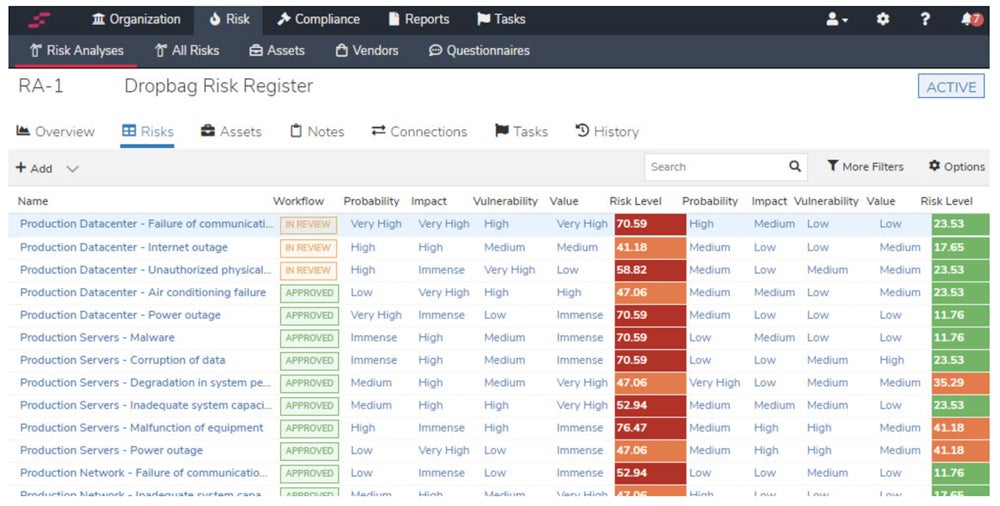
StandardFusion provides a comprehensive suite of GRC features suitable for small and large businesses. Its user-friendly interface and straightforward deployment make it an excellent choice for SMBs, while its advanced functionalities cater to the more complex needs of larger organizations.
The platform simplifies compliance with various regulations, including GDPR, HIPAA, NIST, CCPA, and more. One of StandardFusion’s standout features is its transparent pricing structure, ensuring users are not caught off guard by hidden fees or unexpected costs. Customer reviews consistently highlight the platform’s above-average ratings for ease of use, deployment, and customer support, reflecting its strong reputation in the GRC market.
Pros
Cons
StandardFusion offers four pricing plans
- Trial: A 14-day free trial is available
- Starter: $1,500 per month, onboarding fee: $7,500
- Professional: $2,500 per month, onboarding fee: $10,000
- Enterprise: $4,500 per month, onboarding fee: $20,000
- Enterprise+: $8,000 per month, onboarding: Dedicated implementation
- IT and operational risk management
- Vendor and third-party risk management
- Compliance and audit management
- Policy management
- Incident management
Key Features of GRC Solutions in 2026
Most of the vendors listed above have been recognized in the Gartner Magic Quadrant for IT risk management and Forrester’s GRC Wave. What helps these platforms gain recognition? According to Forrester, a GRC solution should have the breadth and depth to support a wide range of GRC use cases, capabilities to align GRC efforts across multiple business functions, and advanced risk analysis.
Most GRC programs employ some combination of features in the following areas to accomplish these goals:
- Risk and control management
- Document management
- Policy management
- Audit management
- IT risk management
- Third-party risk management
- Risk scoring
- Workflow
- Dashboards and reports
- Preconfigured and custom integration
- End-user experience
How I Evaluated the Best Email Security Software
Intro blurb. See a good Selling Signals example here. The percentages represent the weight of the total score for each product.
Evaluation Criteria
I prioritized the core features of each email security solution according to the following:
- Core features (25%): We focused on the most important security elements for email protection, like spam filtering, virus detection, phishing protection, email encryption, data loss prevention, MFA/sender verification, and content screening. The availability and comprehensiveness of these characteristics were critical in our evaluation.
- Pricing and transparency (20%): I evaluated each solution’s total value, considering the cost of competitors and the features provided. We looked at the clarity and accessibility of price information on provider websites and the availability of free trials for hands-on testing. We also looked into other charges, such as core features offered as add-ons and the structure of maintenance plans.
- Advanced features (15%): These are the non-core elements that improve each solution’s overall security and usefulness, and were carefully considered. These included SIEM/SOAR/XDR integration, real-time threat intelligence, compliance features, and the availability of reporting and analytics tools.
- Ease of use and implementation (15%): I examined how simple and easy each solution was to deploy and manage, understanding that simplicity of use is critical for acceptance by users. This area included automation capabilities, the depth of the accessible knowledge base/resources, the amount of technical competence necessary for setup, policy management choices, and the admin interface’s usability.
- Customer support (15%): I assessed the quality and availability of customer service, emphasizing its relevance in resolving issues and providing assistance quickly. This includes assessing the availability of 24/7 options, live chat and email help, and the comprehensiveness of documentation, demos, and training materials.
- Vendor compliance (10%): Category includes
Frequently Asked Questions (FAQs)
Which Industries Typically Need GRC Tools?
While industries like finance, healthcare, and manufacturing are traditionally associated with strict risk and compliance requirements, nearly every industry today benefits from GRC tools. Modern regulations and cybersecurity risks impact organizations across sectors—from retail managing PCI DSS requirements to global businesses navigating GDPR, CCPA/CPRA, and other regional data privacy laws.
Even smaller organizations face growing pressure from third-party risk, customer data protection expectations, and cyber threats. While highly regulated enterprises often require robust GRC platforms, mid-sized and growing businesses are increasingly adopting GRC tools to scale compliance efforts, centralize risk visibility, and prepare for audits.
What Is a GRC Software?
Governance, risk, and compliance (GRC) software helps organizations centralize and streamline the management of policies, risks, controls, and regulatory requirements. These platforms provide visibility into compliance posture while automating workflows like risk assessments, audit tracking, and policy enforcement.
As regulatory environments grow more complex—with frameworks like GDPR, HIPAA, SOC 2, ISO 27001, and evolving U.S. privacy laws — GRC tools simplify adherence by reducing manual processes and improving accuracy. Many modern GRC solutions also integrate with security tools to provide real-time risk insights and continuous monitoring.
What Is the Purpose of GRC?
The purpose of GRC is to ensure that an organization operates securely, efficiently, and in alignment with regulatory requirements and business goals. It brings together three core functions:
- Governance ensures leadership has visibility into operations, policies, and performance so decisions align with strategic objectives.
- Risk management identifies, assesses, and mitigates threats — such as cyberattacks, vendor risks, or operational disruptions.
- Compliance ensures the organization meets legal, regulatory, and industry standards for handling data and conducting business.
For example, a retail company handling customer data must secure that data (compliance), monitor systems for threats like phishing or breaches (risk management), and ensure internal policies and performance goals are consistently met (governance).
Together, these functions help organizations reduce risk, maintain trust, improve decision-making, and support long-term growth.
Bottom Line: Invest in a GRC Platform That Grows with You
GRC is more than just software — it’s a strategic approach that helps organizations make informed decisions, manage risk proactively, and maintain compliance in an increasingly complex regulatory landscape. When implemented effectively, it connects teams, standardizes processes, and improves visibility across the business.
Organizations of all sizes can benefit from adopting a GRC approach. As regulatory requirements expand and cyber risks evolve, having the right platform in place helps you stay compliant, strengthen security, and operate more efficiently. Investing in a GRC solution that can grow with your organization ensures you’re prepared not just for today’s challenges, but for future risks and opportunities as well.
