

A $170 million order, 750 servers, 600 restricted Nvidia chips, and a Thailand-based front company that a U.S. hardware manufacturer spotted as suspicious within weeks — that is the scheme federal prosecutors say three men used to try to route some of America’s most tightly controlled artificial intelligence technology (AI tech) to China in violation of U.S. export law.
The Justice Department on Wednesday, charged Stanley Yi Zheng, 56, of Hong Kong, Matthew Kelly, 49, of Hopewell Junction, New York, and Tommy Shad English, 53, of Atlanta, Georgia, with conspiring to commit smuggling and export control violations. The three defendants are alleged to have sought millions of dollars’ worth of export-controlled computer chips from a California-based computer hardware company for illegal shipment to China through Thailand.
Zheng was arrested on March 22, while Kelly and English surrendered to federal authorities on March 25.
The criminal complaint references the trio attempting to smuggle hundreds of Nvidia A100 and H100 chips — advanced graphics processing units, or GPUs, that power large-scale AI model training and inference. The scheme targeted a hardware and services company based in San Jose, with a purchase order for server units running Supermicro hardware designed to support Nvidia H100 and H200 GPUs, totaling nearly $62 million for one tranche alone.
Nvidia’s H100 and A100 chips are subject to U.S. Commerce Department export controls because of their direct application to military AI, autonomous weapons systems, and the development of advanced large language models — the class of technology that underpins modern AI systems like those powering China’s rapidly developing military AI programs.
Also read: India Seeks Larger Role in Global AI and Deep Tech Development
According to the criminal complaints, the conspiracy began in May 2023, when Zheng, Kelly, and English started working together to obtain computer servers from the California manufacturer and ship them to Thailand with an ultimate destination of China. They used the names of Thailand-based companies as purported purchasers of the servers when their actual intent was to divert the U.S.-origin AI chips to China.

In October 2023, English, purporting to act on behalf of a Thailand-based company, ordered 750 computer servers for approximately $170 million from the manufacturer. Of the 750 servers ordered, 600 contained a chip controlled on the U.S. Commerce Control List and required a license for export to China.
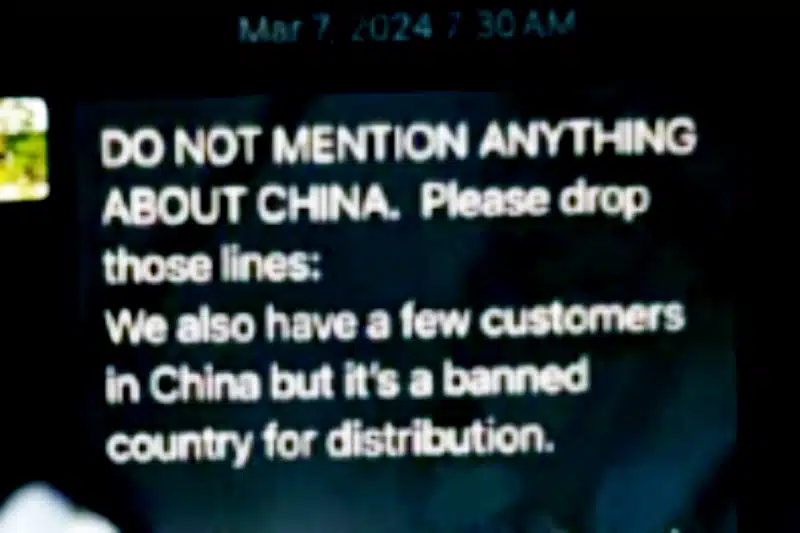
The scheme began unraveling in January 2024, when discussing via email an upcoming compliance review of the October 2023 order, English asked the manufacturer to add Zheng and Kelly to the email thread. This prompted a response from the company noting that Zheng’s company was based in China and that it was “odd” that no one from the Thailand-based company was among those copied. The company also commented that China is an embargoed country restricted by the U.S. government and that U.S. companies are restricted from selling to businesses or end users headquartered in China.
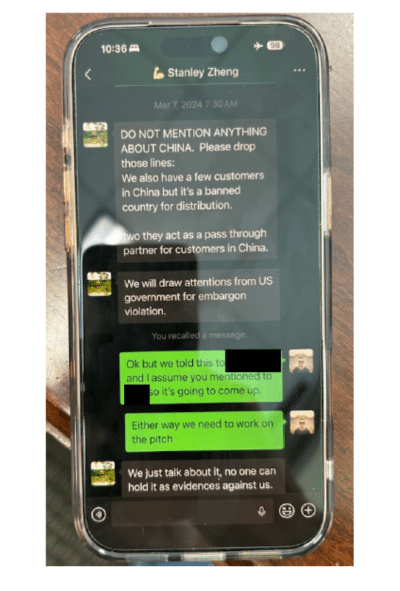
A tipster subsequently notified federal investigators about the scheme in January 2024. In February 2026, federal agents seized the phone and laptop of U.S. suspect Matthew Kelly when he returned to the U.S. from Italy, giving investigators access to WhatsApp messages between the three suspects.
Employees from Nvidia and Supermicro also noticed irregularities in the order requests and canceled them early in 2024.
The use of Thailand as a transshipment node — a third-country routing point designed to obscure the final destination — is a well-documented circumvention technique that has surged since the Biden administration expanded export controls on advanced chips in October 2022 and October 2023.
Prosecutors allege the AI chips the accused attempted to smuggle have military and strategic applications, making their unauthorized transfer a violation of U.S. export control laws. The A100 and H100 in particular can train AI models at the scale required for advanced weapons targeting, signals intelligence analysis, and autonomous systems — capabilities the U.S. government has explicitly sought to deny China’s military through export restrictions.
The two countries are competing for global AI dominance, with a U.S. advisory body warning this week that China’s lead in open-source AI could threaten America’s top position globally in the field. The charges arrive as the DOJ has significantly expanded its enforcement posture on semiconductor export controls — a recognition that chip smuggling represents one of the most direct pathways for adversaries to close the AI capability gap that export restrictions are designed to maintain.
The case is being investigated by the Department of Commerce’s Bureau of Industry and Security, the Defense Criminal Investigative Service, and Homeland Security Investigations. Each defendant faces charges of conspiracy to commit smuggling and conspiracy to violate the Export Control Reform Act — carrying combined potential sentences of over 20 years.
