

As enterprise adoption of artificial intelligence accelerates, a new report warns that organizations may be far less prepared to manage AI risk than they believe.
The State of AI Risk Management 2026 report from the Purple Book Community highlights a widening disconnect between perceived control and operational reality, exposing critical gaps in how companies govern AI systems at scale.
“These findings show that the real challenge is not AI adoption itself, but the governance required to manage it responsibly at enterprise scale,” said Karthik Swarnam, Chief Security and Trust Officer at ArmorCode and Purple Book Community member in the press release.
He added, “Across the industry, visibility into AI is improving, but the volume and speed of change are outpacing how teams actually operate. Signals are coming from everywhere, and without clear ownership and action, things slip through.”
The AI Visibility Paradox
The report, based on a survey of more than 650 senior cybersecurity leaders, reveals a striking disconnect between perception and reality in AI risk management.
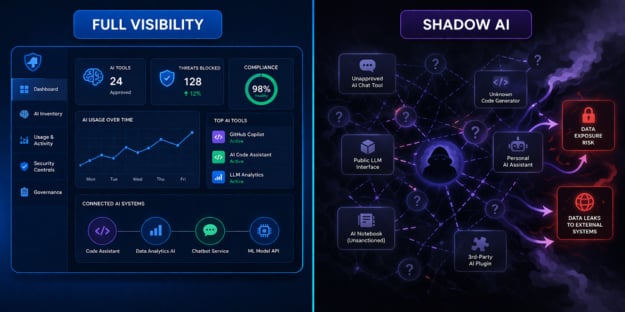
While 90% of organizations believe they have visibility into their AI environments, 59% simultaneously acknowledge the presence of shadow AI.
This contradiction highlights a deeper operational issue: organizations are not blind to AI adoption, but they lack the ability to govern it effectively at scale and speed.
AI Is Now Core Infrastructure — And Risk Is Rising
This gap becomes more concerning as AI moves from experimentation to core business infrastructure.
AI is now embedded across development pipelines, workflows, and autonomous systems, so governance failures can directly lead to data exposure, compliance issues, and production vulnerabilities.
As AI systems take on more decision-making and execution responsibilities, the consequences of weak oversight grow significantly.
Adoption Is Outpacing Security
The pace of adoption is a key driver of this challenge.
According to the report, 66% of organizations now use AI extensively in software development, while 78% are deploying or piloting agentic AI systems capable of taking autonomous actions without constant human input.
This rapid expansion is fundamentally outpacing the ability of security teams, governance frameworks, and traditional tooling to keep up.
In many cases, organizations are building governance processes designed for pilot-scale deployments, not enterprise-wide adoption.
The Shadow AI and Inventory Gap
As a result, several interconnected risk areas are emerging.
Shadow AI remains one of the most significant, but it is closely tied to the broader issue of incomplete visibility.
While 86% of organizations claim to maintain a complete AI inventory, these inventories often reflect only approved tools and sanctioned use cases.
Unapproved tools, embedded AI features within SaaS platforms, and employee-driven adoption frequently fall outside this scope, creating blind spots where sensitive data can be exposed without detection or control.
The AI-Generated Code Risk Problem
At the same time, the rise of AI-generated code is introducing a new class of security challenges.
One of the report’s most notable findings is that 70.4% of organizations report confirmed or suspected vulnerabilities introduced by AI-generated code in production systems, despite 92% expressing confidence in their ability to detect such issues.
Detection Is Happening Too Late
In many cases, vulnerabilities are identified only after code has been deployed, shifting security from prevention to remediation.
This timing gap reflects a broader mismatch between the speed of AI-driven development and the pace of traditional security review processes.
As developers increasingly rely on AI to generate large volumes of code, existing workflows struggle to keep up, allowing risks to accumulate before they are addressed.
Shadow AI Expands the Attack Surface
Meanwhile, shadow AI continues to expand the enterprise attack surface.
Employees using unapproved AI tools — whether for coding, data analysis, or content generation — can inadvertently expose proprietary or sensitive information to external systems.
The report confirms that 59% of organizations either know or suspect this behavior is occurring, reinforcing that shadow AI is not an edge case but a widespread and persistent reality.
Together, these trends illustrate a clear pattern: organizations are adopting AI faster than they can secure it, creating a growing gap between what they believe they control and what is actually happening in their environments.
Reducing Risk in AI Environments
As AI adoption accelerates, organizations must move beyond basic visibility and take proactive steps to manage risk.
Traditional security models were not built to keep pace with the speed, scale, and autonomy of modern AI systems, leaving gaps in protection.
- Continuously discover and monitor AI usage across both approved and shadow tools.
- Shift security earlier in development with automated scanning for AI-generated code.
- Enforce data-level controls to prevent sensitive information from being exposed to AI systems.
- Apply identity-based governance and least privilege to AI tools and agentic systems.
- Reduce tool fragmentation to improve visibility and prioritize real, high-impact risks.
- Implement runtime monitoring — leveraging DevSecOps tools where possible — to detect anomalous AI behavior and data leakage in real time.
- Test incident response plans and use attack simulation tools with scenarios around data exposure and AI-generated code vulnerabilities.
Collectively, these measures help organizations build resilience against AI-driven threats while minimizing the blast radius when incidents inevitably occur.
AI Is Amplifying Existing Security Risks
The findings reflect a broader trend: AI is less about creating entirely new risks and more about exposing and accelerating existing challenges in governance, visibility, and prioritization.
Issues like tool sprawl, fragmented data, and unclear ownership have long existed, but AI is increasing their scale and impact.
The report’s concept of the Confidence Gap highlights this disconnect. Organizations generally recognize AI risks, but many struggle to respond at the pace required.
As AI becomes more embedded and autonomous, closing this gap will depend on how quickly governance models adapt.
This growing gap underscores the need for zero trust solutions, which help provide consistent visibility and granular control.
