

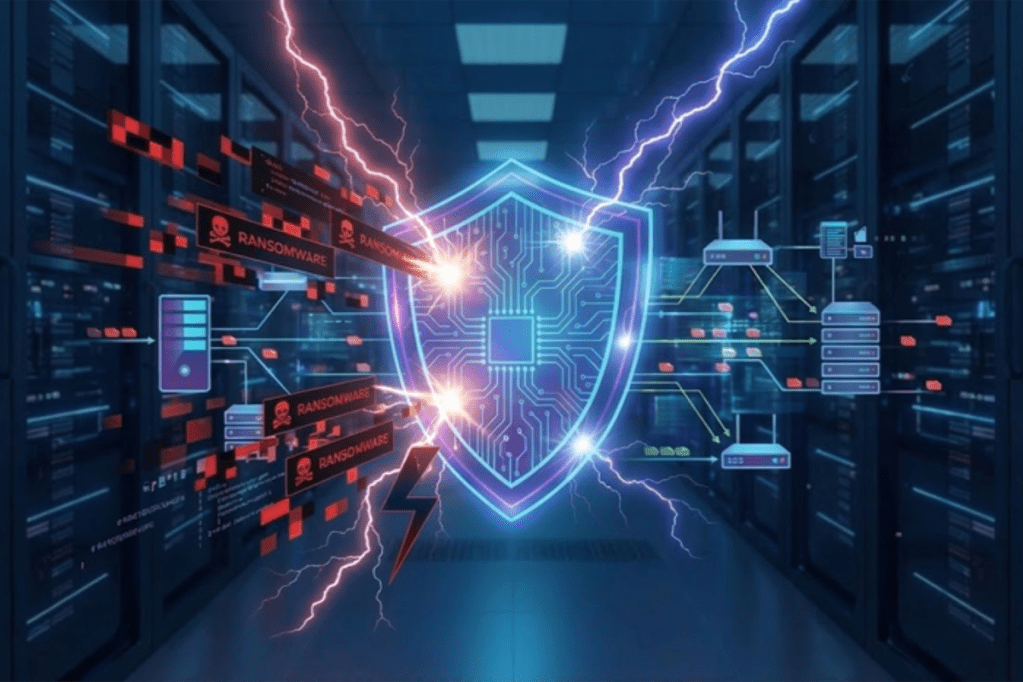

Ransomware attacks in 2025 have caused business operations to cease for weeks and months at a time, resulting in massive financial losses in organizations around the globe in sectors such as retail, manufacturing, and healthcare.
These major breaches go well beyond the purview of the security team alone. They demand boardroom attention and a fundamental rethinking of enterprise defense strategies.
Much of the urgency stems from how artificial intelligence (AI) has rapidly transformed the threat landscape. AI-powered autonomous attacks now probe enterprise networks with minimal human intervention, discovering thousands of potential entry points where human attackers might find only a handful.
The automated nature of these attacks means they’re finding far more vulnerabilities much faster. What happens after infiltration hasn’t changed: lateral movement, hunting for high-value assets, and initiating the ransom process. But AI makes the need for proper security hygiene even more pronounced.
Enterprises need to take a different approach to security. Traditional perimeter-based security assumes a fortress model, with strong walls that protect sensitive internal assets from external threats. But modern enterprises deploy distributed workloads, containers, and dynamic infrastructure that render static perimeter defenses obsolete. Once attackers breach the perimeter, they can move laterally (freely) through flat (unsegmented) networks like burglars in an empty mansion.
Breaking the ransomware kill chain
Breaking the ransomware kill chain requires distributed security controls at multiple stages. During initial infiltration, intrusion prevention capabilities must operate wherever vulnerabilities exist, such as across private clouds, virtual desktop environments, and application layers. This distributed approach is critical, because a single Java or Linux vulnerability might expose dozens of applications simultaneously across hundreds of servers.
Macro- and micro segmentation are the crucial second line of defense. By creating virtual barriers at the workload and hypervisor level, organizations prevent lateral movement after initial compromise. Rather than allowing attackers to roam freely once inside, macro- and micro segmentation contain any threats, limiting damage and buying security teams critical response time.
However, implementation requires discipline. Organizations often mistake micro segmentation’s ultimate goal for the first step, attempting to jump directly to granular application-level controls. The more effective path progresses systematically, guided by built-in deployment tooling in the firewall itself: assess the environment, segment shared infrastructure services, establish zone-based protections, and then evolve toward application-level micro segmentation.
Network detection and response (NDR) provides the third critical capability. As attackers leave behavioral signatures while moving laterally, AI-powered integrated threat defense can correlate these indicators across the environment, identifying malicious activity before data exfiltration and encryption begin. Locking down protocols such as Remote Desktop Protocol becomes essential.
The operational reality is that security tool sprawl undermines even sophisticated strategies. Having multiple disconnected solutions creates deployment delays, policy management nightmares, and incomplete coverage across the attack chain. Organizations purchase numerous tools but deploy only a fraction, across only a subset of applications, leaving dangerous gaps.
The solution lies in integrated software-defined security that deploys at the data center private cloud level, where applications and data reside. Exemplifying this approach is VMware vDefend, a unified stack that provides distributed firewall capabilities for macro- and micro segmentation with automated deployment workflows as well as advanced threat detection and prevention that automatically extend as environments scale. By embedding security into the virtualization and Kubernetes layer with policy mobility and dynamic workload protection, organizations gain comprehensive visibility without IP address complexity or deployment delays.
Modern ransomware demands modern defenses — not more disparate tools but smarter architecture that breaks the kill chain before attacks succeed.
Click to learn more about how VMware vDefend can help your security approach meet AI-powered threats.
