


The India AI Impact Summit 2026 opened with a clear and urgent message from global technology leaders: artificial intelligence is evolving at a pace that is outstripping the world’s ability to regulate, govern, and secure it. At the high-level inaugural session held at Bharat Mandapam in New Delhi and inaugurated by the Prime Minister of India, Narendra Modi, Big Tech CEOs and global policymakers highlighted both the transformative potential of AI and the growing need for Responsible AI at Scale.
Unlike earlier global AI forums that largely celebrated innovation breakthroughs, the India AI Impact Summit 2026 marked a noticeable shift toward deeper concerns around risk, access, governance, and long-term societal impact—signaling that AI is no longer just a technology conversation, but a global policy and security priority.
Sundar Pichai Flags Risk of an “AI Divide” as Technology Accelerates
One of the key moments from the summit came from Google CEO Sundar Pichai, who described artificial intelligence as a turning point comparable to the biggest technology shifts of the past few decades. Speaking about the pace of change, he pointed to AI’s potential to help emerging economies move faster in areas like science, infrastructure, and digital services.
“AI is the biggest platform shift of a lifetime. We are on the cusp of hyper progress and new discoveries that can help emerging economies leapfrog legacy gaps.”

At the same time, Pichai warned that these benefits will not reach everyone automatically. He stressed that unequal access to advanced AI systems and computing resources could widen existing technology gaps between nations.
“We cannot allow the digital divide to become an AI divide.”
His remarks highlighted a growing concern across the tech industry: the countries that control AI infrastructure and large-scale models may also shape the future economic advantages of the AI era.
Dario Amodei Warns AI Could Surpass Human Cognitive Capability Soon
One of the most remarkable observations at the India AI Impact Summit 2026 came from Dario Amodei, CEO of Anthropic, who emphasized the exponential pace of AI development.

“AI has been on an exponential trend for the last 10 years, and we are now well advanced on that curve.”
He suggested that AI systems may soon outperform humans across most domains.

“We are increasingly close to what I’ve called a ‘country of geniuses in the data centre’, a set of AI agents more capable than most humans at most things.”
While highlighting benefits such as disease research and economic transformation, Amodei also warned that rapid capability growth introduces systemic risks.
“That level of capability brings extraordinary opportunities… but it also brings serious risks.”
His remarks reinforced a central theme of the summit—AI capability is accelerating faster than AI governance.
Chandrasekaran Positions AI as Next National Infrastructure Layer
From an industry deployment perspective, N. Chandrasekaran, Chairman of Tata Sons, framed AI as the next foundational infrastructure comparable to electricity or the internet.

“AI is the next big infrastructure. It is the infrastructure of intelligence.” He emphasized that the real challenge is ensuring AI accessibility at scale.
“We should put AI tools in the hands of the last person of the country.”
His statement aligned closely with India’s broader push toward democratized AI deployment across sectors such as healthcare, agriculture, and public services.
Global Leaders Stress AI Governance and Strategic Independence
Beyond technology executives, global political leadership also used the India AI Impact Summit 2026 platform to underline governance concerns.
António Guterres, Secretary-General of the United Nations, warned against concentration of AI power.
“The future of AI cannot be decided by a handful of countries or left to the whims of a few billionaires.”
He called for a Global Fund on AI to support developing economies.
Meanwhile, Emmanuel Macron stressed that AI sovereignty will shape geopolitical balance.
“The smartest AI is not the most expensive. It is the one built by the best people and for the right purpose.”
Deepfake Risks and Need for AI Red Teaming
While global CEOs discussed capability growth, the panel on Responsible AI at Scale shifted attention to emerging cyber risks.
Beenu Arora, Co-Founder and CEO of Cyble, emphasized that organizations must actively test AI systems before deploying them.
“I think my final take is based upon how I started my career, which was trying to hack them on a penetration test.”
“For enterprises or any academia, I think red teaming — which is basically trying to hack your AI infrastructure, AI models, or AI assumptions… is going to be most critical.”
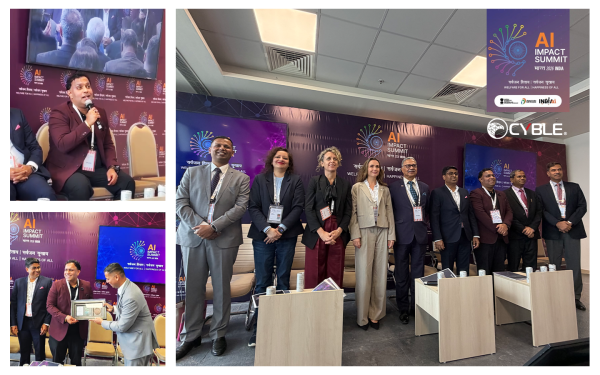
He also highlighted the rapid rise of deepfake-enabled fraud.
“On average, we are seeing around 70 to 100 thousand new deepfake audio calls in our systems.”
These examples underscored a key takeaway from the India AI Impact Summit 2026—AI is no longer just transforming productivity; it is also reshaping cyber threats.
India AI Impact Summit 2026 Reflects Shift From AI Innovation to AI Accountability
The India AI Impact Summit 2026 made it clear that while artificial intelligence is advancing rapidly, the bigger challenge now is how it is managed and used responsibly. Throughout the discussions, global technology leaders spoke about the opportunities AI can bring, but they also acknowledged the risks that are already beginning to surface.
Warnings from leaders like Sundar Pichai and Dario Amodei showed that AI is no longer just about innovation—it is about access, control, and security. At the same time, cybersecurity experts highlighted how threats such as deepfakes and AI-driven fraud are becoming more common, making stronger safeguards essential.
What stood out at the India AI Impact Summit 2026 was the balanced message: AI has the potential to transform economies and industries, but without proper governance and cyber readiness, the risks could grow just as fast as the technology itself.
As AI continues to expand into everyday systems and critical sectors, the focus is clearly shifting. The real success of AI will not only depend on how powerful the technology becomes, but on how safely, fairly, and responsibly it is deployed.
