

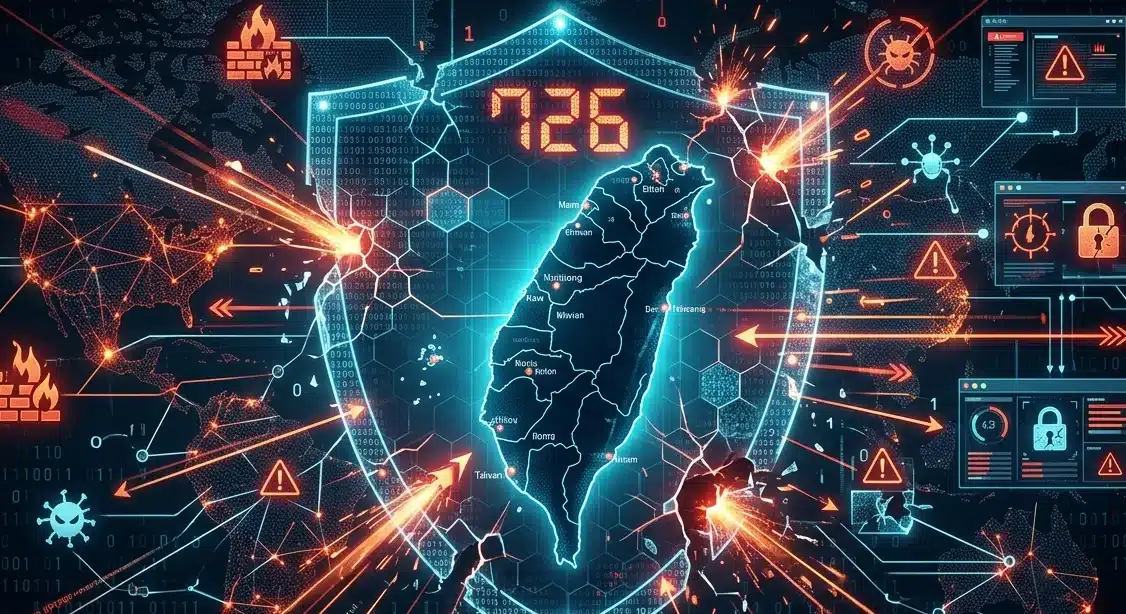
Taiwan’s digital security authorities have identified five major areas of concern following hundreds of reported cybersecurity incidents involving government agencies in 2025. According to Taiwan’s Ministry of Digital Affairs, the country recorded 726 cybersecurity incidents this year, highlighting ongoing Taiwan cyber risk challenges tied to ransomware, fake software, supply chain weaknesses, and social engineering attacks.
The Administration for Cyber Security said the total number of reported cases declined slightly compared to 2024, with 29 fewer incidents recorded year over year. However, officials warned that attack methods continue to expose weaknesses across government systems and digital infrastructure.
Cybersecurity Incidents in Taiwan
As reported by CNA and cited by UDN, most cybersecurity incidents were categorized as low-level threats under Taiwan’s classification system. However, authorities stressed that even minor breaches can create broader operational and national security concerns if left unresolved.
Under Taiwan’s cybersecurity framework, incidents are divided into four levels based on their impact on confidentiality, integrity, and system availability. Level 1 incidents accounted for 87.33% of all reports in 2025, while Level 2 incidents represented 9.78%. Level 3 incidents made up 2.89% of the total. No Level 4 incidents — the most severe category — were reported during the year.
Unauthorized access remained the most common issue among reported cybersecurity incidents, accounting for 68.6% of all cases. Equipment-related failures represented 15.43% of incidents, while denial-of-service attacks accounted for 4.96%. Website attacks made up another 2.48% of reported cases.
Following a review of cyber threat patterns and incident reports from government agencies, Taiwan’s Administration for Cyber Security identified five major Taiwan cyber risk trends that officials believe require immediate attention.

Fake Messaging Apps Raise Taiwan Cyber Risk
One of the biggest cybersecurity risks highlighted by the administration involved fake communication software distributed through unofficial websites. According to UDN, some users unknowingly downloaded counterfeit messaging applications after replacing old devices or setting up new computers.
Authorities said these downloads allowed attackers to install backdoor malware capable of compromising systems and sensitive information. The administration urged government agencies to implement stricter procedures for system modifications and software installations.
Officials recommended that all software, hardware, and application installations receive prior approval before being used within agency systems. The administration warned that unofficial downloads continue to create major Taiwan cyber risk exposure across public sector networks.
Ransomware Tactics Become More Sophisticated
The second major concern centered on ransomware groups using customized software drivers to infiltrate systems and evade security detection tools. Authorities noted that attackers are becoming more advanced in bypassing conventional endpoint security measures.
To reduce the likelihood of future cybersecurity incidents, the administration advised agencies to regularly scan websites for vulnerabilities, apply timely fixes, deploy web application firewalls, and ensure endpoint protection software remains updated.
The ministry emphasized that outdated security tools and delayed patch management continue to increase Taiwan’s cyber risk across both government and critical infrastructure networks.
Weak Supply Chain Security Creates Additional Exposure
Supply chain vulnerabilities were identified as the third major cybersecurity threat. Officials cited one case in which a maintenance contractor installed remote desktop software on a website server. Hackers later gained access to the system after successfully guessing the password linked to the remote access tool.
The incident highlighted growing concerns about third-party vendors and contractor oversight. According to the administration, external maintenance work can create hidden entry points for cybercriminals if agencies fail to maintain strict security controls.
The administration said agencies should strengthen supervision of vendors, improve password management practices, and enforce tighter restrictions on remote access systems to reduce Taiwan’s cyber risk tied to supply chain operations.
