

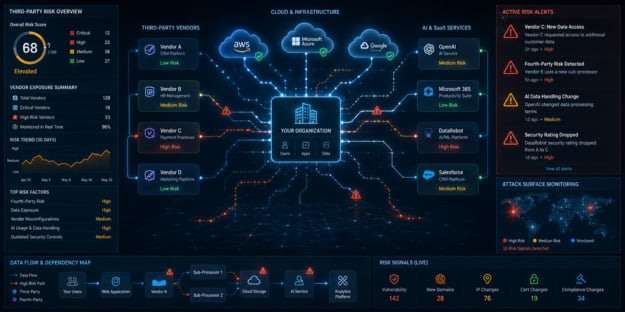
Traditional point-in-time vendor risk assessments are becoming increasingly difficult to maintain in environments where vendors, technologies, and regulatory requirements continuously evolve.
During a recent discussion with eSecurity Planet, Auditive Founder and CEO Daniel Faddoul explained why many organizations are struggling to keep pace with modern third-party risk exposure and why continuous monitoring is becoming more important for enterprise security programs.
According to Faddoul, one of the biggest limitations of traditional vendor assessments is that organizations often evaluate a vendor once during onboarding and then wait months or even years before reassessing them.
During that time, vendors may expand their services, access additional internal systems, adopt new AI tools, or increase their use of fourth-party providers without organizations fully understanding how their risk exposure has changed.
Key Takeaways on Risk Assessments
- Traditional point-in-time vendor risk assessments are struggling to keep pace with rapidly evolving third-party environments.
- AI adoption, cloud services, and fourth-party providers are significantly expanding vendor-related attack surfaces.
- Annual reassessments often miss critical changes in vendor technologies, data handling, and AI usage.
- Continuous vendor risk monitoring focuses on ongoing visibility, external risk signals, and real-time tracking of vendor posture changes.
- Many organizations still rely on manual workflows, spreadsheets, and compliance-driven processes that limit effective third-party risk management.
AI and Fourth-Party Risk Are Expanding Exposure
Faddoul said the rapid adoption of AI is accelerating this challenge because many vendors are now integrating large language models (LLMs) and AI-powered tooling into their platforms at a much faster pace than organizations can traditionally assess.
As vendors connect AI systems to more internal data sources and workflows, the overall attack surface expands significantly.
He noted that organizations are discovering during annual reassessments that vendors began using additional AI services or new fourth-party providers long after the original review process was completed.
Questions around how vendors handle customer data, whether information is used to train AI models, and how data is segregated are becoming much more important within modern vendor risk programs.
Faddoul also explained that regulators are struggling to keep pace with rapidly changing technologies.
Organizations already overwhelmed by vendor assessments often face additional pressure trying to interpret evolving regulatory requirements while frameworks and compliance expectations continue shifting alongside new innovations.
What Continuous Vendor Risk Monitoring Actually Means
According to Faddoul, continuous monitoring should not be viewed as a one-time onboarding exercise but rather as an ongoing process that spans the entire vendor lifecycle, from initial procurement through offboarding.
He described continuous monitoring as a layered approach that combines external risk signals, ongoing vendor-provided updates, and continuous tracking of regulatory or framework changes.
The goal is to identify meaningful changes in vendor risk posture as they happen rather than waiting until the next scheduled reassessment.
Faddoul said organizations should first focus on properly categorizing vendors based on business criticality and exposure.
That classification can then guide how deeply vendors should be assessed, which frameworks apply, and which types of risk signals require ongoing monitoring.
He also emphasized the importance of defining operational processes around how organizations respond when new risks or signals are identified.
Detecting changes alone is not enough if organizations do not have workflows for reevaluation and remediation.
Why Many Organizations Struggle to Transition
Despite growing interest in continuous monitoring, many organizations face operational and infrastructure challenges when attempting to modernize vendor risk programs.
Faddoul said many practitioners are already overwhelmed managing large volumes of vendor assessments, making it difficult to redesign existing processes or adopt new approaches.
He added that many organizations also still rely heavily on spreadsheets, emails, and shared drives to manage third-party risk workflows.
Without centralized tooling or automation, establishing baseline measurements and continuously tracking vendor changes becomes significantly harder.
Another challenge is culture. Faddoul noted that vendor risk management is still frequently treated as a compliance-oriented “check-the-box” process rather than an ongoing risk measurement exercise tied directly to operational exposure.
How Organizations Can Start Improving Vendor Risk Visibility
Rather than attempting a complete overhaul immediately, Faddoul recommended organizations focus first on identifying the weakest areas within their existing vendor risk process.
That could include improving vendor intake and classification, updating outdated questionnaires and frameworks, or introducing external risk signals for critical vendors.
He also advised organizations to prioritize their most critical vendors first instead of trying to apply broad changes across their entire portfolio simultaneously.
Focusing improvements on the vendors with the highest business impact and largest data exposure can help organizations reduce risk more effectively while building momentum for larger program changes.
As organizations adopt more AI, cloud services, and interconnected vendors, traditional annual assessments no longer provide enough visibility into rapidly evolving third-party risks.
