

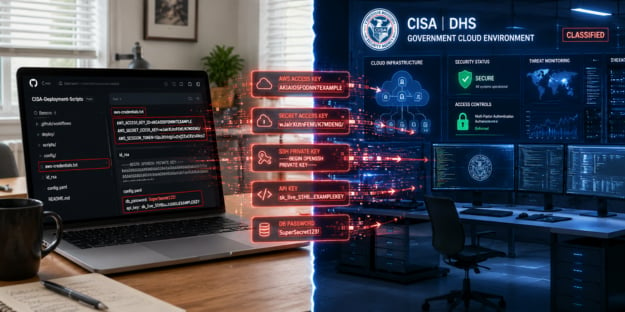
A public GitHub repository tied to a CISA contractor reportedly exposed sensitive AWS GovCloud credentials, plaintext passwords, and internal deployment files.
Researchers said the exposure may have provided privileged access to multiple internal systems and cloud environments before the repository was removed.
“Passwords stored in plain text in a csv, backups in git, explicit commands to disable GitHub secrets detection feature,” said Guillaume Valadon, a researcher at GitGuardian, as reported by KrebsOnSecurity.
He added, “I honestly believed that it was all fake before analyzing the content deeper. This is indeed the worst leak that I’ve witnessed in my career.”
Key Takeaways of the CISA GitHub Incident
- A public GitHub repository tied to a CISA contractor reportedly exposed AWS GovCloud credentials, plaintext passwords, SSH keys, and internal deployment data.
- Researchers said the exposure may have provided privileged access to multiple government cloud environments and internal systems.
- The repository allegedly contained access to CISA software repositories, raising concerns about software supply chain and CI/CD security risks.
- Some exposed credentials reportedly remained active for nearly 48 hours after the repository was removed.
Inside the CISA GitHub Exposure
According to KrebsOnSecurity, the public GitHub repository allegedly exposed AWS GovCloud credentials, plaintext passwords, SSH keys, authentication tokens, deployment logs, and internal CISA and DHS development data.
Researchers said the exposure included access to CISA’s internal artifactory systems, raising concerns attackers could tamper with software packages, inject malicious code, or maintain persistent access through trusted deployments.
The incident comes amid growing concerns over software supply chain security and attacks targeting cloud infrastructure, CI/CD environments, and developer tooling.
Researchers said the repository appeared to function more like a personal synchronization workspace than a properly managed enterprise development environment.
Commit history allegedly suggested the contractor may have been using the public repository to transfer files between work and personal systems over an extended period of time.
Researchers also observed that the repository owner reportedly disabled GitHub’s built-in secret-scanning protections designed to detect exposed passwords, SSH keys, and API tokens in public repositories.
Some internal passwords reportedly relied on weak naming conventions, such as platform names combined with the current year.
Although the repository was removed shortly after researchers contacted CISA, some exposed credentials allegedly remained active for nearly 48 additional hours before being revoked.
At the time of publication, CISA stated it was investigating the incident and said there was no indication sensitive data had been compromised as a result of the exposure.
The agency also said it is implementing additional safeguards to help prevent similar incidents in the future.
Securing Cloud and CI/CD Environments
Security teams should take a layered approach that combines strong access controls, continuous monitoring, and hardened developer environments.
- Implement automated secret scanning, repository monitoring, and DLP controls to identify exposed credentials and sensitive files before they are publicly accessible.
- Enforce least-privilege access, short-lived credentials, MFA, and just-in-time administrative access across GitHub, cloud, and CI/CD environments.
- Use centralized secrets management and prohibit plaintext credential storage, weak password practices, and unauthorized synchronization workflows between personal and enterprise systems.
- Harden developer environments by restricting public repository creation, enforcing signed commits, applying branch protections, and monitoring for suspicious repository or CI/CD activity.
- Segment cloud, build, and software repository environments to reduce lateral movement opportunities and limit the impact of compromised developer accounts or exposed credentials.
- Continuously monitor Git history, IAM activity, cloud configurations, and public repositories for abnormal behavior, credential leaks, and unauthorized access attempts.
- Test incident response plans and use attack simulation tools with scenarios around credential compromise, data exposure, and supply chain compromise.
Collectively, these steps can help reduce overall exposure and improve resilience.
Why Developer Environments Are Targeted
The CISA GitHub exposure highlights how cyber risk often centers around cloud infrastructure and software supply chains beyond just traditional perimeter defenses.
This incident also reflects broader challenges organizations face as development environments become more distributed and CI/CD ecosystems grow more complex.
As cloud adoption and automation expand, repositories, build systems, and privileged developer environments have become attractive targets because they often provide direct access to sensitive systems and infrastructure.
The incident also reinforces why organizations are adopting zero trust approaches to help manage risk across developer access, cloud environments, and software supply chains.
