

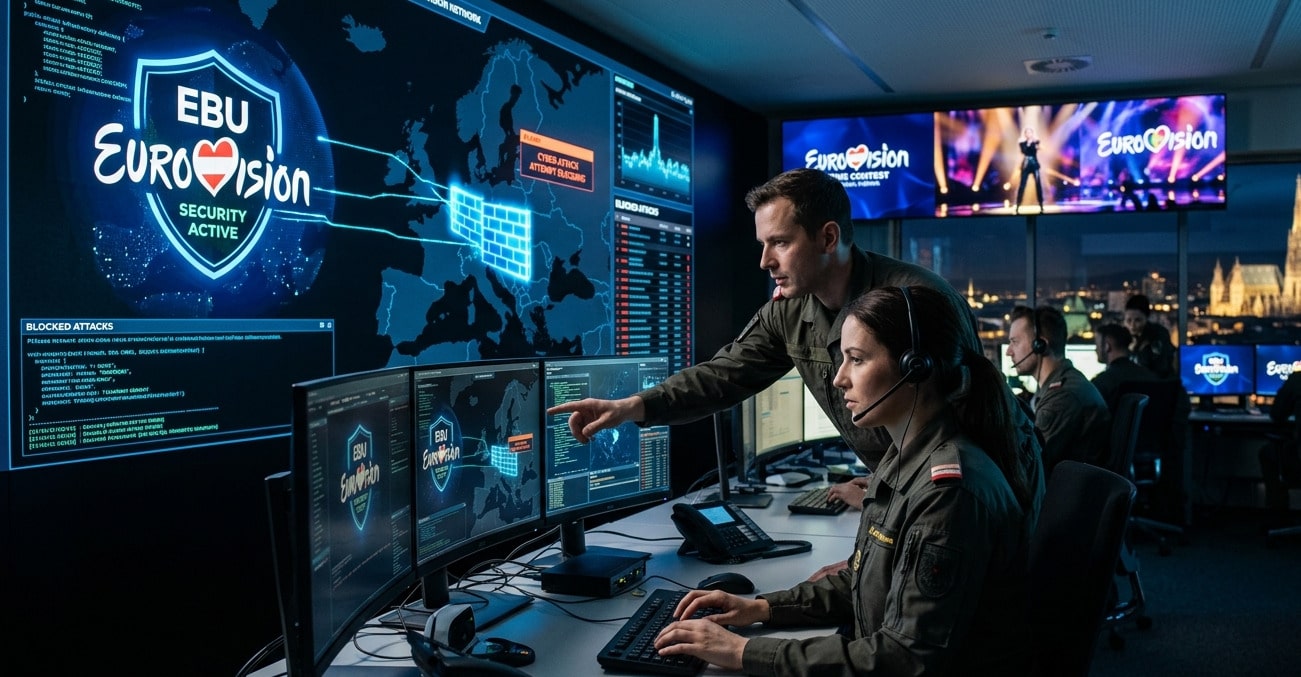
Authorities in Austria said they successfully blocked the Eurovision cyberattack, targeting the Song Contest during the competition week in Vienna.
According to Austrian authorities, nearly 500 cyberattack attempts were recorded during Eurovision activities in the capital. The cyberattack on Eurovision targeted both the official Eurovision website and access control systems used at the venue, raising concerns about possible disruption to one of Europe’s largest live entertainment broadcasts.
Michael Takàcs, head of Austria’s federal police, said the attempted cyber sabotage operations were detected and prevented before they could cause serious damage. Speaking at a press conference, Takàcs explained that the attackers attempted to slow down systems, interfere with operations, and potentially disable critical infrastructure connected to the contest.
“The perpetrators sought to disrupt, slow down, or disable systems,” Takàcs said, adding that investigators have not yet identified those responsible for the Eurovision cyberattack attempts or determined their motives.
Eurovision Cyberattack Prompts Major Security Operation in Austria
In response to the heightened threat environment, Austrian authorities implemented extensive security measures throughout the final week of the Eurovision Song Contest. Around 3,500 Austrian police officers were deployed across Vienna, while special police units from Bavaria, Germany, assisted local law enforcement teams.
Security agencies also increased monitoring of online activity during the event. Officials from Austria’s Interior Ministry said authorities observed rising levels of polarization and radicalization on social media platforms in the lead-up to the contest. Intelligence and domestic security services reportedly paid close attention to extremist threats and groups linked to Iran, although officials did not directly connect them to the cyberattack on Eurovision systems.

Austrian Interior Minister Gerhard Karner said the primary objective was to guarantee public safety during the event and prevent major incidents during live broadcasts and public gatherings. “The goal had been to ensure a safe and peaceful event. We succeeded,” Karner stated, noting that no serious disruptions occurred during the Eurovision Song Contest despite the cybersecurity threats and demonstrations.
Eurovision Song Contest in Vienna Marked by Protests and Arrests
Alongside the Eurovision cyberattack attempts, the contest also faced political demonstrations linked to Israel’s participation in this year’s competition. Several protests were held in Vienna during the event week, reflecting broader political tensions that have increasingly surrounded the Eurovision Song Contest in recent years.
Shortly before Saturday’s grand final, Austrian police detained 14 masked pro-Palestinian activists after they refused to end an unauthorized but peaceful protest despite repeated police instructions. Authorities said the demonstrators failed to comply with orders to disperse from the area surrounding the venue.
In total, 16 detentions were made during the Eurovision Song Contest. One individual was also detained after attempting to climb over a security barrier near the event site.
Officials maintained that, despite the tense atmosphere, the event proceeded without any major security failures. Austrian authorities credited the coordinated efforts of police forces, cybersecurity teams, and intelligence agencies for ensuring the competition continued safely and without interruption.
