

editorially independent. We may make money when you click on links
to our partners.
Learn More
Deepfakes are creating new cybersecurity risks that many organizations — and their cyber insurance policies — may not be fully prepared to address.
As attackers increasingly use AI-generated voice, video, and identity impersonation in fraud and ransomware attacks, cybersecurity experts warn businesses must reassess both security strategies and cyber insurance coverage.
During a recent Channel Insider interview, DeltaBear CEO Daniel Elliott discussed how deepfake attacks are evolving into broader trust-based threats targeting financial transactions and communications.
Key Takeaways
- Deepfake attacks are increasingly targeting financial transactions, communications, and authentication workflows.
- Many cyber insurance policies may not fully address AI-driven threats such as synthetic identity fraud and deepfake impersonation.
- Traditional security controls like MFA and IAM may struggle to detect realistic voice and video impersonation attacks.
- Healthcare, education, and financial services organizations face elevated risk due to reliance on trusted digital communications.
- Organizations are adopting proactive defenses such as deepfake detection, behavioral analytics, and zero trust security models.
Deepfake Cyber Risk and Insurance Challenges
| Deepfake Risk Area | Potential Impact |
| Deepfake Voice & Video Fraud | Financial fraud and executive impersonation |
| AI-Driven Social Engineering | Increased success of phishing and BEC attacks |
| Cyber Insurance Gaps | Unclear coverage for AI-enabled attacks |
| Traditional Security Limitations | MFA and IAM may not stop impersonation attacks |
| Expanding AI Adoption | Larger attack surface across business operations |
| Regulatory & Compliance Risk | Increased audit, legal, and reporting challenges |
| Emerging Security Response | Deepfake detection and Zero Trust adoption |
Deepfakes Are Becoming a Business Risk
Deepfake attacks have become more operational for threat actors because artificial intelligence tools are now capable of mimicking voices, facial expressions, communication patterns, and other human behaviors with increasing realism.
According to Elliott, the issue is no longer limited to spoofing an email or phone number.
Instead, attackers are exploiting the human trust organizations rely on for daily operations.
How Deepfake Attacks Impact Organizations
One growing concern involves business email compromise (BEC) and voice phishing attacks targeting financial departments.
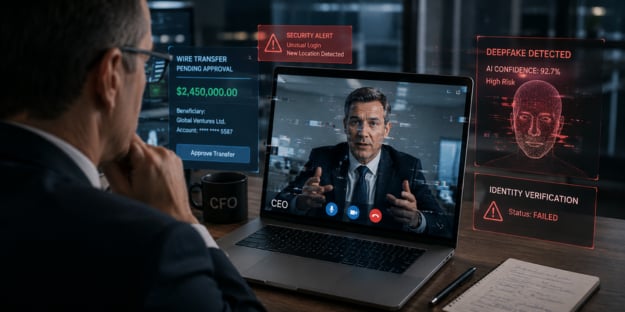
In some scenarios, a chief financial officer may receive what appears to be a legitimate phone or video call from a company executive authorizing a payment transfer.
Because the interaction can sound and appear authentic, traditional security awareness training and authentication controls may fail to detect the deception.
These attacks can result in significant financial losses, but the long-term operational damage may be even greater.
Organizations often spend substantial time investigating breaches, conducting audits, responding to regulators, and rebuilding customer trust after an incident occurs.
Why Cyber Insurance Policies May Not Cover AI Threats
Deepfakes are exposing gaps in cyber insurance policies, with many insurers still treating AI-driven attacks as a gray area despite growing ransomware and fraud risks.
Coverage language may not explicitly address deepfake impersonation, AI-assisted fraud, or synthetic identity attacks.
This creates uncertainty for organizations attempting to determine whether an insurer would cover losses tied to AI-enabled social engineering attacks.
Policies may contain exclusions, negligence clauses, or ambiguous language that limit payouts if an organization failed to implement what insurers consider adequate security controls.
Cybersecurity professionals argue that businesses should carefully review insurance policies rather than assuming coverage automatically extends to emerging AI threats.
Organizations may need to evaluate whether their policies address risks such as ransomware-as-a-service (RaaS), deepfake-enabled fraud, business impersonation, and manipulated communications.
Another challenge is that many traditional security tools were not designed to detect synthetic identity attacks.
Multi-factor authentication (MFA), endpoint security, and identity and access management (IAM) platforms remain critical security layers, but they may still struggle to detect attackers impersonating trusted individuals during calls, video meetings, or financial transactions.
AI Is Expanding the Modern Attack Surface
Healthcare, education, and financial services organizations may face elevated risks because they rely heavily on sensitive personal information, remote communications, and trusted digital workflows.
Telehealth systems, online learning platforms, and remote financial operations create additional opportunities for attackers to exploit human trust using AI-generated identities.
The increasing use of artificial intelligence across business operations also expands the potential attack surface.
Organizations are rapidly integrating AI-powered tools into customer service, communication platforms, workflow automation, and collaboration systems.
At the same time, threat actors are using many of the same technologies to improve phishing campaigns, automate impersonation attempts, and scale ransomware operations.
Organizations Are Adopting More Proactive Security Strategies
As a result, cybersecurity professionals are encouraging organizations to adopt more proactive security strategies focused on verification and trust validation.
Some organizations are adopting deepfake detection, behavioral analytics, and zero trust models that continuously verify users, devices, and communications.
Industry experts also recommend that organizations regularly review cyber insurance policies with legal, compliance, and security teams to better understand potential coverage gaps tied to artificial intelligence risks.
Security awareness training also needs to evolve beyond traditional phishing education to include synthetic media and impersonation threats.
Deepfakes Are Changing How Organizations Define Trust
Ultimately, the growing use of deepfakes in cyberattacks highlights a broader reality facing modern organizations: trust itself has become a target.
Businesses may need to rethink how they secure systems, verify identities, and assess insurance readiness as AI continues reshaping both cyberattacks and defenses.
As organizations rethink trust in the age of AI-driven threats, many are turning to zero trust solutions that continuously verify users, devices, and communications.
