

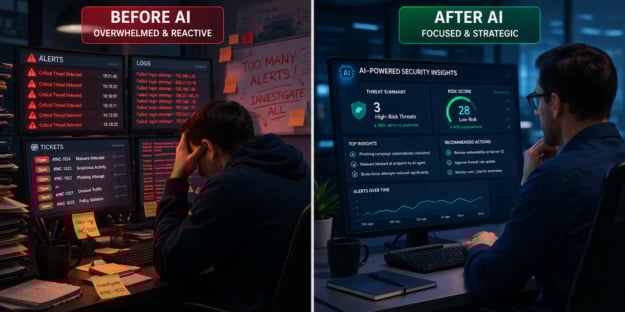
Artificial intelligence (AI) is rapidly transforming cybersecurity roles, but not in the way many expected.
Rather than just eliminating jobs, AI is redefining how cybersecurity professionals work, shifting the focus from manual task execution to higher-level decision-making and analysis.
The work of security professionals “becomes less about processing and more about applying strong judgment, logic, and reasoning,” said Maruf Ahmed, CEO of Dexian in an email to eSecurityPlanet.
How AI Is Changing Day-to-Day Cybersecurity Work
This evolution is creating both new opportunities and new challenges for organizations and professionals alike.
Contrary to concerns about job displacement, AI is increasingly embedded in day-to-day cybersecurity workflows, particularly within security operations centers (SOCs).
AI-driven agents now handle tasks such as alert triage, ticket generation, and initial incident investigation — functions that were traditionally performed by L1 SOC analysts.
In many cases, these tools can process and respond to incidents significantly faster than humans, accelerating workflows and reducing manual effort.
It also frees up L1 analysts to upskill for threat hunting and deeper threat intelligence tasks.
Where AI Falls Short: The Need for Human Judgment
However, this shift does not eliminate the need for human expertise. Instead, it changes where that expertise is applied.
As AI takes over repetitive and time-consuming tasks, cybersecurity professionals are increasingly responsible for evaluating AI-generated outputs.
This includes assessing the accuracy of alerts, determining business impact, and making informed risk decisions.
The work is becoming less about processing large volumes of data and more about applying judgment, reasoning, and contextual understanding.
While AI reduces the burden of initial analysis, it simultaneously increases the number and complexity of decisions that must be made on the back end.
How AI Is Impacting Pen Testing and GRC
This transformation is evident in areas such as penetration testing and governance, risk, and compliance (GRC).
In penetration testing, AI can rapidly identify potential vulnerabilities and map attack paths.
However, it often lacks the contextual awareness needed to understand how those vulnerabilities behave and impact a specific environment.
As a result, security professionals may spend less time discovering issues and more time validating, prioritizing, and chaining them into meaningful attack scenarios.
Similarly, in GRC, AI can assist with control mapping and identifying compliance gaps across frameworks, but it cannot effectively communicate risk to business stakeholders or translate technical findings into organizational impact.
Rethinking Cybersecurity Talent and Job Requirements
The growing reliance on AI is also exposing a critical gap in how organizations approach hiring.
Many job descriptions still reflect outdated expectations, emphasizing task-based responsibilities that AI agents can perform.
As a result, organizations often struggle to find candidates who match these legacy roles.
The issue is not necessarily a shortage of talent, but rather a mismatch between hiring criteria and the current demands of the role.
Modern cybersecurity positions increasingly require professionals who can interpret AI outputs, apply domain-specific context, and make informed decisions — not just execute predefined tasks.
Addressing this gap requires organizations to rethink their talent strategies. Job descriptions and hiring requirements must evolve to reflect the changing nature of cybersecurity work.
This may involve prioritizing skills such as critical thinking, communication, and business acumen alongside technical expertise.
In some cases, domain-specific knowledge — such as understanding clinical environments in healthcare — can be essential for accurately assessing risk and impact.
Why Fundamentals Still Matter in an AI-Driven World
For individuals pursuing careers in cybersecurity, the rise of AI underscores the importance of foundational knowledge.
Core concepts such as networking, operating systems, data protection, and how data flows across systems remain critical, as they form the basis for understanding more advanced technologies.
While AI tools can enhance productivity and automate workflows, they are built on these underlying concepts.
Professionals who develop a strong foundation are better positioned to adapt as new technologies emerge and integrate AI effectively into their workflows.
How Cybersecurity Professionals Should Work With AI
At the same time, cybersecurity professionals must learn how to work alongside AI.
This includes understanding where AI can add value, how to integrate it into existing processes, and how to validate its outputs.
Rather than focusing solely on using AI tools, professionals should consider how AI can enhance specific tasks within their role and workflow, from incident response to threat intelligence.
Ultimately, the impact of AI on cybersecurity careers is less about replacement and more about evolution.
Organizations that recognize this shift and align their hiring, training, and technology strategies accordingly will be better equipped to build effective security teams.
Those that continue to rely on outdated role definitions risk falling behind, both in talent acquisition and in their ability to respond to modern threats.
As AI continues to mature, cybersecurity roles will continue to evolve, placing greater emphasis on human judgment, adaptability, and strategic thinking in an increasingly automated landscape.
