


Robots are cool, but real productivity from physical AI isn’t as close as boosters are making it out to be, said IT leaders at Nvidia’s GTC developer show last month.
“There’s a huge potential, a huge promise, but there’s also a lot of categories where that promise is a decade out,” said Mark Hindsbo, head of operations software at Siemens Digital Industries, during a panel discussion at the show.
Physical AI implementation has a high cost and a steep learning curve. It also requires a lot of planning, and that involves figuring out devices, value, roadmap, and practicality, panelists said.
There was a lot of hype around physical AI at GTC. But the world is nowhere close to 100% autonomous self-reasoning robots that can automatically assemble devices, Hindsbo said.
Siemens is taking a pragmatic approach as it considers where to deploy intelligent robots across its factories and customer base.
“When we look at the productivity we can drive in our factories… there is probably an $800 billion productivity improvement that can be done over the next decade, maybe even a little longer,” Hindsbo said.
Siemens’ robots have evolved over time. Older collaborative bots were preprogrammed to pick and place specific components for one product at a time.
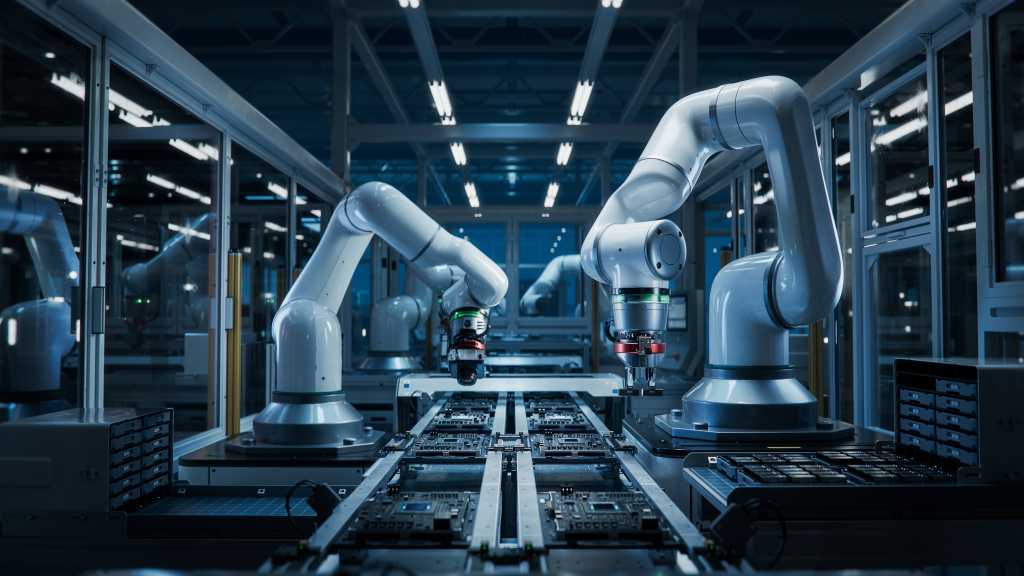
The newer robots with visual recognition can identify random parts in bins and know where to place them in the assembly line. That gives Siemens the flexibility to manufacture more devices without preprogramming robots.
“It starts becoming more autonomous, like a human being could be,” Hindsbo said.
But there are challenges at every level, despite factories becoming more efficient.
“We start spending at least as much time on training and deploying and commissioning them as we would have had on labor cost, and the ROI of the whole thing goes away,” Hindsbo said.
Implementing AI for back-office functions is easy, but integrating physical AI across kilometers of car production lines and thousands of devices is complex, said Jochen Fichtner, CIO for Volkswagen de Mexico.
“You’re not doing this only on the technology perspective… we do have also to think [about] the people,” Fichtner said. “We are talking about thousands of people working in three shifts in different lines in only one plant.”
VW’s governance model includes training employees and making proof-of-concepts so “people can also see and feel how it works,” Fichtner said.
“To trust and use it means also really understanding what benefit this … will bring online,” Fichtner said.
But there are no signs of robots replacing humans, Siemens’ Hindsbo said.
“We still have a skilled labor shortage, and we still have a need to get new people in and get them trained up quickly,” he said. “We’re not over here where the labor force at large is in jeopardy.”
Productivity for Siemens has gone up 7% per year in modern factories while labor force numbers have stayed constant.
“It has not been a displacement. It has been an increase of production, an increase of capacity in the same factory footprint,” Hindsbo said.
Additionally, VW’s Fichtner said, the software is still too hard to use and requires a massive investment.
“Today there is a quite high one-time cost of having the trained professionals, the methodology and so on to build a digital twin, so you need a certain size and scale to be able to really benefit from it,” Fichtner said.
VW is preparing devices, data and platforms to use AI. The company will then experiment with AI technologies, all while keeping the factory line and mixing new cars in production lines.
“Time is really critical… we have to be fast, but we have to be really prepared and structured also [in] how we’re doing this,” Fichtner said.
The platform may be ready in two years, and VW hopes to see benefits.
“We are working with this, making the first experiences… This will be a lighthouse also for other business owners, because you can see how it works,” Fichtner said.
Related reading:
- What’s next after agentic AI? Physical AI, Nvidia says
- At CES, AI moves beyond chatbots and agents into the physical world
- Amid AI gloom and doom, WEF attendees were bullish on physical AI
- With physical AI, gunslingers and risk takers need not apply
