

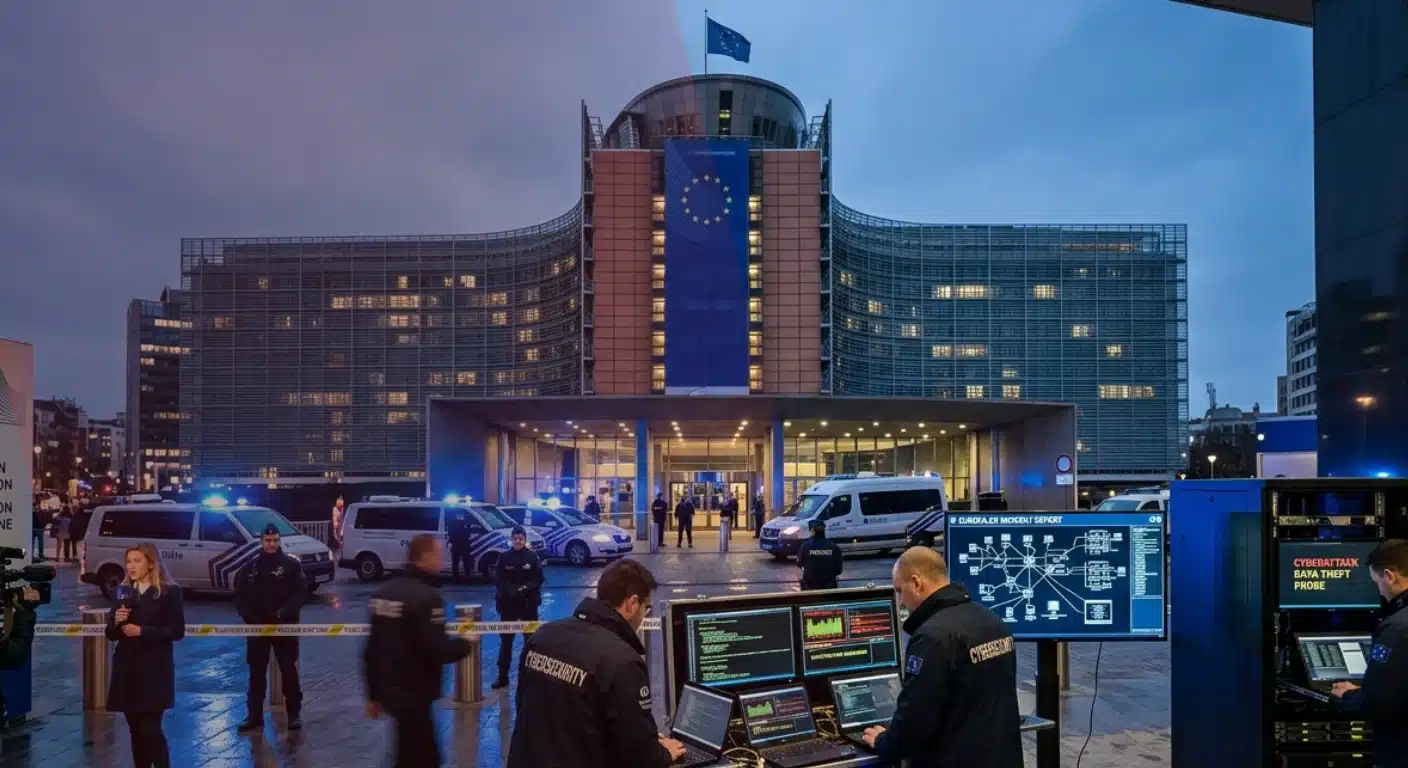
The European Commission cyberattack disclosed on March 24 has exposed potential data risks after attackers targeted the cloud infrastructure hosting the Commission’s Europa web platform.
The Commission said it detected the cyberattack on European Commission early and moved quickly to contain it, ensuring that Europa websites remained online without disruption.
The platform, which hosts official EU information and services, continued to function normally during and after the response.
However, the situation is not without concern.
Data Possibly Accessed in European Commission Cyberattack
While confirming that its internal systems were not affected, the Commission acknowledged that early findings indicate data may have been taken from the affected websites.
“The Commission’s internal systems were not affected by the cyber-attack.”

At this stage, the full extent of the data exposure remains unclear. Authorities have started notifying relevant Union entities that could have been impacted, as investigations continue.
The European Commission cyberattack highlights a familiar pattern, systems stay operational, but questions around data access emerge later.
Europa Platform Remains Online Despite Attack
One key takeaway from the Europa platform cyberattack is the Commission’s ability to maintain service availability. Unlike many incidents that lead to outages, this attack was contained without affecting public access.
That said, keeping services online does not necessarily mean the impact is minimal. The possibility of data being exfiltrated shifts the focus from disruption to data security.
Public-facing platforms like Europa are designed for accessibility, which also makes them more exposed compared to internal systems.
Cloud Infrastructure Under Growing Pressure
The European Commission cyberattack also points to a broader issue, cloud infrastructure is becoming a frequent target.
As more government services move to cloud environments, attackers are increasingly focusing on these layers. Even when core systems are protected, web platforms and hosted services can become entry points.
In this case, the separation between internal systems and public infrastructure appears to have worked as intended. But the incident still raises concerns about how much data can be accessed through these external-facing services.
EU Cybersecurity Frameworks in Focus
The timing of the European Commission cyberattack is notable. The EU has been actively pushing new cybersecurity measures, including the NIS2 Directive and the Cyber Solidarity Act, to strengthen resilience across member states.
The Commission also introduced a new Cybersecurity Package earlier this year to boost collective defenses.
This incident doesn’t indicate failure, but it does show the gap between policy and real-world threats. Frameworks can guide response, but they don’t eliminate risk.
The Commission said it will continue monitoring the situation and analysing the incident to strengthen its cybersecurity capabilities.
For now, the European Commission cyberattack remains contained, but the investigation will determine how serious the data exposure is, and what lessons come next.
