

editorially independent. We may make money when you click on links
to our partners.
Learn More
A widely used AI development library was compromised in a recent supply chain attack, potentially exposing a large number of systems to risk.
Malicious LiteLLM packages on PyPI were backdoored to quietly steal credentials, tokens, and sensitive infrastructure data from both development and production environments.
“The LiteLLM compromise shows just how quickly supply chain attacks can escalate and how blind we are if we only rely on known vulnerabilities,” said Dr. Zulfikar Ramzan, Chief Technology & AI Officer of Point Wild in an email to eSecurityPlanet.
“This incident forces a broader conversation about how organizations treat their dependency graph. Zero trust has been applied to users, devices, and networks. Dependencies deserve the same scrutiny,” said Jacob Krell, Senior Director of Secure AI Solutions & Cybersecurity at Suzu Labs in an email to eSecurityPlanet.
“We should care because the industry’s reliance on public repositories without local hash verification or ‘lockfiles’ has effectively turned the Internet into an unvetted production dependency,” said Noelle Murata, Sr. Security Engineer at Xcape, Inc in an email to eSecurityPlanet.
“The big picture issue is that the software supply chain is still built on too much implicit trust and not enough immutability or verification,” said Cory Michal, CISO at AppOmni in an email to eSecurityPlanet.
Inside The LiteLLM Supply Chain Attack
The attack targets LiteLLM, an open-source library with about 95 million monthly downloads that routes requests across multiple LLM providers through a single interface.
Because LiteLLM is widely used in production and cloud environments, it often has access to sensitive data such as API keys, cloud credentials, and Kubernetes configurations.
Researchers have attributed the attack to TeamPCP, a threat actor linked to recent supply chain compromises involving tools like Trivy and KICS.
How The Backdoor Was Delivered
The malicious code was injected into the PyPI distribution while the GitHub repository remained clean, meaning developers reviewing the source saw nothing suspicious while installed packages were backdoored.
The incident exposes a critical weakness in the software supply chain: many organizations trust package registries without independently verifying that distributed artifacts match their upstream source.
Inside The Multi-Stage Attack
Once installed, the malware uses a multi-stage execution chain designed for stealth and persistence.
The initial trigger is deceptively simple — a small snippet of injected code that decodes and executes a hidden payload as soon as the affected module is imported.
Attackers escalated the technique further by including a malicious .pth file, which causes the payload to execute automatically every time the Python interpreter starts, even if LiteLLM is never directly used.
This increases the blast radius, turning any Python execution into a potential compromise point.
After execution, the malware proceeds through three coordinated stages.
First, an orchestrator script prepares and launches the attack chain.
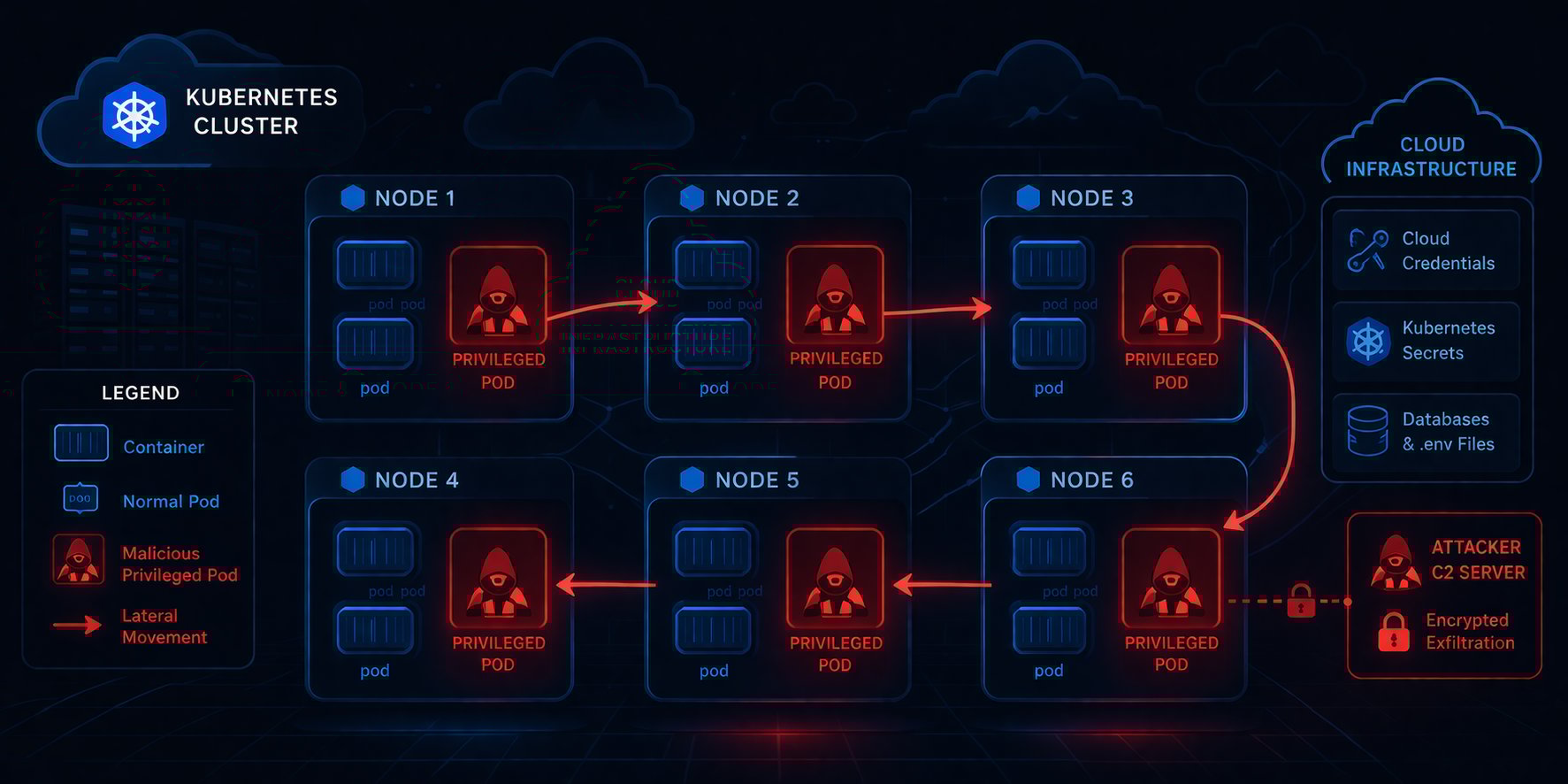
Next, a credential-harvesting component systematically collects sensitive data from the host, including SSH keys, cloud provider credentials, Kubernetes secrets, .env files, database configurations, and other high-value artifacts.
Finally, the malware establishes persistence by installing a system-level backdoor that periodically contacts attacker-controlled infrastructure for additional payloads and instructions.
Beyond simple data theft, the attack is designed for expansion.
The malware enables lateral movement in Kubernetes by deploying privileged pods across nodes to expand attacker access.
Stolen data is encrypted before exfiltration to attacker-controlled domains, making detection more difficult.
Mitigating Software Supply Chain Risk
Organizations that may have been exposed to the compromised LiteLLM packages should move quickly to assess risk and contain potential damage.
Given the scope of the attack and its focus on credential theft and persistence, standard remediation steps may not be sufficient on their own.
Security teams should treat affected environments as potentially compromised and prioritize both immediate cleanup and longer-term hardening.
- Remove compromised LiteLLM versions, reinstall a verified clean version, and rebuild affected systems from a known-good baseline rather than attempting in-place cleanup.
- Search for persistence mechanisms and indicators of compromise, including suspicious systemd services, unexpected files, and unauthorized Kubernetes pods or privileged workloads.
- Rotate and revoke all exposed credentials, including cloud tokens, API keys, SSH keys, and active sessions, and audit IAM roles and secrets access for signs of abuse.
- Audit CI/CD pipelines and development environments for downstream compromise, rotate pipeline secrets, and review logs for credential leakage or anomalous activity.
- Monitor network and system behavior for signs of exfiltration and lateral movement, including unusual outbound traffic, periodic beaconing, and abnormal process execution patterns.
- Strengthen supply chain security by pinning dependencies, verifying packages against upstream sources, using trusted publishing methods, and maintaining SBOM visibility across environments.
- Regularly test incident response plans and tabletop around software supply chain attack scenarios.
Collectively, these measures help organizations build resilience against supply chain attacks while reducing exposure to compromised dependencies and hidden threats.
The LiteLLM incident reflects a broader shift, with attackers increasingly focusing on tools that already have access to sensitive systems and data.
By targeting these high-trust components, threat actors can more easily move past traditional defenses and expand their reach within an environment.
It also highlights how attacks can span multiple ecosystems, with groups like TeamPCP leveraging stolen credentials from one compromise to enable the next across CI/CD pipelines, package registries, and now AI tooling.
For organizations, this reinforces the need to continuously verify the integrity of software dependencies.
This growing need to continuously verify trust and limit implicit access is exactly where a zero trust approach can help strengthen defenses against modern supply chain attacks.
