

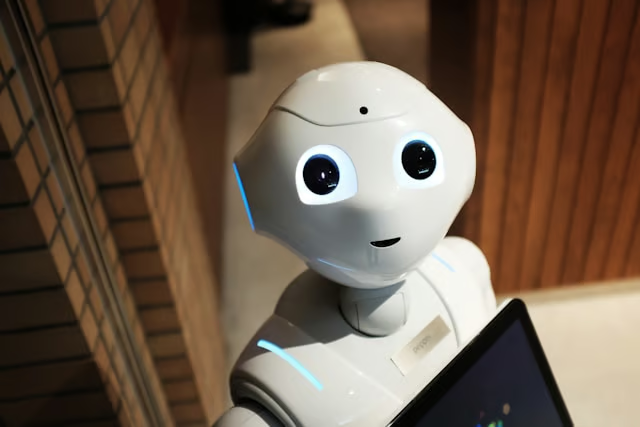
Humanoid robots are arriving with enterprise-friendly components — Wi-Fi, cameras, onboard compute, and over-the-air software updates — but they behave less like traditional IT devices and more like operational technology (OT) systems. They interact with the physical world, operate under strict latency constraints, and can cause real harm if something goes wrong.
That convergence is no longer theoretical. Modern humanoid robots are capable of navigating environments, manipulating objects, and executing tasks after receiving high-level instructions from software agents or human operators.
For security teams, this means a new class of cyber-physical endpoint is entering enterprise environments.
If these systems fail — whether through bugs, misconfiguration, or compromise — the consequences can extend beyond data loss to physical safety and operational disruption.
This shift highlights a critical difference between humanoid robots and traditional enterprise endpoints.
| Security Factor | Traditional Endpoint | Humanoid Robot |
| Environment | Digital systems | Physical environment |
| Security model | IT endpoint security | OT + AI security |
| Failure impact | Data loss | Safety + operational disruption |
| Control layer | User / application | Agent + autonomy systems |
| Attack surface | Network & software | Sensors, autonomy, AI agents |
| Security frameworks | IT frameworks | OT + AI governance |
Step one: treat humanoids as OT systems
Security teams should start by classifying humanoid robots as operational technology devices rather than traditional endpoints.
NIST’s guidance on operational technology security defines OT as programmable systems that interact with the physical environment while requiring reliability, safety, and performance guarantees. Mobile robots fit that definition.
Similarly, the ISA/IEC 62443 standards address security requirements for industrial automation and control systems (IACS). As robots begin performing tasks within factories, warehouses, and logistics facilities, they effectively become mobile components within those control environments.
This distinction matters because many traditional endpoint security tools assume systems can tolerate scanning, patching, or delays — assumptions that don’t hold in environments where availability and physical safety are critical.
Step two: recognize the agent layer as a new privilege boundary
Modern robotics architectures increasingly rely on layered autonomy systems.
At the lowest level, real-time control systems manage motors, balance, and physical motion. Above that sits a “skill” layer responsible for discrete capabilities such as opening doors or picking up objects.
A third layer — often called the agent or planning layer — orchestrates tasks based on high-level instructions or environmental inputs.
In some deployments, this agent layer may run on local servers within a facility rather than directly on the robot.
From a security standpoint, this introduces a new privilege boundary:
- Control layer: executes physical movement (high impact)
- Skill layer: performs discrete capabilities
- Agent layer: determines what actions should occur (high leverage)
If attackers influence the agent layer — or the tools and models it relies on — they may be able to trigger legitimate robot actions for malicious reasons.
In other words, the robot might behave exactly as designed but in the wrong context.
This layered architecture creates multiple security touchpoints where compromise could influence robot behavior.
| Layer | Function | Security Risk |
| Control layer | Physical movement and balance | Direct safety impact |
| Skill layer | Object manipulation and navigation | Unauthorized action execution |
| Agent layer | Task planning and orchestration | Prompt injection / manipulation |
| Networking | Communication with infrastructure | Lateral movement risk |
| AI models | Interpret commands and environment | Model exploitation |
Map agentic-robot risks to the OWASP LLM Top 10
If a robot uses a language or vision model to interpret instructions, environment data, or tool outputs, several risks from the OWASP Top 10 for LLM Applications become directly relevant.
Examples include:
- LLM01: Prompt Injection — crafted inputs manipulate model behavior
- LLM02: Insecure Output Handling — unsafe use of model-generated outputs
- LLM08: Excessive Agency — granting models too much autonomy without guardrails
These categories were originally developed for AI software applications, but the implications become far more serious when the “application” can move through physical space, open doors, or manipulate equipment.
Governance frameworks still apply
Organizations deploying autonomous systems should also treat robotics programs as AI governance initiatives.
The NIST AI Risk Management Framework provides a practical structure for evaluating and managing these risks. Its core functions — Govern, Map, Measure, and Manage — help organizations integrate policy, technical safeguards, monitoring, and continuous improvement across the AI lifecycle.
For robotics deployments, this framework helps connect security practices with safety and operational oversight.
Cyber incidents can become safety incidents
Unlike traditional endpoints, compromised robots introduce the possibility of immediate physical consequences.
A manipulated robot could potentially:
- Enter restricted areas or unlock doors
- Move inventory or equipment in unauthorized ways
- Block emergency exits or disrupt workflows
- Damage physical assets
In environments such as warehouses, factories, and logistics facilities, these actions could quickly escalate from a security incident to a safety event.
That is why robotics security must combine both cybersecurity and operational safety practices.
Baseline security controls for robotics deployments
Security teams evaluating robotics deployments should require several baseline protections before allowing robots into production environments.
Network segmentation and internal-only services
Robots should operate on segmented networks with tightly controlled east-west traffic, and their agent services and control systems should remain on internal infrastructure rather than being exposed to the public internet.
This approach follows established operational technology (OT) security best practices designed to limit lateral movement and reduce external attack surfaces.
Strong authentication and authorization for skill invocation
Robotic systems often expose discrete “skills” such as navigation, object manipulation, or environment interaction.
Triggering those skills should be treated as privileged action execution, with identity controls, policy enforcement, and full logging.
Signed updates and software supply-chain controls
Modern robots are heavily software-defined systems. Updates to autonomy stacks, AI models, and control software must follow strict software supply chain practices, including signed artifacts, staged rollouts, and rollback mechanisms.
Safety constraints backed by vendor documentation
Some robot manufacturers explicitly warn users to maintain safe distances due to the power and complexity of humanoid machines. Those warnings should translate into formal safety controls and operational procedures within deployments.
What to include in robotics security requirements
Organizations considering humanoid robots should include security language in procurement and deployment planning.
Key requirements include:
- Clear trust boundaries (on-robot, on-prem, and cloud components)
- Full documentation of ports and protocols
- Detailed logging of commands, skills invoked, and agent actions
- Update validation and rollback mechanisms
- Incident response procedures including safe shutdown and isolation
Bottom line
Humanoid robots shouldn’t be evaluated like gadgets — and they shouldn’t be secured like laptops.
They represent a new class of cyber-physical endpoint: operational technology devices augmented with AI decision layers.
Securing them requires combining traditional OT security practices such as NIST SP 800-82 (Guide to OT Security) and ISA/IEC 62443 with modern AI threat modeling approaches like the OWASP LLM Top 10 and governance frameworks such as NIST AI RMF.
As robots move from demonstrations to real deployments, organizations that treat them as critical infrastructure from the start will be far better prepared to manage the risks they introduce.
This convergence of OT and enterprise IT is driving organizations to adopt zero trust solutions to better secure emerging technologies and critical systems.
